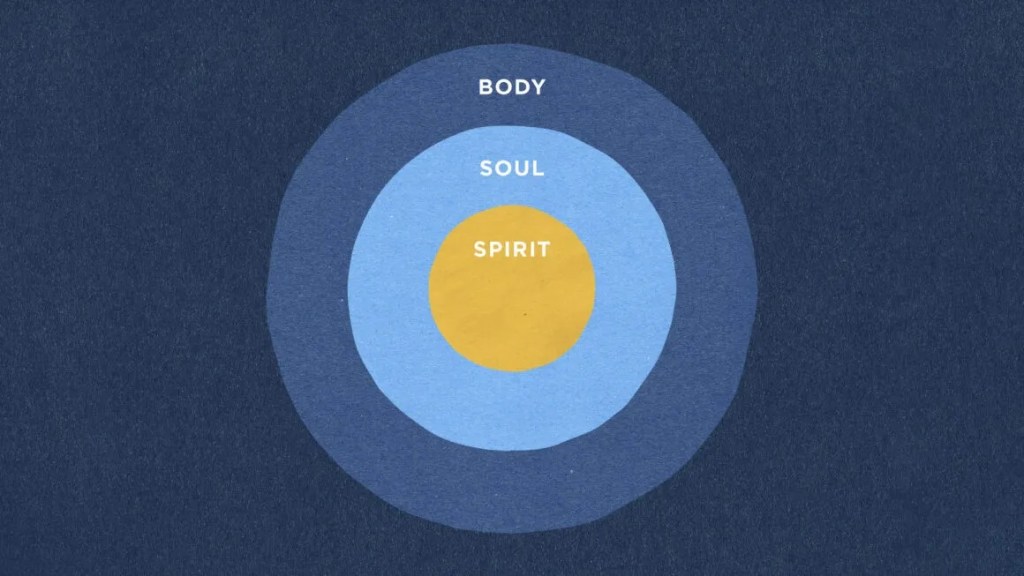
For centuries theologians and Bible students have debated whether a person consists of two parts (body and soul/sprit—called dichotomous) or three parts (body, soul, and spirit—trichotomous). Each side would point to particular passages of the Bible in support of their beliefs. Genesis 2:7, for instance, speaks of man as body and soul: “And the Lord God formed man of the dust of the ground, and breathed into his nostrils the breath of life; and man became a living soul.” Paul, however, in his blessing to the Thessalonians writes, “And the very God of peace sanctify you wholly; and I pray God your whole spirit and soul and body be preserved blameless unto the coming of our Lord Jesus Christ” (1 Thess. 5:23). But is there truly a distinction between soul and spirit, or is the Apostle Paul merely employing poetical language? Consider.
If a person does consist of body, soul, and spirit, the threefold distinction might be argued for in this way.
The Body. The home for the soul and spirit is the physical body. The body expresses what the soul and spirit desire. However, because of sin, the body is subject to disease and sickness, and eventually dies and turns to dust. By faith, Christians believe the body will be resurrected one day according to promise.
Jesus said to Martha, “I am the resurrection and the life. He who believes in Me, though he may die, he shall live. And whoever lives and believes in Me shall never die. Do you believe this?” (John 11:25, 26).
“Do not marvel at this; for the hour is coming in which all who are in the graves will hear His voice and come forth—those who have done good, to the resurrection of life, and those who have done evil, to the resurrection of condemnation” (John 5:28, 29).
While the body is pampered throughout life, it remains mortal and subject to death. In contrast, the soul and spirit are eternal.
The Soul. In contrast to the body is the soul which consists of will, emotion, and intellect. Made in the image of God, the soul reflects the essence of the divine.
The Spirit. The spirit refers to that part of man which is designed to enter into the closet communion with God through prayer, meditation, and study of Scripture.
The Temple of God
| The Body | The Outer Court | This is where life is lived on the outside. |
| The Soul | Holy Place | This is where thoughts, emotions, and the will is exercised. |
| The Spirit | Holy of Holies | This is the deepest chamber of a person where communion with God takes place. |
We would be wise here to remember the counsel of A. W. Tozer: “The modern scientist has lost God amid the wonders of His world; we Christians are in real danger of losing God amid the wonders of His Word. We have almost forgotten that God is a Person and, as such, can be cultivated as any person can. It is inherent in personality to be able to know other personalities, but full knowledge of one personality by another cannot be achieved in one encounter. It is only after long and loving mental intercourse that the full possibilities of both can be explored.”
When God is cultivated as a person, the words of Augustine are better understood when he wrote of the restlessness of the heart.
“Great art Thou, O Lord, and greatly to be praised; great is Thy power, and of Thy wisdom there is no end. And man, being a part of Thy creation, desires to praise Thee, man, who bears about with him his mortality, the witness of his sin, even the witness that Thou ‘resistest the proud,’—yet man, this part of Thy creation, desires to praise Thee. Thou movest us to delight in praising Thee; for Thou hast formed us for Thyself, and our hearts are restless till they find rest in Thee. Lord, teach me to know and understand which of these should be first, to call on Thee, or to praise Thee; and likewise, to know Thee, or to call upon Thee.
Oh! how shall I find rest in Thee? Who will send Thee into my heart to inebriate it, so that I may forget my woes, and embrace Thee my only good? What art Thou to me? Have compassion on me, that I may speak. What am I to Thee that Thou demandest my love, and unless I give it Thee art angry, and threatenest me with great sorrows? Is it, then, a light sorrow not to love Thee?
Alas! alas! tell me of Thy compassion, O Lord my God, what Thou art to me. ‘Say unto my soul, I am thy salvation.’ So, speak that I may hear. Behold, Lord, the ears of my heart are before Thee; open Thou them, and ‘say unto my soul, I am thy salvation.’ When I hear, may I run and lay hold on Thee. Hide not Thy face from me. Let me die, lest I die, if only I may see Thy face.” ~ St. Augustine of Hippo, Confessions, 1,1.5
In order to “see” the face of God, something transcendent to the body and soul must take place. The Bible calls this being born again. Jesus told Nicodemus, “Unless one is born again, he cannot see the kingdom of God” (John 3:3b).
To be born again means more than feeding the body with food, comfort, and pleasure.
To be born again means more than making wise choices, feeling good about oneself, and acquiring knowledge. Knowledge is not enough. Knowledge can make a person proud. The Devil has a lot of knowledge. He knows the Scriptures and understands theology and remains the enemy of God. It is not enough to saturate the soul with entrainment, art, literature, science, music, and emotions.
To be born again is to have one’s spirit awakened to a consciousness of God. It is the spirit that provides the oil that makes soul-life meaningful. Without an awakened spirit, life remains without meaning or purpose.
Before man was created, God created a world with ten thousand gifts of divine grace to give to him. But it was all without meaning if the Lord had not walked with him each evening (Gen. 3:8a).
This close communion with God in the spirit gave meaning, purpose, and definition to the bodily experiences and development of the soul Adam and Eve enjoyed. Then, something terrible happened. In his soul, and with his body, Adam made a conscious decision to defy God. Adam ate forbidden fruit and died in his spirit. Fellowship with God was cut off.
In order for the spirit to have fellowship with God, the Father must draw a person to Himself (John 6:44), and there must be searching after the Lord—just as the Psalmist tells us: “As the deer pants for the water brooks, So pants my soul for You, O God” (Ps. 42:1).
Only when the spirit is fed can the soul find the satisfaction, joy, and peace that it craves, and the passions of the body subdued. Only when the spirit is reconnected to God will there be life, and that more abundantly.
To reconnect with God in one’s spirit, by the power of the Holy Spirit, the following can be done.
We can confess the sin of living a soulish life where one’s will makes decisions contrary to the known will of the Lord, where emotions are given unbridled freedom, and the imagination is only that of evil continually.
We can repent, or turn from our wicked ways.
We can pray for holiness.
We can praise and bless the Lord. When Billy Graham was nearing the end of his life he was asked if he would have done anything differently. “Yes,” he replied, “I would not have accepted so many invitations to speak, I would have studied more, and I would spend more time in prayer and telling God that I love him.”
We can realize “there is a spirit in man, And the breath of the Almighty gives him understanding” (Psalm 32:8). While not ignoring the body, nor dismissing the soul, the spirit must pursue God. God has promised, “And you will seek Me and find Me, when you search for Me with all your heart. 14 I will be found by you, says the Lord” (Jer. 29:13, 14a).
 The Collected Works of Stanford E. Murrell