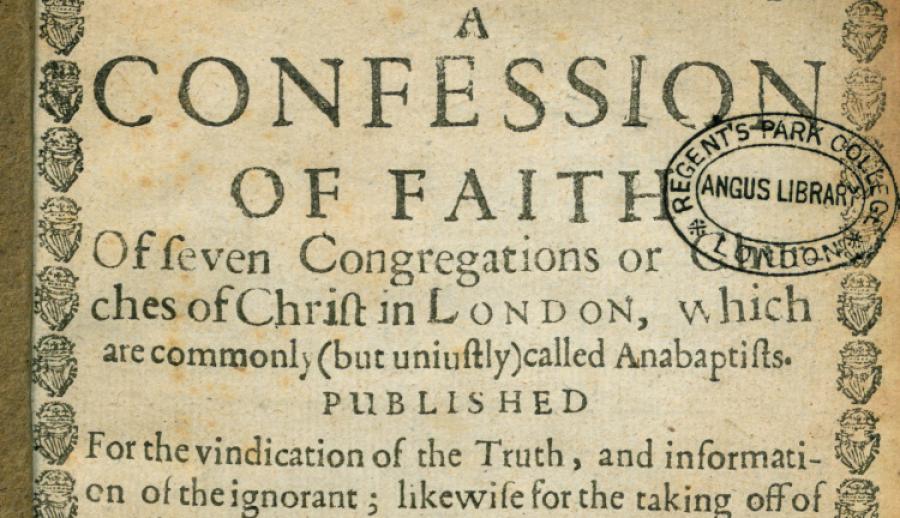
Doctrinal statements are not written in a vacuum but within a historical context. The London Baptist Confession of 1689 is no exception. The creation of the 1689 Confession is united to early English Baptist history where a distinction was made between the “General” and “Particular” Baptist.
The General Baptists emphasized a view of the atonement whereby Christ died for all alike. An individual’s free-will determines their salvation.
In contrast, Particular Baptists emphasized a particular atonement whereby the death of Christ was limited to those whom God has chosen to save. Salvation is ultimately the work of God, and His sovereign choice, rather than the free will of man. Particular Baptists (also called Calvinistic Baptists or Reformed Baptists) are united in embracing the position that a Christian’s salvation is ultimately rooted in God’s electing grace.
The distinct emphasis by the General Baptists and by the Particular Baptists was important for while doctrine divides it also unites people of like mind and faith. Unity of faith is important, especially in times of suffering, persecution, and religious controversy.
As the 17th century progressed, the Particular Baptists took the opportunity to set forth a statement of their faith. In 1644, seven congregations of churches of Christ in London wrote down 52 Articles of Faith, with Scriptural references, and a conclusion. The purpose of the document was to formally state what Particular Baptists believed. The document was published in 1646.
In 1677, English Baptists felt the need to create a more detailed confession of faith. The document that was produced defined the structure of individual congregations, and crystalized a commitment to baptizing professing believers.
In 1689, The Toleration Act was passed, which allowed religious freedom among the established Church of England and Scotland. This was good news to the Baptist who had become a persecuted people, especially after the Act of Uniformity in 1662 made it illegal to use anything but the new Anglican Prayer Book in every Anglican, Presbyterian, Congregationalist, and Baptist churches in England.
It was with great joy and excitement that representative from over 100 Particular Baptist churches met together in London from July 3 to July 11th, 1689 to endorse the 1677 document. Despite the fact that the Confession was written in 1677, the official preface to the document has ensured it will be forever known as the 1689 Baptist Confession of Faith.
We commend it for study, and it can be found here.
 The Collected Works of Stanford E. Murrell