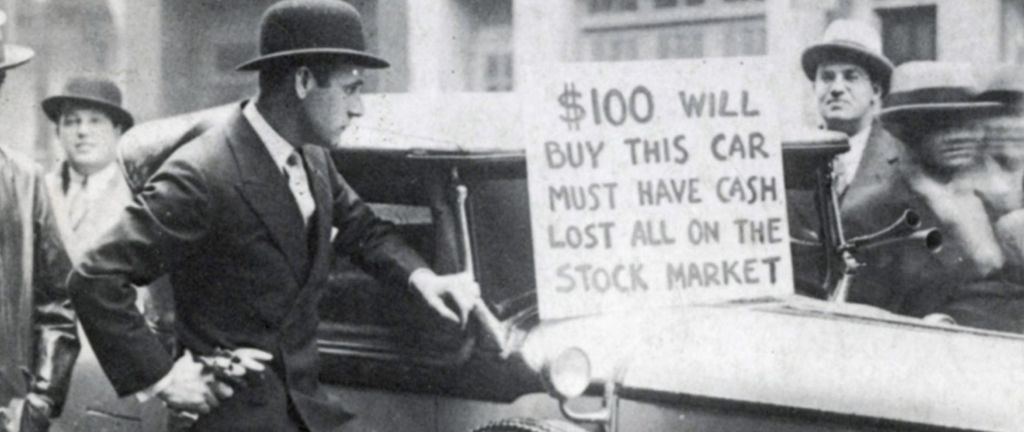
In American history, the years known as the Roaring Twenties, were intoxicating. The Great War was over, and the world began looking for a good time. Ease and luxury were possible in large part because an economic belief was embraced by millions that investing in the stock market insured perpetual dividends. Stock prices began to double, then tripled. Radio, automobile, telephone companies, and consumer goods companies encouraged investments from ordinary people who had never owned stocks before.
By buying on margin, anyone could get into the market. And so, Americans invested. Taxi cab drivers, housewives, barbers, and shoeshine boys joined the Barons of Wall Street in a frantic pursue of wealth and happiness. Individuals dreamed of a financial Golden Age. Consumers went to the store and bought items—on credit. Cars were purchased—on credit. Bank loans were given—on credit. Families went on vacations—on credit. It was all so exciting. A nation convinced itself that debt was harmless, prosperity was endless, and the market could only soar higher and higher.
There was an initial basis for this illusion.
From 1924 to 1929 the Dow Jones Average tripled. People continued to buy on margin. A stock could be bought for ten percent of its value. Bankers would extend credit by using the other ninety percent of the stock as collateral. Initially, no one cared if some stock failed because there were other stocks doing well. By 1929 six billion dollars in broker loans were outstanding. Still, no one cared.
Books and articles were written to fuel the illusion of endless prosperity and encourage buying on margin. Demarcate financial adviser John Jacob Raskob (1879–1950) with DuPont and General Motors provided investment tips for the average person in Ladies’ Home Journal, “Everybody Ought to be Rich.” People listen to a successful individual, and John Raskob was one of the most successful investors in the stock market. As an innovative financier and self-made businessman, he built the Empire State building. When Raskob wrote about “Beneficial Borrowing,” many took his words seriously. “We now know that borrowing may be a method of earning and beneficial to everyone concerned,” wrote Raskob.
On October 24, 1929 that illusion was shattered. Black Thursday arrived. The day began with a significant drop in stock prices. Panic set in when word got out of the sharp decline taking place in the New York Stock Exchange. A record 12.9 million shares were traded on the exchange.
Then came October 29, Black Tuesday. On that day 16.4 million shares were traded. Overnight, the “Roaring Twenties” came to an abrupt halt. The Great Depression began.
All of this happened because the warning signs were ignored.
Common Sense. What goes up, must come down. This is a Law of Physics, and it is a Law of Finances. If no preparation is made for the downward direction, the end result will be catastrophic.
Lack of Collateral. Millions of common people who invested in the stock market had no collateral on which to justify the credit they received. The fantasy was that resources would come in due time through shares in the stock market. So, the future was mortgaged without any concern that a job might be lost, or medical attention would be needed. Famers believed the land would always produce abundant crops. Manufactures believed customers would consume their products. The cry of the masses was, “MORE! MORE! MORE!”
Diminishing Returns. Not many paid close attention to corporate earnings. They were in decline. There comes a point of saturation with consumer goods.
Rising Unemployment. As corporations reduced their inventory, manufactures slowed down. With the means of production being arrested, jobs were suspended or lost. But few cared. After all, most of the country was still doing well. President Ronald Reagan once quipped that a recession is when your neighbor loses his job; a depression is when you lose yours.
Greed. Though clever language was used to justify the inordinate pursuit of wealth, while the love of money was disguised, the truth is that the Roaring Twenties was an extended period of greed. The more people had, the more they wanted. And that brings us to some of what is going on in the Church today.
The modern Church is, from a human point of view, a very wealthy corporation. There are a variety of dynamics have contributed to its success, but there are other forces at work which are destroying it. A Pew Research Center report tells the story: “Christianity continues to see more people leaving than joining. Among today’s youngest adults, 12% have left Catholicism, while only 1% have converted into it. Although some switch to another faith, most become religiously unaffiliated.”
The internal shaking of the visible Church has not come without warning signs.
Doctrinal Error. The Seeker Sensitive Movement has certainly contributed to allowing doctrinal error into the Church. With a desire to get as many unsaved people as possible into the sanctuary to hear the gospel, worship has been transformed. Pastors and people dress down when they used to dress up out of respect before coming into the presence of the Lord of Glory and the King of kings. Doctrinal truths about sin and the need to repent are minimized or completely set aside. Theology is reworded to justify intimate same sex relationships, and promote salvation by moral reformation and self-esteem.
Scandal. In both Catholic and Protestant churches, scandal after scandal occurs. In far too many congregations, money is collected and spent without accountability. Lavish lifestyles are encouraged and modeled by pastors and other Church leaders. Pastoral accountability is lacking leading to religious fiefdoms.
Greed. The Prosperity Gospel encourages greed as slogans are coined to extract resources, promises of financial reward are made about giving, and dreams of health and wealth are encouraged. It is all so very shameful.
Many years ago, a famous exchange took place between Thomas Aquinas (1225–1274) and Pope Innocent IV (1243–1254). During a visit to the Vatican, the Pope was found counting a large sum of money. When he saw Thomas, the pope said, “Look, Thomas. The Church can no longer say, ‘Silver and gold have I none.’” “Neither can the Church say, ‘Arise and walk,’” responded Thomas
Glitter and Gold. A large number of those who are attracted to the Church today are lured in, not by a desire to be forgiven of sin, not to be redeemed by the blood of the Lamb, not to worship God in Spirit and in truth, not to learn Bible doctrine, not to enjoy the fellowship of the saints; they are lured in by expertly run nurseries, day care, adult care, and community programs. State of the art tech gear turns the songs into a rock concert, enhanced by theatrics. Popcorn, pizza, magic shows, game nights, and bouncing houses attract the young people. Youth for Christ rallies belong to a past generation. Teaching young people how to study the Bible, witness for Jesus, and live a clean holy life is boring.
When the Sock Market got out of hand in 1929, a course correction came. It was painful, but necessary for the survival of the nation.
In like manner, when the Church goes astray, there is a course correction. October 31, 1517 brought a course correction. God raised up several generations of Reformers to restore the faith once delivered to the saints (Jude 3).
In America, in the 1730s and 1740s, heaven came down and revival broke out. A nation was preserved. In His mercy, the Lord caused a Second Great Awakening to occur in the United States the late 18th to early 19th century.
Since the two Great Awakenings, there have been some significant movements within Christendom.
The Advent Movement (1830s and 1840s), turned attention to the Second Advent of Jesus.
The Holiness Movement, emphasized the need for personal sanctification.
The Restoration Movement, called on Christians to return to a purer form of worship which is outlined in the book of Acts. Of the early Church it was said that believers “continued steadfastly in the apostles’ [a]doctrine and fellowship, in the breaking of bread, and in prayers” (Acts 2:42, NKJV).
The Pentecost/Charismatic Movement, has focused on the person and work of the Holy Spirit and the spiritual gifts of grace God has given to the Church.
The Fundamentalist Movement, which began in the late 19th century, primarily among conservative Presbyterian theologians at Princeton Theological Seminary, gained momentum among conservative Baptists. There was a desire to return to the fundamentals of the faith: belief in the inspired, inerrant, Scripture, salvation by faith alone in Christ alone, the divinity of Christ and the redemption He secured for the elect, and evangelism.
The Christian Reconstruction Movement turned attention to Calvinism, Christian homeschooling, and the need for Law in the life of the believer.
What is needed more than movements is a heaven-sent revival that will restore doctrinal integrity, cleanse the Church of scandal, burn out the spirit of greed, and remove all the glitter to bring forth pure gold of the gospel instilled in the souls of those who follow the Lamb wherever He goes.
 The Collected Works of Stanford E. Murrell