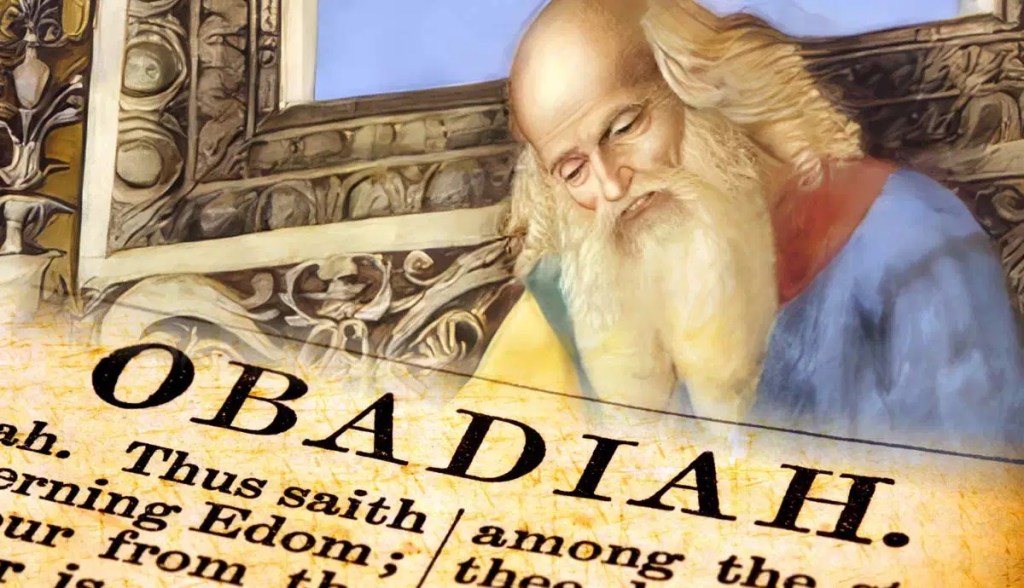
“But upon mount Zion shall be deliverance, and there shall be holiness; and the house of Jacob shall possess their possessions. And the house of Jacob shall be a fire, and the house of Joseph a flame, and the house of Esau for stubble, and they shall kindle in them, and devour them; and there shall not be any remaining of the house of Esau; for the LORD hath spoken it. And they of the south shall possess the mount of Esau; and they of the plain the Philistines: and they shall possess the fields of Ephraim, and the fields of Samaria: and Benjamin shall possess Gilead. And the captivity of this host of the children of Israel shall possess that of the Canaanites, even unto Zarephath; and the captivity of Jerusalem, which is in Sepharad, shall possess the cities of the south. And saviors shall come up on mount Zion to judge the mount of Esau; and the kingdom shall be the LORD’s.” (Obad. 1:17-21)
Obadiah is the shortest of all the books of the Old Testament. Like so many of the prophets, little is known of Obadiah. Some think that Obadiah was a steward in the household of King Ahab (1 Kgs. 18:3). Others believe that Obadiah was a contemporary with Hosea, Joel, and Amos (8th century BC). Still more believe that he lived at the time of the fall of Jerusalem (586 BC).
Really, it does not matter, for the message is more important than the man. Obadiah writes what he saw in a vision. The vision focused upon and against Edom and her national sins against Judah. In his denunciation, Obadiah would not be alone. Other prophets also had harsh things to say against this nation (cf. Jer. 49:7; Ezek. 25:12). The Edomites were the descendants of Esau, the twin brother of Jacob. The hostility of the brothers was carried on by the descendants of each. The sins of the parents are reflected in the children. We have in outline form the following.
Threatening Against Edom in Obadiah
Their pride was to be humbled (1:2-4)
Their wealth should be taken away (1:5-7)
Their wisdom will be frustrated (1:8-9)
Their behavior against Israel is to be avenged (1:10-16)
Gracious Promises to Israel in Obadiah
The nation will be restored and reformed (ch. 1)
They shall have victory over the Edomites (1:17-20)
The Messianic kingdom will be established (1:21)
The vision of Obadiah begins with a declaration of war against Edom (1:1). The reason for the war will be soon apparent. The Edomites have hurt the people of God. A principle is established. “All who hurt God’s people shall certainly bring Divine wrath upon themselves.”
Like a loving father, like a protective mother, God will move to put a ring of safety around His people. To announce His determination to help His hurting people God sent His ambassador among the heathen. The message is specific. Arise ye, and let us rise up against her (Edom) in battle.
The call did go forth to the heathen nations. God had bloody work to do and he needed natural butchers to perform His terrible judgment. Unfortunately, there are many natural born killers. Obadiah predicts a successful campaign against Edom (Obad. 1:2). Edom shall be subdued, spoiled, brought down.
Edom’s strategic geographical position would not save her (Obad. 1:2). What has brought the wrath of God? Among other things, pride. Pride is what plunged the angels into sin (Isa. 14). God hates unholy pride. Someone has said that we are the closest to the devil when we are lifted up with pride.
Ungodly pride is an exalted view of one’s self. Ungodly pride holds all others in contempt: There is economic pride which breeds class envy. There is military pride which David manifested when he numbered Israel. There is intellectual pride of a superior intellect. There is political pride which can create wars in the name of nationalism illustrated in WW I. There is racial pride. There is religious pride such as the Pharisees displayed. There is sexual pride reflected in hedonistic philosophy. There is bodily pride illustrated in the muscle builders. There is oratorical pride. There is musical pride. There is artistic pride. There is literary pride.
Edom had so much pride that she was deceived and destroyed by it. Edom thought that she was secure in her defenses so she began to boast (Obad. 1:3). God responded to Edom’s boast with a divine promise, “I will bring thee down.”
The spiritual lesson is important. Men may trust in many things to get them to heaven such as good works, great deeds (etc.) but they will be brought low, for God is at war with all who do not meet Him on gospel terms. The judgment of God against Edom will be more severe than what ordinary warfare would normally bring (Obad. 1:5).
Moreover, the political friends of Edom would betray them (Obad. 1:7). Edom had made treaties with the Ammonites and the Moabites. These nations took food supplies from Edom they had free housing for their soldiers, and they took pay as mercenaries. These nations were very respectful until the day came when it was to their advantage to attack Edom.
The friendships of the world did not last; they never do. And the worst part is that these allied nations “laid a wound” under Edom. In other words, Edom rested upon the validity of her foreign treaties for comfort. However, beneath the bed there was the sword of death and the hand of betrayal.
It is far better to trust in the strength of the Lord and have His arms of love underneath us. The fact is that the political rulers of Edom “have no understanding” or they would never had trusted their enemies to such an extent (like Neville Chamberlain who trusted Adolf Hitler and made sure with that trust that WW II would begin).
In the Day of Judgment the Lord declares that He will target the wise men of Edom (1:8). He will make the wisdom of men to become foolish. And the Lord will target the mighty men or the men of war. Courage will fail them. The spiritual lessons must not be lost.
The church must be careful not to make alliances with historical enemies (such as the cult; Rome).
The heart must be guarded against unbiblical pride.
The Lord needs to be glorified for the way He works on our behalf.
The church must cultivate a sense of need and dependency upon the Lord.
Precious Promises
Turning to Obadiah 1:17-21 we find several precious promises that concern the salvation of the church (symbolized by Judah). The prophet declares (Obadiah 1:17), “But upon Mt. Zion shall be deliverance.” For Jews in captivity, this would be a wonderful promise of hope. Mt. Zion was where the Holy Temple was located. Mt. Zion was the place of worship. Mt. Zion was where God met with His people. There was salvation to be found in Mt. Zion.
Historically, the Jews of the Babylonian Captivity took hope when they read the words of the prophet, and they did return. Wave upon wave went back to Jerusalem from the land of Babylon after seventy years of captivity. Other generations also took hope during difficult days.
For example, had a Jew, after the fall of Jerusalem in AD 70, read the prophet Obadiah, the heart might have been encouraged that yet again, the time would come when the Jews would return to the land. And they would have been right! Since in 1948, many Jews have literally found deliverance and safety in Mt. Zion.
In a larger sense, the deliverance of the Jews is typical of the redemption the church enjoys in Christ. Spiritually, Mt. Zion speaks of heaven in eternity and worship in time. A remnant shall always be found upon the holy mountain. As a spiritual nation, the church might know something of temporary conquest. In Britain, the Church of England is being surrounded by Islamic Fundamentalism. Still, God has a remnant. Men like Gordan Bayliss still worship the true God. In America, formalism, ritualism, and ecumenicalism have united with liberalism to encroach upon the church. But we are here and a multitude more have found salvation upon Mt. Zion.
No matter how dark the days may become politically, socially, or spiritually, the church can look to the future with confidence that there will be deliverance upon Mt. Zion. As there will be salvation so there will be sanctification. Our text says, “and there shall be holiness.” It is easy to despair over sin. We struggle and struggle against sin.
We make resolutions. We read books. We weep at the altar. And yet still we sin.
We grow afraid, for we have read that without holiness no one shall see God. Sometimes we despair for we sense that sin has made a hypocrite of our faith. There is public behavior but private sin.
We feel we are a spiritual schizophrenic. Our heart is divided. Our lives are compartmentalized so that there is spirituality but there is also shame because of sin. We believe that we are alone in our struggles. All others seem to be so much better. And we wonder if we know anything of true salvation.
It seems as if Satan can take us captive at his will while on other occasions there is resistance to sin and great love for the Lord. We wonder what the future holds. The prophet encourages our heart for the promise is given,
“And there shall be holiness.”
This could not be said unless there is to be a divine operation. Our hearts take courage. If salvation is of the Lord, so is sanctification. As Christ works our salvation, so our sanctification will be according to grace. 1 Corinthians 1:30 declares, “But of him [God] are ye in Christ Jesus, who of God is made unto us wisdom, and righteousness, and sanctification, and redemption.”
All God’s people can look to the future for holiness. While the struggle against sin continues in the flesh, the promise is given, “And there shall be holiness.” God has spoken. It will come to pass.
The second promise Obadiah gives to the church is that both salvation and sanctification shall spread. “The house of Jacob shall possess their possessions.” Lydia’s heart was open and her whole household was saved. The woman at the well drank from the Living Water and went and told the men of the city how to be saved.
Peter met Jesus and later preached to the Gentiles who brought their honor and glory into the New Jerusalem. “And the nations of them, which are saved, shall walk in the light of it: and the kings of the Earth do bring their glory and honor into it (Rev. 21:24). God has promised an inheritance for His people.
A new home. Eternal life. A new name. A new body. A new heaven and a new earth. A new government of righteousness. A reunion with loved ones.
The promise of seeing Christ. The promise of sitting at a banquet table with Abraham, Isaac, and Jacob.
After each one of these things it could be written, “And the house of Jacob shall possess their possessions.”
There is a third promise. In the future, as Obadiah sees it, the church shall judge its enemies (1:18). “And the house of Jacob shall be a fire [of judgment], and the house of Joseph a flame, and Esau [the enemy], for stubble.” All the New Testament writers agree that the church shall one day judge the angels, and judge the world (the Queen of Sheba shall rise up in judgment…)
Finally, the church shall not only be saved, sanctified, secure in its possessions and sit in judgment, it shall also see its borders expand.
On Obadiah 1:19-20, historically, the prophet predicted that Judah would one day return to the land and expand her territory in the South (Edom), West (Philistines), North (Ephraim and Samaria), and East (Benjamin/other side of the Jordan).
Spiritually, the prophet sees that the church shall know great triumph. And she has! Starting small in Jerusalem, the church has gone into Judea, Samaria, and unto the uttermost parts of the world. This has happened because (Obadiah 1:21) God has already sent forth saviours in the form of preachers of the gospel. While unbelievers are judged by the gospel, it is still salvation to all that believe. According to Obadiah, the future is full of hope and glory for the church. We are invited to see the future through the eyes of the prophet.
 The Collected Works of Stanford E. Murrell