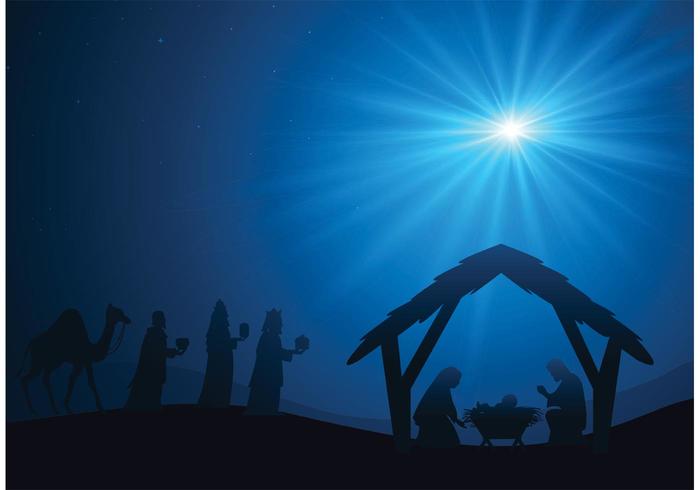
“And there were in the same country shepherds abiding in the field, keeping watch over their flock by night. And, lo, the angel of the Lord came upon them, and the glory of the Lord shone round about them: and they were sore afraid. And the angel said unto them, Fear not: for, behold, I bring you good tidings of great joy, which shall be to all people. For unto you is born this day in the city of David a Saviour, which is Christ the Lord.” (Luke 2:8-11)
The year was 1809.
The international scene was tumultuous.
Napoleon was sweeping through Austria; blood was flowing freely.
Nobody then cared about babies, but the world was overlooking some very important births.
For example, William Gladstone was born that year. He was destined to become one of England’s finest statesmen.
That same year in England, Alfred Lloyd Tennyson was born to an obscure minister and his wife.
The child would one day greatly affect the literary world in a dramatic manner.
On the American continent, Oliver Wendell Holmes was born in Cambridge, Massachusetts.
Not far away in Boston, a baby was born who would grow to be a poet and a writer of horror.
Edgar Allan Poe began his eventful, although short and tragic, life.
It was also in that same year of 1809 that a physician in England named Darwin, and his wife named their child Charles Robert.
Young Charles would one day go on a voyage aboard a ship named the Beagle, and return to give the world the theory of evolution.
That same year produced the cries of a newborn infant in a rugged log cabin in Hardin County, Kentucky.
The baby’s name? Abraham Lincoln.
If there had been news broadcasts at that time, these words might have been heard:
“The destiny of the world is being shaped on the battle-fields of Austria today.”
But history was actually being shaped in the cradles of England and America.
In like manner, everyone thought taxation was the big news during the days of Caesar Augustus.
But a young Jewish woman cradled the biggest news of all in her arms: the birth of the Messiah, the Saviour of the world.
The narrative of the incarnation of Christ is part of The Greatest Story Ever Told. Today, the gospel has captured the hearts of more than 2.2 billion people who profess to be Christian. As attention is turned once more to the Advent story, a fundamental question arises:
“Jesus, why did you come?”
The Bible records the answer.
First, the Bible teaches that Jesus came to fulfill the promise God the Father made in the Covenant of Redemption. When Adam, acting as the Federal Representative of mankind, Fell in the Garden of Eden, he condemned not only himself but all of humanity to a godless state of existence. The Bible says,
Wherefore, as by one man sin entered into the world, And death by sin; and so, death passed upon all men, For that all have sinned” (Rom. 5:12).
Every person who is born into the world is born with the plague of all plagues clinging to the soul, and permeating every fiber of existence. That plague is sin. What does sin do to self, and others?
Sin darkens the understanding.
Sin perverts the emotions.
Sin dominates the will.
Sin moves men to love darkness rather than light.
Sin creates chaos and confusion.
Sin destroys the moral compass of the will while exalting pride, selfishness and greed.
Sin will silence the conscience.
Sin defies God.
Sin destroys relationships.
Sin demands servitude, and gives only death as wages in return.
Despite all the wars that have been waged, all the tears that have been shed, all the promises that have been made, all the self-loathing that has been expressed,the power of sin is still present. Despite all the self-help programs on the market, despite all the professional counseling in the country, despite all the rehab programs and prisons that have been erected, despite all the personal shame that tormented souls carry in private, Sin is still alive and well on planet earth.
Because sin is so pervasive and strong, if any person is ever to know redemption and forgiveness of God, than the question of sin has to be dealt with. In infinite grace, in the same spot that sin was first conceived, God entered into a Covenant of Redemption with man.
After the Fall, God promised, Someone would come to reverse the works of unrighteousness,
thereby allowing individuals to be reconciled, and have fellowship with the Father, based upon the righteousness of justice being satisfied.
Where sin abounded, grace did much more abound (Rom. 5:20).
The long wait for the fulfillment of the Covenant of Redemption began, with great hopes and many expectations. But these gave way to a patient waiting.
During the waiting period, the Law came with all of its Jewish rituals and ceremonies. These rituals served a purpose, which was to remind individuals that by the works of the Law, no flesh can ever be justified in the sight of God. Moreover, the shedding of the blood of animals does not take away sin for they are not perfect either, having been touched by the same plague that afflicts mankind.
Realizing this, religious men, like the Pharisees, grew desperate. They hoped against hope that somehow the righteousness of God could be appeased by the blood of bulls and goats in association with many good works. And yet,
“Every smoking altar, every bleeding victim, every ascetic privation, every priestly intervention, was a testimony to the guilt of sin and the need of [a more perfect way for the] remission [of sin] ….” (David Clark)
Lest mankind utterly despair, the prophets appeared to remind the people of the Prince, who was to come, who would make a Covenant with His people.
Finally,
“in the fullness of time,” at the appointed moment, a Savior was born who is Christ the Lord (Gal. 4:4).
They called Him Jesus.
Thirty years later, in His maturity, Jesus went and stood on the edge of the Jordan River to be baptized in order to be presented as the Lamb of God which taketh away the sin of the world (John 1:29).
Upon learning the Messiah had come, many people in Palestine rushed to receive Christ, though other people drew back. There were those who could not believe that Jesus was the Anointed One.
But to as many as received Him, to them He gave the right to become the sons of God, even to as many as believed on His name (John 1:12).
Tragically, there are still those who cannot believe that Jesus is the Son of the Living God. Many people cannot believe that Christ is truly Emmanuel, God with us, despite abundant evidence that Jesus is divine.
There is the evidence of the virgin birth, the influence of His personality upon the world, and the personal testimony of many. Regarding the Virgin Birth, it is a great mystery, but the Bible tells us that Jesus was born without personal sin, and without the imputation of Adam’s sin. How God could be both true deity and true humanity has occupied the conversation of theologians and Church Councils for centuries (Chalcedon AD 451). The Bible simply records the facts, without explanation, and calls upon the heart to believe in the miraculous, because it is true.
The baby in the cradle of Bethlehem was also the Eternal Son and, as the Eternal Son, Jesus had something to say to the Father the night of His birth. And this is what Christ said when He came into the world:
Sacrifice and offering thou wouldest not, But a body hast thou prepared for me: In burnt offerings and sacrifices for sin Thou hast had no pleasure. Then said I, Lo, I come (in the volume of the book it is written of me,) to do thy will, O God (Heb. 10:5-7).
Later, Roman historians would record that the world had been waiting for Someone as special as Jesus.
Suetonius noted,
“There had spread over all the Orient an old and established belief, that it was fated at that time for men coming from Judaea to rule the world” (Suetonius: Life of Vespasian, 4:5).
Tacitus tells of the same expectation declaring,
“there was a firm persuasion … that at this very time the East was to grow powerful, and rulers coming from Judaea were to acquire universal empire” (Tacitus: Histories, 5:13).
The Jews also had hope,
“about that time, one from their country should become governor of the habitable earth” (Josephus: Wars of the Jews, 6:5, 4).
In the fullness of time, God brought forth His Son (Gal. 4:4). What a Son, Jesus would prove to be. The totality of his life was a constant demonstration of His deity. And by that life He became, “The Man Who Changed the World.” Dr. Herbert Lockyer explains.
“More than 1900 years ago there was a Man born contrary to the laws of life.
This Man lived in poverty and was reared in obscurity…
Only once did He cross the boundary of the country in which He lived: That was during His exile in childhood…
In infancy He startled a king: in childhood He puzzled the doctors:
In manhood He ruled the course of Nature, walked upon the billows as if pavement, and hushed the sea to sleep.
He never wrote a book, and yet all of the libraries of the country could not hold the books that have been written about Him.
He never wrote a song, and yet He has furnished the theme for more songs than all the songwriters combined.
He never founded a college, but all the schools put together cannot boast of having as many students…
The names of the past proved statesmen of Greece and Rome have come and gone.
The names of past scientists, philosophers and theologians have come and gone; but the name of this Man abounds more and more.
Though time has spread between the people of this generation and the scene of His crucifixion, yet He still lives.
Herod could not destroy Him, and the grave could not hold Him.
He stands forth upon the highest pinnacle of Heavenly glory, proclaimed of God, acknowledged by angels, adored by saints, and feared by devils, as the living, personal Christ, our Lord, our Saviour and our God.”
“Jesus, why did you come?”
Listen to Christ as He says,
“I came as the Son of the Living God to offer myself as a Perfect Sacrifice to honor the Covenant of Redemption first stated in the Garden of Eden.”
“Lord, is that the only reason why you came?”
“No, I also came to destroy the works of the Devil” (1 John 3:8).
Lying is a work of the Devil as Satan lied in the Garden of Eden.
Now the serpent was more subtle than any beast of the field which the Lord God had made.
And he said unto the woman, Yea, hath God said, Ye shall not eat of every tree of the garden?
And the woman said unto the serpent, We may eat of the fruit of the trees of the garden: But of the fruit of the tree which is in the midst of the garden, God hath said, Ye shall not eat of it, neither shall ye touch it, lest ye die.
And the serpent said unto the woman, Ye shall not surely die:
For God doth know that in the day ye eat thereof, then your eyes shall be opened, and ye shall be as gods, knowing good and evil (Gen. 3:1-5).
St. Augustine reminds us that,
“When regard for truth has been broken down, or even slightly weakened, all things will remain doubtful.”
Murder is a work of the Devil. We read of how Cain, motivated by Satan rose up and murdered his righteous brother Abel,
because his own works were evil, And his brother’s righteous (1 John 3:10-12).
Moving men to pride is a work of the Devil manifested in the Divine narrative of how the Evil One moved David to number the children of Israel.
And Satan stood up against Israel, and provoked David to number Israel
…And God was displeased with this thing; therefore, he smote Israel…. (1 Chron. 21:1, 7, 9-14).
The nation of Israel paid a terrible price for the pride of one man. Someone has said that we are never more like Satan himself than when we are filled with inordinate pride. Pride can make individuals unwilling to repent, unwilling to say, “I’m sorry,” and unwilling to tell the truth about things that all the world knows to be different. The Bible declares that God will always resist the proud, but He will give grace to the humble.
Betrayal is a work of the Devil reflected in the fact that for 30 pieces of silver Judas betrayed the Son of God, after the Devil had entered into him (John 13:23-30).
There are many forms of betrayal such as, a contract not honored or re-negotiated, a friendship abused for selfish purposes, and a willingness to advance one’s own agenda at all cost.
The story is told of William Tyndale and how he was betrayed. Tyndale was the first person to translate the Bible from Hebrew and Greek into English. He wanted to make a Bible for the common people. Tyndale believed that a plowboy of ten with a Bible, could know more than the Pope himself without the Scriptures. But the church officials stepped in to forbid Tyndale from giving the Bible to common people.
Tyndale continued his work in secret until, in 1535, a friend betrayed him. He was taken prisoner to the English castle of Vilford, where he still tried to continue his work. He was unable to finish his translation because he was sentenced to die a heretic’s death.This involved strangulation and burning at the stake.
On October 6, 1536, William Tyndale spoke his last words, “Lord, open the eyes of the king of England.” William Tyndale was a victim of betrayal and treachery.
Now Christ has come to destroy all the works of the Devil. And where Christ puts forth His strength, He overthrows the Evil One as well as sin. This means that,
in the end of regeneration, sin will be destroyed, and all who are born of God will live righteously and godly because God’s Spirit corrects the passions of sin (John Calvin).
“Jesus, why did you come?”
“I came to destroy the works of the Devil.”
“Lord, is that all?”
“No, I also came to seek and to save that which is lost and to give eternal life to all who will believe.”
Because eternal life is a relationship with the Living Lord based upon faith in all that Jesus claimed to be, the content of belief is important.
George Whitefield was preaching to coal miners in England. He asked one man,
“What do you believe?”
“Well, I believe the same as the church.”
“And what does the church believe?”
“Well, they believe the same as me.” Seeing he was getting nowhere, Whitefield said,
“And what is it that you both believe?”
“Well, I suppose the same thing.”
The coal miner lacked real content for faith.
The content of faith is the gospel (1 Cor. 1-3).
The object of saving faith is Christ.
But faith in Christ must not be in the abstract. It must be personal and real. “The life of Christianity consists of possessive pronouns,” said Martin Luther. It is one thing to say, “Christ is a Saviour.”
It is quite another thing to say, “Jesus is my Saviour and my Lord.” The devil can say the first but only the true Christian alone can say the second.
“Jesus, why did you come?”
“I came to honor the Covenant of Redemption.
I came to destroy the works of the Devil.
I came to seek and to save the lost.
I came to give eternal life.
I came so that individuals might say, ‘Jesus is my Lord and my Saviour.’” Amen.”
 The Collected Works of Stanford E. Murrell