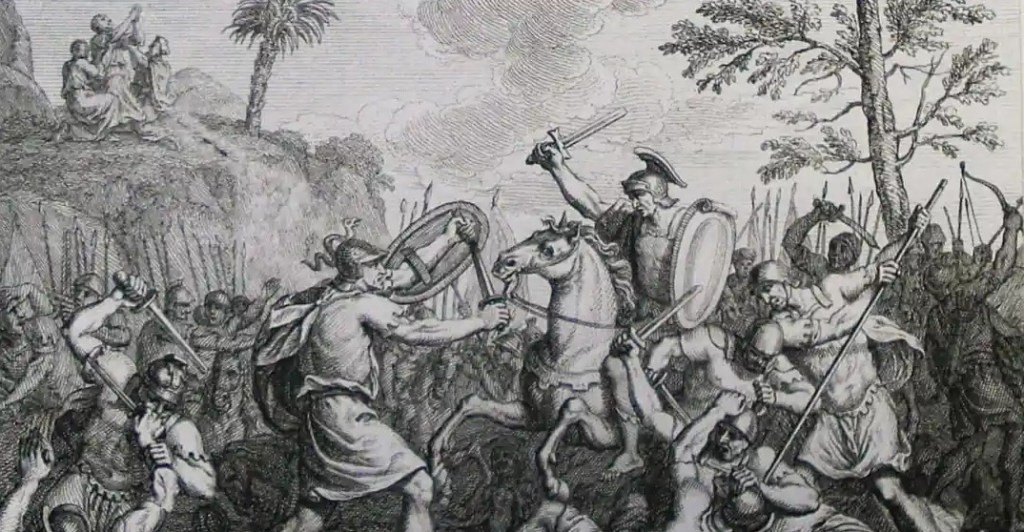
“And these are the countries which the children of Israel inherited in the land of Canaan, which Eleazar the priest, and Joshua the son of Nun, and the heads of the fathers of the tribes of the children of Israel, distributed for inheritance to them. By lot was their inheritance, as the Lord commanded by the hand of Moses, for the nine tribes, and for the half tribe. For Moses had given the inheritance of two tribes and an half tribe on the other side Jordan: but unto the Levites he gave none inheritance among them. For the children of Joseph were two tribes, Manasseh and Ephraim: therefore they gave no part unto the Levites in the land, save cities to dwell in, with their suburbs for their cattle and for their substance. As the Lord commanded Moses, so the children of Israel did, and they divided the land. Then the children of Judah came unto Joshua in Gilgal: and Caleb the son of Jephunneh the Kenezite said unto him, Thou knowest the thing that the Lord said unto Moses the man of God concerning me and thee in Kadeshbarnea. Forty years old was I when Moses the servant of the Lord sent me from Kadeshbarnea to espy out the land; and I brought him word again as it was in mine heart. Nevertheless my brethren that went up with me made the heart of the people melt: but I wholly followed the Lord my God. And Moses sware on that day, saying, Surely the land whereon thy feet have trodden shall be thine inheritance, and thy children’s for ever, because thou hast wholly followed the Lord my God. And now, behold, the Lord hath kept me alive, as he said, these forty and five years, even since the Lord spake this word unto Moses, while the children of Israel wandered in the wilderness: and now, lo, I am this day fourscore and five years old. As yet I am as strong this day as I was in the day that Moses sent me: as my strength was then, even so is my strength now, for war, both to go out, and to come in. Now therefore give me this mountain, whereof the Lord spake in that day; for thou heardest in that day how the Anakims were there, and that the cities were great and fenced: if so be the Lord will be with me, then I shall be able to drive them out, as the Lord said. And Joshua blessed him, and gave unto Caleb the son of Jephunneh Hebron for an inheritance. Hebron therefore became the inheritance of Caleb the son of Jephunneh the Kenezite unto this day, because that he wholly followed the Lord God of Israel. And the name of Hebron before was Kirjatharba; which Arba was a great man among the Anakims. And the land had rest from war.” (Josh. 14:1-15)
There is an ancient town located in the mountains of Judah, about 2,800 feet above the Mediterranean Sea, and between Beersheba and Jerusalem. Among those who lived near this ancient town called Hebron, were Abraham (Genesis 13:18), Isaac and Jacob (Genesis 35:27) Sarah was buried near by (Genesis 23:2).
Is it any wonder that when the children of Israel finally crossed over the Jordan River to take possession of the Land of Promise that Hebron became an object of desire? In the camp of Israel there was one man who wanted to possess the mountain Hebron and its vicinity. He believed that the area belonged to him according to Divine promise and so it was. His name was Caleb.
We are first introduced to Caleb in Numbers 13 as one of the 12 spies sent into the Land of Canaan to bring back a report. After forty days the men made their report. Ten of the spies were unnerved by what they had seen. Though the land flowed with milk and honey, there were grants in the land. “We look like grasshoppers in their sight,” said the spies. “We are no match in war.” Caleb and Joshua disagreed. They too had seen the giants but were not intimidated. God could grant wisdom as to how to defeat the greatest of foes.
Because of his good report, because of his great personal courage, Caleb was promised the mountain of Hebron for a possession. But like so many promises of God, a long interval of time would pass before the fulfillment.
And Caleb waited. Ten years passed. He still waited. Finally, after forty-five years it was time to take possession.
Perhaps on a bright sunny morning, with the sky so very blue and a few white clouds gently floating by, Caleb sought out the leader of Israel. It was his old friend Joshua.
Together, Caleb and Joshua had survived the death of the whole wilderness generation. Because of unbelief they were all dead. Moses was gone also.
Those two men were the oldest in all of Israel. They were twenty years older than their nearest kinsmen, and they had something to discuss.
Caleb took the initiative. “Joshua,” he said. “Let me remind you of what took place forty-five years ago. I was only forty years old then, when Moses, the servant of the Lord, sent me from Kadesh-bar-nea to spy out the land. And I brought him word again as it was in mine heart.”
The word in the heart of Caleb was victory. When others saw defeat, Caleb saw success. When others reported their fears, Caleb reported his faith, as it was in his heart.
When the ten spies made the heart of the people to melt, Caleb and Joshua spoke words that were designed to transform cowards into conquerors.
God listened, and He was determined to honor such faithfulness. Under divine inspiration, Moses spoke and Caleb remembered, “Joshua, do you remember so long ago saying, ‘Surely, the land where thy feet have trodden shall be their inheritance, and thy children’s forever…’ Joshua, I want that land. “Now therefore, give me this mountain.”
As the leader of Israel, Joshua might have looked at his old friend Caleb for a long time. It seemed like only yesterday they were secretly laying behind large rocks so as not to be seen by the children of Canaan. The years disappeared as the morning must in the memory of his mind. He was a young soldier again.
Caleb was as good as his name which meant “all heart.”
Joshua remembered it all so clearly. He remembered the stalk of grapes gathered by the brook of Eschol, the spies had carried on their way back to camp. He remembered how excited the people were at the abundance of pomegranates and figs. He remembered also how angry he was with the ten spies who spread panic into the hearts of the people.
Returning to the present mindset, there was only one thing for Joshua to do. He must honor his friend, and so it was that Joshua blessed Caleb and gave unto him Hebron for an inheritance.
Now Caleb had his mountain to conquer. But what does it take to conquer a mountain?
In the physical dimension of time it takes several things. First, it takes courage.
Warfare is often idealized. People fantasize about such concepts as bravery, honor, and duty. Theodore Roosevelt thought the Spanish-American War of 1898 would be healthy for the American spirit. He did everything he could as Under Secretary of the Navy to promote the hostilities and then resigned his position to become a Colonel in the Army. He got his “splendid little war” at the price of the destruction of the battleship Maine which was blown up in Havana Harbor.
There is nothing picturesque about hands and arms being blown off and bodies being hacked into pieces. And yet, in this sin-saturated world, warfare is sometimes the only way to bring peace, and it takes courage to go into battle. Caleb had physical courage.
Second, in order to conquer a mountain fortified as a military stronghold, it takes confidence. Many an important position has been lost to an enemy because the commander lacked confidence that an objective could be taken.
During the Civil War, one event that frustrated President Lincoln time and again was the fact that when his Generals had the advantage they did not press on to conquest. General George B. McClellan was notorious for being cautious, or more bluntly, for lacking confidence.
Then third, in order to defeat a strong enemy in a fortified position, there must be Divine enablement. All the bright planning in the world will fail unless God is in it. History is filled with examples of Divine intervention such as the Miracle of Dunkirk, that took place in the early stages of World War II. Hitler’s panzer army division had the French and British army surrounded at Dunkirk. It seemed that there would be a wholesale slaughter until something strange happened.
The Panzer division stopped in their tracks. The German Luff was suppose to finish off the allied army by the air, but heavy clouds rolled in and the pilots could not see their targets.
While the army paused, while the planes searched for their target, the British people began the greatest rescue operation of the War. Anything that could float was pushed across the English Channel to rescue the stranded soldiers. Though casualties were high the allied army survived to fight another day. There was a Miracle at Dunkirk. It was the will of God that the great giant of Nazism should ultimately be destroyed.
Many will never have to fight in a military battle, but there are spiritual battles which are just as real and just as costly. There are spiritual mountains to conquer. If the truth were known in the heart of God’s people, there is a mountain to conquer.
For one person it may be a “financial mountain.” Today, with the hospital expenses so excessive it does not take much of an accident, or a need, to destroy the family’s income.
Some people must conquer their anger before it destroys others. Some struggle against a besetting sin. Whatever the mountain may be, fear of the unknown, lack of compassion, personal greed, or harsh language, the time might be right to go to our great Joshua and cry out, “Lord, give me this mountain.”
But, before there is victory, something is needed. The spiritual mountain of life can only be conquered by faith. This is a difficult point to make but it seems to me that the solution to the problems of life pursued by many are really just so many techniques.
For example, in the struggle against the mountain of some specific sin, what the world calls disorder, techniques are suggested.
In and of themselves, the techniques are not wrong, but here is the question. After a person has memorized Scripture, become accountable to another person, confessed sin, attended all the religious services possible, read the Bible, and claimed victory, and still finds himself doing that which he hates, and what offends God, what is next? The techniques do not work.
Is this not why many people became disillusioned with the church? They have heard that religion brings joy. The church is a place of sweet fellowship. The church is the meeting ground between God and man, and all of this is true.
Why then does the joy fade, and the hallowed ground become barren? Why is the fellowship strained? Is it possible that there has been a loss of faith? Faith can easily be replaced by concepts of criticism and words that wound. Cynics in the synagogue speak of a lost faith.
The world of reality must be transformed by idealism, which by faith becomes reality. Abraham did this very thing (Hebrews 11:8-10), as did Moses (Hebrews 11:24-29) and as did Jesus Christ who sees the church in all her splendid glory (Revelation 21:9).
May I suggest that you and I begin to transform the world of present reality into idealism, which by faith, becomes spiritual reality.
Do you, can you see yourselves as the Word of God presents you as a saint (Romans 1:7), as a king (Revelation 1:6), as a priest of the Most High God, as more then conquerors through Christ, and as redeemed by the blood of the Lamb? Techniques will fail. But there is a Cross where redemption took place. There is an empty tomb whereby the Lord of Glory moved from earth to heaven. By faith we look to our conquering Joshua, and ask for the spiritual mountains to be given to us. It is the right time to do so.
For the glory of God, and for the betterment of the soul, it is not wrong to want to conquer spiritual mountains, and to drive out the evil giants of the land. It is difficult. To have faith is not easy. The disciples of Christ had to pray, “Lord, increase our faith.” One man who came to Jesus cried, “Lord, I believe, help my unbelief.”
At age 85, Caleb was stronger in his faith then he was at age 40. What was it that increased the faith of Caleb? Two things as recorded in verses 10 and 11. First, the passing of time. Simply because he was kept alive Caleb knew God would honor His Word. Second, the fact that he kept his physical strength.
Dear people, if you are alive, and if your strength remains it is for the spiritual labor the Lord would have you to do. I have always been impressed with those people who die still serving the Lord. That is how I want to be. Still preaching at 85. Still trying to educate children not only for time but, for eternity. Still trying to get God’s people to join together instead of staying apart. Still trying to be more holy and more sensitive to the Spirit of the Living God. We can rest in heaven. We need to labor in time. May God grant us the request for victory as we ask today in Jesus name. “Lord, give me this mountain.”
 The Collected Works of Stanford E. Murrell