“And it came to pass, as he went to Jerusalem, that he passed through the midst of Samaria and Galilee. And as he entered into a certain village, there met him ten men that were lepers, which stood afar off: And they lifted up their voices, and said, Jesus, Master, have mercy on us. And when he saw them, he said unto them, Go shew yourselves unto the priests. And it came to pass, that, as they went, they were cleansed. And one of them, when he saw that he was healed, turned back, and with a loud voice glorified God, And fell down on his face at his feet, giving him thanks: and he was a Samaritan. And Jesus answering said, Were there not ten cleansed? But where are the nine There are not found that returned to give glory to God, save this stranger.” (Luke 17:11-18).
The narrative of Luke 17 whereby Christ healed ten lepers but only one returned to give Him thanks reflects the depravity of the human heart and its hardness as well. An attitude of gratitude is a spirit that must be cultivated and will be when individuals pause to reflect upon even the smallest matters of life. A thoughtful mother understood this when she wrote the following.
“One day as I was picking
the toys up off the floor,
I noticed a small hand print
on the wall beside the door.I knew that it was something
that I’d seen most every day,
but this time when I saw it there,
I wanted it to stay.Then tears welled up inside my eyes,
I knew it wouldn’t last,
for every mother knows
her children grow up way too fast.Just then I put my chores aside
and held my children tight.
I sang to them sweet lullabies
and rocked into the night.Sometimes we take for granted,
all those things that seem so small.
Like one of God’s great treasures….
A small hand print on the wall.”
The mother could give thanks for a small handprint on the wall because her heart had learned to cultivate an attitude of gratitude, which means she had learned to think in a positive manner. So much conversation and so many observations are negative in nature. Individuals tend to be surprised to find someone who is known for gracious remarks and positive thoughts. Scottish minister Alexander Whyte was such a person. He was known for his uplifting prayers in the pulpit.
Dr. Whyte always found something for which to be grateful. One Sunday morning the weather was so gloomy that one church member thought to himself, “Certainly the preacher won’t think of anything for which to thank the Lord on a wretched day like this.”
Much to his surprise, however, Whyte began by praying, “We thank Thee, O God, that it is not always like this.”
Perhaps individuals would be willing to cultivate an attitude of gratitude if they did not have so much already. A 12-year-old boy named David was born without an immune system. He underwent a bone marrow transplant to correct the deficiency.
Up to that point he had spent his entire life in a plastic bubble to prevent exposure to common germs, bacteria, and viruses that could kill him. He lived without ever knowing human contact.
When asked what he would like to do if released from his protective bubble, he replied, “I want to walk barefoot on grass, and touch my mother’s hand.”
Ten lepers were touched by the Master’s hand but nine of them neglected to say “Thank you” for even in their wretched condition they still had too much in life to be grateful.
Warren Wiersbe writes in his book, God Isn’t in a Hurry, these words.
“I have felt for a long time that one of the particular temptations of the maturing Christian is the danger of getting accustomed to his blessings. Like the world traveler who has been everywhere and seen everything, the maturing Christian is in danger of taking his blessings for granted and getting so accustomed to them that they fail to excite him as they once did.
The philosopher Ralph Waldo Emerson said that if the stars came out only once a year, everybody would stay up all night to behold them. We have seen the stars so often that we don’t bother to look at them anymore. We have grown accustomed to our blessings.
The Israelites in the wilderness got accustomed to their blessings, and God had to chasten the people (Num. 11). God had fed the nation with heavenly manna each morning, and yet the people were getting tired of it. “But now our whole being is dried up,” they said, “there is nothing at all except this manna before our eyes!” (Num. 11:6).
Nothing but manna! They were experiencing a miracle of God’s provision every morning; yet they were no longer excited about it. Nothing but manna! One of the evidences that we have grown accustomed to our blessings is this spirit of criticism and complaining. Instead of thanking God for what we have, we complain about it and tell him we wish we had something else. You can be sure that if God did give us what we asked for, we would eventually complain about that.
The person who has gotten accustomed to his blessing can never be satisfied.”
Ironically, the person who has grown accustomed to his blessing can still plunge the soul into spiritual darkness and despair by doubting the future goodness and grace of God. That was the gloomy attitude of Robert Cushman, who recorded his despair on the Mayflower in 1620. He wrote,
“If we ever make a plantation in New England, God works a miracle! Especially considering how scant we shall be of victuals [vittles], and (worst of all) ununited amongst ourselves. If I should write you of all the things that foretell our ruin, I should overcharge my weak head and grieve your tender heart. Only this I pray you. Prepare for evil tidings of us every day. I see not in reason how we can escape. Pray for us instantly.”
Despite Robert Cushman’s fears, God brought the pilgrims to their destination and enabled them to establish a home in the wilderness. Despite the lack of an attitude of gratitude Christ healed the lepers and showed great mercy and grace. Perhaps it is time for some Christians to apologize for whining and not having more of an attitude of gratitude.
“Today upon a bus,
I saw a lovely maid with golden hair;
I envied her—she seemed so gay, and how,
I wished I were so fair;
When suddenly she rose to leave,
I saw her hobble down the aisle;
She had one foot and wore a crutch,
but as she passed, a smile.
Oh God, forgive me when I whine,
I have two feet—the world is mine.
And when I stopped to buy some sweets,
the lad who served me had such charm;
He seemed to radiate good cheer,
his manner was so kind and warm;
I said, ‘It’s nice to deal with you,
such courtesy I seldom find’;
He turned and said,
‘Oh, thank you sir.’
And then I saw that he was blind.
Oh, God, forgive me when I whine,
I have two eyes, the world is mine.
Then, when walking down the street,
I saw a child with eyes of blue;
He stood and watched the others play,
it seemed he knew not what to do;
I stopped a moment, then I said,
‘Why don’t you join the others, dear?’
He looked ahead without a word,
and then I knew he could not hear.
Oh God, forgive me when I whine,
I have two ears,
the world is mine.
With feet to take me where I’d go;
with eyes to see the sunsets glow,
With ears to hear what I would know.
I am blessed indeed.
The world is mine;
oh, God, forgive me when I whine.”
One must wonder why the nine lepers did not return to give thanks to Christ for their healing. It would not have taken much time to say “Thank you.” Dr. Harry Ironside was able to make this point in a humorous way one day to a stranger when he was in a crowded restaurant.
Just as Dr. Ironside was about to begin his meal, a man approached and asked if he could join him. Ironside invited him to have a seat. Then, as was his custom, Ironside bowed his head in prayer. When he opened his eyes, the other man asked, “Do you have a headache?”
Dr. Ironside replied, “No, I don’t.”
The other man asked, “Well, is there something wrong with your food?”
Ironside replied, “No, I was simply thanking God as I always do before I eat.”
The man said, “Oh, you’re one of those, are you? Well, I want you to know I never give thanks. I earn my money by the sweat of my brow and I don’t have to give thanks to anybody when I eat. I just start right in!”
Dr. Ironside responded, “Yes, you’re just like my dog. That’s what he does too!”
It does not take much time to give thanks to God.
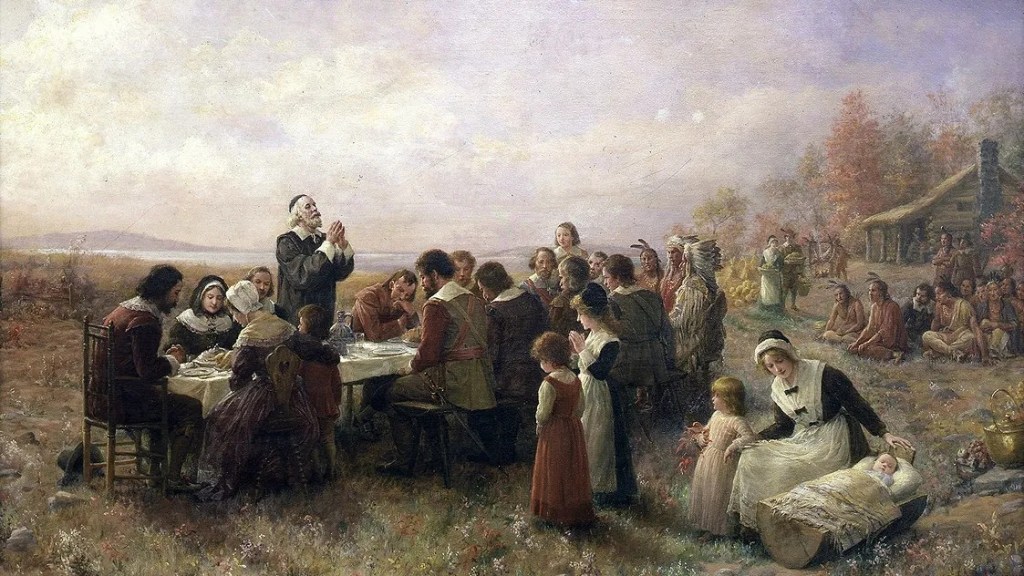
The problem with the stranger that shared the meal with Dr. Ironside is he had never seen God working in his life. Sometimes, only at the end of a life can God’s hand be discerned. This truth is reflected in the story of an Indian named Squanto who was a special instrument of God’s providence in American history.
Historical accounts of Squanto’s life vary, but historians believe that around 1608—more than a decade before the Pilgrims landed in the New World—a group of English traders, led by a Captain Hunt, sailed to what is today Plymouth, Massachusetts. When the trusting Wampanoag Indians came out to trade, Hunt took them prisoner, transported them to Spain, and sold them into slavery.
But God had an amazing plan for one of the captured Indians—a boy named Squanto.
Squanto was bought by a well-meaning Spanish monk, who treated him well and taught him the Christian faith. Squanto eventually made his way to England and worked in the stable of a man named John Slaney. Slaney sympathized with Squanto’s desire to return home, and he promised to put the Indian on the first vessel bound for America.
It was not until 1619—ten years after Squanto was first kidnapped—that a ship was found. Finally, after a decade of exile and heartbreak, Squanto was on his way home. But when he arrived in Massachusetts, more heartbreak awaited him. An epidemic had wiped out Squanto’s entire village.
We can only imagine what must have gone through Squanto’s mind. Why had God allowed him to return home, against all odds, only to find his loved ones dead?
A year later, the answer came. A shipload of English families arrived and settled on the very land once occupied by Squanto’s people. Squanto went to meet them, greeting the startled Pilgrims in English.
According to the diary of Pilgrim Governor William Bradford, Squanto
“became a special instrument sent of God for [our] good . . . He showed [us] how to plant [our] corn, where to take fish and to procure other commodities . . . and was also [our] pilot to bring [us] to unknown places for [our] profit, and never left [us] till he died.”
When Squanto lay dying of a fever, Bradford wrote that their Indian friend
“desir[ed] the Governor to pray for him, that he might go to the Englishmen’s God in heaven.” Squanto bequeathed his possessions to his English friends “as remembrances of his love.”
Who but God could so miraculously weave together the lives of a lonely Indian and a struggling band of Englishmen? It’s hard not to make comparisons with the biblical story of Joseph, who was also sold into slavery—and whom God likewise used as a special instrument for good.
Squanto’s life story is remarkable, and we ought to make sure our children and grandchildren learn about it. While you are enjoying turkey and pumpkin pie tomorrow, share with your kids the Indian side of the Thanksgiving story. Tell them about Squanto, the “special instrument sent of God”—who changed the course of American history. (Charles Colson, BreakPoint, November 25, 1998).
Tell them to be grateful.
Had the lepers known their own history of Israel better, perhaps they would have been more grateful to Christ. Had the lepers been more reflective and thoughtful, they would have cultivated an attitude of gratitude that would have brought them back to say “Thank you.”
Reflecting as to why only one cleansed leper return to thank Jesus, Charles L. Brown has the following reasons. One waited to see if the cure was real. One waited to see if it would last. One said he would see Jesus later. One decided that he had never had leprosy. One said he would have gotten well anyway. One gave the glory to the priests. One said, “O, well, Jesus didn’t really do anything.” One said, “Any rabbi could have done it.” One said, “I was already much improved.”
Now the question comes.
“What is our reason for not giving thanks for the many spiritual blessings we have received?”
Conversely, “What are our reasons for giving thanks?”
 The Collected Works of Stanford E. Murrell