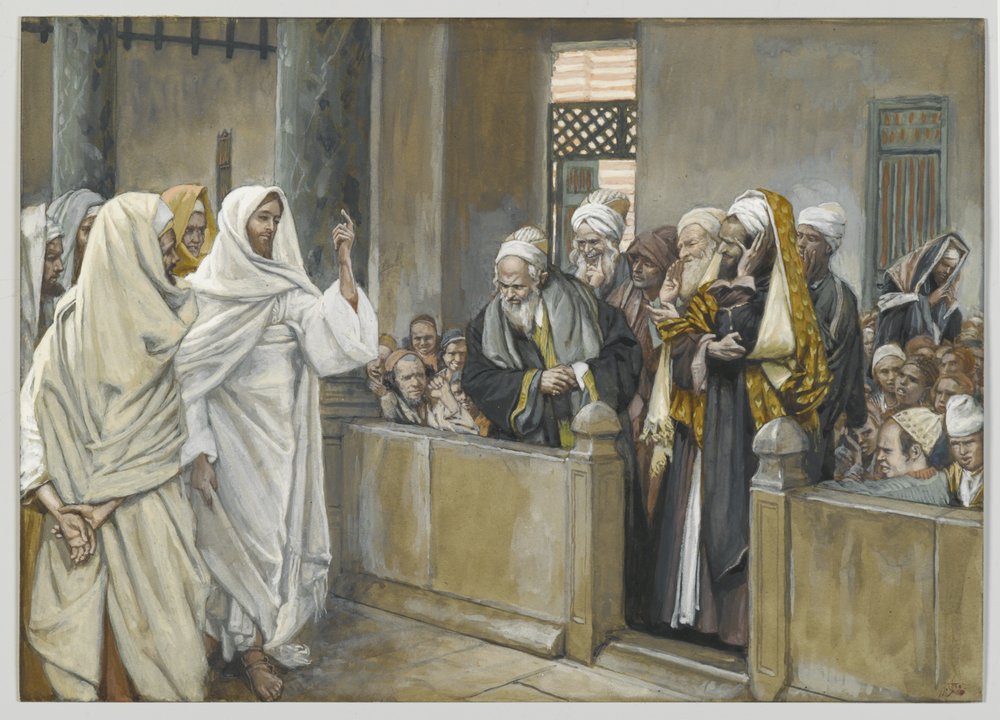
“And when he was come into the temple, the chief priests and the elders of the people came unto him as he was teaching, and said, By what authority doest thou these things? and who gave thee this authority? And Jesus answered and said unto them, I also will ask you one thing, which if ye tell me, I in like wise will tell you by what authority I do these things. The baptism of John, whence was it? from heaven, or of men? And they reasoned with themselves, saying, If we shall say, From heaven; he will say unto us, Why did ye not then believe him? But if we shall say, Of men; we fear the people; for all hold John as a prophet. And they answered Jesus, and said, We cannot tell. And he said unto them, Neither tell I you by what authority I do these things.” (Matt. 21:23-27)
Death continued to loom over the life of Jesus. The dim shadow of the Cross was becoming larger.
Jesus could see it clearly. Just a few more hours, and the Great Ordeal would begin in earnest.
Before the moment of His arrest, Jesus had so much He wanted to say and do. To that end, Jesus went into the Temple, and began to teach because more people than ever were listening to Him.
Some listened, because they saw His holy boldness, when He took a whip and drove the greedy merchants from His Father’s house.
Some people listened, because they believed He was the Messiah, the Son of the Living God.
Some people listened, because they wanted a confrontation to challenge Christ. The Bible identifies this latter group of people as the Chief Priests and Elders. Collectively, the Chief Priests and Elders had a tremendous knowledge of the Law of Moses, and that was commendable. Many people looked to the Chief Priests and Elders for guidance and justice. In the Court of Public Opinion, the verdict would be the Chief Priests and Elders were good men.
Certainly, these Religious Leaders saw themselves as responsible men. They saw themselves as the Defenders of the Faith, and they saw Jesus as someone to be challenged. With hatred in their hearts the Chief Priests and Elder sharpened their verbal weapons against Jesus. They had their reasons.
First, the Religious Leaders resented Jesus, because they believed that with His rising popularity, they would be diminished in importance. In this assessment, they were right. The shining sun always eclipses the lesser luminaries of the sky. Jesus was a brighter personality than they were. All would have been well if the Religious Leaders been like John the Baptist and cried out,
“He must increase, but I must decrease.”
This was something the Religious Leaders of Israel would never say.
Second, Jesus was hated because He had challenged what the Chief Priests and Elders were doing to the people. They were placing arbitrary religious duties that were burdensome to bare. The Religious Leaders had imposed so many rules and regulations, many individuals found no delight in the things of God.
Jesus wanted the spiritual leaders to stop putting excessive regulations on the people, and He wanted them to stop exploiting God’s people.
Jesus was a witness to the unjust financial transactions of the Religious Leaders.
Jesus wanted to make the captives free from religious legalism.
The Lord’s voice against spiritual tyranny caused a defining moment.
For those who heard Jesus speak, a decision had to be made. The choice was simple. Would the Religious Leaders repent of their hatred and attempts to hurt Jesus, or would they harden their hearts, and continue with their indefensible attitude against Him? In time, and by God’s grace, some of these Religious Leaders would eventually repent, such as Nicodemus.
Nicodemus was a ruler of the Jews, who visited Jesus one fateful night, and was born again (John 3:1-21). His heart had been disturbed by the teachings of Christ. His conscience had been smitten.
He wanted to be different. He wanted to know that he was going to heaven when he died. Nicodemus wanted to be forgiven for his sins, and he was.
Unfortunately, at this time, Nicodemus went to Christ alone. Other Chief Priests and Elders made the fateful decision to harden their hearts. Once that decision was reached, the Religious Leaders began to meet in secret in order to find a way to challenge Christ openly before the people. In private conversations, they shared their fears, hopes, and dreams, with one another, in order to justify what they would do next. Together, they agreed that Jesus should be discredited before the people.
The attempt to discredit Christ came when the Lord was in the Temple teaching. Interrupting Him, one of the Religious Leaders posed a question. The question was carefully crafted, to put Jesus on the defense.
“By what authority are you doing these things?” they asked.
In, and of itself, the question was a good one, and worthy of being answered, for two reasons.
First, many people in the Temple did not really know Christ. The source of His authority would be of important interest to them.
Second, it was a good question because a person must have the right authority to speak. Lack of legitimate authority to speak can cause lead to an abuse of power and position. Former Secretary of State, Alexander Haig, discovered this the hard way.
The date was March 30, 1980, when John Hinckley Jr. shot, and seriously wounded President Ronald Reagan. The President was rushed to the hospital for emergency surgery. The doctors discovered that a bullet was less than one inch away from penetrating his heart. As President Reagan was in the hospital incapacitated, Vice President George Bush was on a plane returning to the White House. For some reason, Secretary Alexander Haig felt it necessary to step up to the microphone, and tell the world,
“I am in charge here…”
While his motives were well meaning, he certainly did not have any right, or authority to say what he did. When there is no legitimate authority to do or say something, great harm can be done. The Religious Leaders were convinced that Jesus had no authority for what He was doing.
He was not a priest. He was not an Elder. He had not taken the Nazarite vow. He did not claim to be prophet. He was only a popular carpenter.
So, by what authority was Jesus cleansing the Temple, healing the sick, and teaching the Word of God.
The Chief Priests, and Elders, believed that Jesus had no right to do these things unless He explained where His power came from. Was His authority from Beelzebub, or God? The Religious Leaders believed they had legitimate authority. And, they were right.
They did have the authorization of the Law of Moses, which established the priesthood. They had tradition and social acceptance to appeal to. If the Temple needed cleansing, they should have been the ones to cleanse it. If someone needed disciplining, they should have been the ones to administer it. If laws needed to be reformed, they should have been the ones to reform them. By what right then, did Jesus have to do what He was doing?
By asking this question, the Religious Leaders were not only putting Jesus on the defense, but they were opening the windows of their soul. Jesus looked through that window, and saw what was going on in the hearts of these men.
What the Lord discerned, was that this was not a legitimate question. This was another verbal trap.
The Chief Priests, and the Elders, expected Jesus to wilt, and crumble before their precise, surgical question concerning authority. To their surprise, the Lord had a response for them.
“Well,” said Jesus. “If you want to talk about authority, and the right to speak, I will ask you a question about the same topic. If you answer me, I will answer you.”
Answering a question with a question is a good way to take control of a conversation. With His words, Jesus established the principle that fairness should be found in a conversation. It is within the heart of people to want to say things, but not be challenged for truth or accuracy. In all His conversations, the Lord insisted on fairness.
“I will answer you, if you will answer me. The baptism of John, whence was it? from heaven, or of men?” What a wonderful response this was. Suddenly, the Religious Leaders found themselves on the defense, and on the horns of a dilemma.
If they acknowledged the baptism of John was from heaven, they would be admitting they were not the ultimate authority in the land. There is another authority to be honored, the prophets of God. The Chief Priests and Elders never claimed to be prophets of God. There is more. If the Religious Leaders answered Jesus, they would be condemning themselves for they had ridiculed and rejected John as a madman of the desert. Why had they not received him? However, if the Religious Leaders say what they really believed, that John had no authority, they feared the multitude, for many believed John was a prophet. The fear was real for several reasons.
First, the Religious Leaders feared if they answered Jesus honestly, the good opinion they enjoyed with the people would be lost. This was a legitimate concern. “A good name is rather to be chosen than great riches” (Prov. 22:1).
Once a person’s reputation is tarnished, or discredited for whatever reason, it is hard to reclaim a good name, no matter how many years pass, and no matter how many changes are made. The Religious Leaders did not want to lose the good opinion they enjoyed with the people. They did not mind shaming Christ, as long as they could maintain societal honor themselves.
Second, the Religious Leaders feared financial loss, and that too is understandable. Whenever one’s livelihood is dependent upon the good will of others, it is natural to refrain from offending those who can immediately retaliate.
Third, the Religious Leaders feared physical violence. When religious people turn on one another, they do it not only with words and money, but often with physical vengeance. A large part of European history is the history of religious wars and holy crusades. Christians turned on Christians for many reasons including doctrinal disputes. In an act of cruel mockery, Presbyterians drowned Anabaptist over believer’s baptism saying, “If you want to be immersed, we will make it complete.”
There are historical accounts of Presbyterians cutting off ears, particularly during the 17th century in Scotland. This was part of a broader context of religious and political conflict, especially during the Covenanter movement, where Presbyterians resisted the imposition of Anglican practices.
Christians have verbally, and sometimes violently turned on Christians; and it still happens today.
Who has not heard the modern-day observation, “The church is the only hospital that shoots its wounded.”
As the Religious Leaders considered the Lord’s question, the Bible says they decided on a course of action. They would not reveal what they believed. They would issue a public statement designed to mislead what they really thought. After a brief consultation the Religious Leaders answered Jesus and said, “We do not know.”
But they did know what they believed. Sin had just made cowards of them all in this specific area. Sin had silenced them from speaking what they believed was the truth.
What should we think about these Religious Leaders? Where they right to answer Jesus the way they did?
It is instructive that Matthew makes no moral judgment at this point by way of condemnation.
He did not have to. Matthew simply tells what happened, and our minds naturally evaluate what has taken place. However, we can render a righteous judgment.
In passing judgment, it is possible to pity the Religious Leaders. They are so human. We want to take them aside, and make them see, there is a better way than to cover up the truth out of fear, and that is a change of heart. If we had the wisdom and ability, we would like for the Religious Leaders to see the superiority of Christ, reflected in His answer.
What a wise answer it was, for it exposed the essence of their hearts. Only One sent from God could counter an initial inquiry with another penetrating question. “Is not this the Christ?” If we had the power, we would want the Religious Leaders to perceive that in the act of rebuttal, Jesus was offering them an opportunity to reconsider all that they had said and thought before about John, and the message he preached—“Behold the Lamb of God who takes away the sins of the world!”
Christ is doing the same today. The Lord invites people to reconsider their beliefs and behavior. When Jesus becomes Lord of one’s life, there is a natural desire to right whatever is wrong, to heal the hurting, and comfort those who are sad. In these areas, and more, the Christian can help.
It is a simple fact that the children of Adam will act as Adam did. But if we are the children of God, then we must repent of our attitudes and actions, tell the truth, walk in the light, and fight against our dark impulses.
It would have been a life changing moment if the Religious Leaders would have fallen down at the feet of Jesus and called Him Lord. It would have been a wonderful ending to a sad situation. But the Religious Leaders did not repent. The fires of hatred fanned higher than ever in their hearts. They wanted revenge.
The Law was on their side, and they would use it to try to kill Love. And so they did. The Religious Leaders knew how to manipulate events so Jesus would speedily be arrested. Before the week was over, they will kill their perceived, Arch enemy. Such was the outcome of their defining moment.
It did not have to end that way. God’s grace is available for people to be different. It is possible for individuals to be like the others in the Temple that day. The common people heard Jesus gladly, and because their hearts were open to Him, the Lord healed them, the Lord sanctified them, and the Lord taught them. The common people too had a defining moment. They believed on the Lord Jesus Christ, and were saved.
There is one final observation.
Jesus did not try to force the Religious Leaders to tell the truth. The Lord knew their cover story of ignorance was transparent, but He let them have their way. He left them alone. Jesus did not say anything else. Perhaps there are times when we should do the same.
There are some people who should be left alone to believe what they want.
There are some people who will not believe the truth.
There are some people who will almost, but not altogether, be persuaded.
“Almost persuaded now to believe;
Almost persuaded Christ to receive;
Seems now some soul to say,‘Go, Spirit, go Thy way;
On Thee I’ll call.’”~Philip P. Bliss
In the hour of reconsidering, a person must ask, “Have I been fully persuaded to receive and live like Jesus?” It is a defining question. It is meant to be.
This is the teaching of the Lord.
 The Collected Works of Stanford E. Murrell