The Background Story
Two years after the death of Josiah, king of Judah in 608 BC, Nebuchadnezzar became king of Babylon. A warrior-king, Nebuchadnezzar set out to expand his empire by marching through Palestine to conquer Egypt.
The prophet Jeremiah had counseled Judah to submit to Babylon, but was considered a traitor for such a suggestion. Even when Jeremiah spoke in the name of the Lord, and wrote down what God said, the leadership did not listen (Jer. 25 – 28). The king of Judah threw his scroll into a fire (Jer. 36:4; 21-23). Not to be silenced, Jeremiah put a yoke around his neck to illustrate how Judah should humble herself before Nebuchadnezzar (Jer. 27:2-11).
The Babylonian Conquest of Israel: The First Invasion
In the end, Nebuchadnezzar invaded Judah, and took many citizens captive, including Daniel. The year was 605 BC. In addition to taking youth from the royal family, Nebuchadnezzar took priceless utensils from the Holy Temple (2 Kings 24:10; Daniel 1:1-2).
The Second Invasion
In 597 BC, King Nebuchadnezzar returned to Judah in the eighth year of his reign. During this excursion, both the Holy Temple, and the royal palace treasures were confiscated, and carried into exile, along with many leaders in society, and skilled artisans (2 Kings 24:18-19; Jer. 25:1-3).
The Third Invasion
It was at this point that the Lord told His prophet, Jeremiah, to instruct the king of Judah to form a coalition with Babylon, and not with Egypt. Jeremiah warned people not to listen to the false prophets who were pro-Egyptians (Jer. 27:1-15).
Because King Zedekiah of Judah did not listen to the Lord through Jeremiah, Nebuchadnezzar marched a third time against Judah in the 18th year of his reign, 587 BC. Nebuchadnezzar compelled Zedekiah to watch his sons being slaughtered, then he was blinded and taken to a prison in Babylon. The Sacred Temple was destroyed by fire, along with the royal palace, and many homes. Gold, silver, and bronze were taken from the Temple. The walls of Jerusalem were torn down. The only people left in Judah were the poorest of the poor to work the land (2 Kings 25:1-21).
The story of Daniel begins soon after the First Invasion of Judah by Nebuchadnezzar. Daniel, along with three friends, were taken captive to Babylon where they were renamed, and put to work in the royal palace. They would be challenged to honor the Lord, and not despair.
When Names are Changed
- Daniel “God is judge” = Belteshazzar “protect his life”
- Hananiah “Yah(weh) is gracious” = Shadrach “circuit of the sun”
- Mishael “who is what God is?” = Meshack “sowing” or “possession”
- Azariah “Yahweh has helped” = Abed-nego “servant of Nego” [the god of science and literature in Babylon]
The Book of Daniel is easily divided into two main sections. In chapters 1 – 6, the story is told of Daniel and the courage and conviction of his three friends. In chapters 7 – 12, the visions of Daniel are described.
Of particular interest for Bible scholars is the fact that Daniel chapter 1 is written in Hebrew, then, chapters 2 – 7 are written in Aramaic, and finally chapters 8 through 12 return to the Hebrew language. Aramaic is itself a Semitic language which was spoken widely in the ancient world beginning in the 6th century, and during the time of Christ. While the New Testament was written in Greek, there are a few Aramaic words or phrases to be found.
Aramaic Word / Meaning / New Testament Reference
- Talitha cum / “Little girl, get up!” / Mark 5:41
- Ephphatha / “Be opened!” / Mark 7:34
- Abba / “Father” / Mark 14:36
- Raca / “fool” / Matthew 5:22
- Rabbouni / “teacher” / John 20:16
- Eli Eli lema sabachthani / “My God, my God, why have you forsaken me?” / Matthew 27:46
- Hosanna / “O Lord, save us.” / Mark 11:9
- Maranatha / “Lord, come!” / 1 Corinthians 16:22
Perhaps the reason for this distinctness is to emphasize the information in chapters 2 through 7 through the lenses of chapter 1, and then chapters 8 through 12.
Faithful to the Torah: Daniel 1:1-20
Attention is focused on Daniel and his three friends, of whom it is said there was no physical blemish on them, and that they were intelligent (1:1-4). When the young men believed they were being asked to give up their Jewish heritage, and eat inappropriate foods, and drink wines from the table of King Nebuchadnezzar, there was cause for alarm. The prince of the eunuchs who had care of Daniel, Hananiah, Mishael, and Azariah was concerned that the king would think he was not doing his job well, if the privileged captives became sick or emaciated (1:5-17). A test was suggested by Daniel, which allowed him, and his friends, to be faithful to the Torah, and the prince of the eunuchs to be relieved. Within a short period of time, Daniel and his friends were found to be in good health, and excelling in matters of wisdom and understanding (1:18-21).
The King’s Dream: Daniel 2:1-49
In the second year of his reign, Nebuchadnezzar had a dream. The year was 604 BC. Only Daniel could understand the dream, or even tell the king what he had dreamed. It was an amazing feat which all the wise men and magicians of Babylon could not replicate.
Nebuchadnezzar saw in his dream a colossal image made of four metals: gold, silver, bronze, and iron. The metals were symbolic of succeeding empires beginning with Babylon (gold), the Medo-Persian Empire (silver), which would give way to the Greek Empire (bronze), which would then be conquered by the Romans (iron and clay).

“This image’s head was of fine gold, his breast and his arms of silver, his belly and his thighs of brass, 33 His legs of iron, his feet part of iron, and part of clay” (Daniel 2:32-33).
While the statue stood, a massive rock appeared to smash the feet of the image, representative of Rome, causing the statue to collapse, while the rock, representing Jesus Christ, grew larger, into a great mountain, and filled the whole earth (Daniel 2:35).
A Prophesy That Has Been, is Being Fulfilled
From the vantage point of time, in the year of our Lord, 2021, it can be categorically stated that Daniel was a true prophet of God. All that Daniel said did come to pass, and is coming to pass in this very hour. It is exciting to be part of an ancient prophesy being fulfilled.
History conclusively confirms that the Babylonian Empire fell to the Persian Empire, which was conquered by Alexander the Great of Greece. The Greek Empire gave way to the Roman Empire.
Then came Jesus, and smashed the Roman Empire. Daniel said it would happen, John, in the Revelation saw the conquering Christ riding forth, and history confirms that what Daniel said would happen, and John saw would happen, did happen.
“After the conversion of Constantine, he allowed for the freedom of the Christian church for the first time in its existence. The Christians could crawl out of the catacombs, and actually build buildings, where they could publicly worship Jesus. It was a glorious time for the church after 300 years of persecution.
But a few decades after Emperor Constantine’s death, there arose a ruler from his own family who tried to turn his back on Christianity, and make the Roman empire solidly pagan. His name was Julian the Apostate.
By rejecting Jesus, Julian the Apostate made a wreck of his life, but thankfully his reign was short-lived. It is said that he was wounded in battle, and as he lay dying, sinking into the sand, he picked up a handful of sand filled with his own blood, and threw it into the sky and said, “Thou hast conquered, Oh Thou Galilean” and thus, Julian’s work perished with him. Attempting to overthrow the Christian religion by writing a book against it, he inadvertently ended up confirming most of its basic historic tenants.
Our faith is built upon a solid rock, that neither pagan, nor demon, can overthrow. Yes, there have been small clouds that have come and obscured the sun for a moment. “Julian was such a cloud,” said Athanasius, the great defender of the faith. But the cloud, as he said, “…it is a little cloud, it passes away.” The sun, however, continues to shine in its brightness in the sky, and so it is with Christ” (Dr. D. James Kennedy).
Before Jesus ascended into heaven, He declared His victory, and sovereignty, having all powers in the universe.
“And Jesus came and spake unto them, saying, All power is given unto me in heaven and in earth. 19 Go ye therefore, and teach all nations, baptizing them in the name of the Father, and of the Son, and of the Holy Ghost: 20 Teaching them to observe all things whatsoever I have commanded you: and, lo, I am with you always, even unto the end of the world. Amen” (Matt. 28:18-20).
Church, do not miss out on the message. Our God reigns. The strategic victory was won when Jesus rose from the dead. Today, the ascended Christ rules the nations with a rod of iron. This is not a future state to come, but a present reality. Jesus is now, today, in this very hour, KING OF KINGS AND LORD OF LORDS. But, do you believe this? If you do then sing, Church of the living Lord. Sing!
Crown Him with many crowns,
The Lamb upon His throne.
Hark! How the heav’nly anthem drowns
All music but its own!Awake, my soul, and sing
Of Him who died for thee;
And hail Him as thy matchless king
Through all eternity!Crown Him the virgin’s son!
The God incarnate born,
Whose arm those crimson trophies won
Which now His brow adorns!Fruit of the mystic rose,
As of that rose the stem;
The root whence mercy ever flows,
The Babe of Bethlehem!Crown Him the Lord of love!
Behold His hands and side,
Those wounds, yet visible above,
In beauty glorified:No angel in the sky
Can fully bear that sight,
But downward bends his burning eye
At mysteries so bright!Crown Him the Lord of peace!
Whose power a scepter sways
From pole to pole, that wars may cease,
Absorbed in prayer and praise:His reign shall know no end,
And round His pier-ced feet
Fair flowers of paradise extend
Their fragrance ever sweet.Crown Him the Lord of years,
The Potentate of time,
Creator of the rolling spheres,
Ineffably sublime.All hail, Redeemer, hail!
For Thou has died for me;
Thy praise and glory shall not fail
Throughout eternity.Crown Him the Lord of Heav’n,
Enthroned in worlds above,
Crown Him the king to whom is giv’n
The wondrous name of Love.Crown Him with many crowns,
As thrones before Him fall;
Crown Him, ye kings, with many crowns,
For He is king of all.Crown Him the Son of God,
Before the worlds began,
And ye who tread where He hath trod,
Crown Him the Son of Man;Who every grief hath known
That wrings the human breast,
And takes and bears them for His own,
That all in Him may rest.Crown Him the Lord of life,
Who triumphed o’er the grave,
And rose victorious in the strife
For those He came to save.His glories now we sing,
Who died, and rose on high,
Who died eternal life to bring,
And lives that death may die.Crown Him the Lord of lords,
Who over all doth reign,
Who once on earth, the incarnate Word,
For ransomed sinners slain,Now lives in realms of light,
Where saints with angels sing
Their songs before Him day and night,
Their God, Redeemer, king.”—George J. Elvey
They Did Not Bend, Bow, or Burn: Daniel 3:1-30
Perhaps, inspired by his dream, and the interpretation of it by Daniel, Nebuchadrezzar made a colossal image of gold that stood 90 feet tall, and 9 feet wide. With music playing, individuals were commanded to bow down before the image which Nebuchadnezzar had made, or suffer the penalty of death in a burning fiery furnace (3:15). When Shadrach, Meshach, and Abed-nego heard what the king had said, the Lord gave them grace to respond. “Shadrach, Meshach, and Abed–nego answered, and said to the king, O Nebuchadnezzar, we are not careful to answer thee in this matter. 17 If it be so, our God whom we serve is able to deliver us from the burning fiery furnace, and he will deliver us out of thine hand, O king. 18 But if not, be it known unto thee, O king, that we will not serve thy gods, nor worship the golden image which thou hast set up” (Daniel 3:16-18). These three men of God did not bow, they did not bend, and, in the providence of God, they did not burn, though the king tried to burn them alive (3:19-30). The Lord honored those who honored Him.
Some Dreams do Come True: Daniel 4:1—5:31
In chapters 4 and 5, the pride of Nebuchadnezzar, and the pride of Belshazzar are set forth in order to demonstrate important gospel truths that should comfort the people of God in every generation.
First Gospel Truth
It is God who establishes the kings, and kingdoms, of this world. It is the Lord who raises up earthly potentates, and disposes of them as He pleases.
Speaking to King Nebuchadnezzar, Daniel had said to him, “Blessed be the name of God for ever and ever: for wisdom and might are his: 21 And he changeth the times and the seasons: he removeth kings, and setteth up kings: he giveth wisdom unto the wise, and knowledge to them that know understanding: 22 He revealeth the deep and secret things: he knoweth what is in the darkness, and the light dwelleth with him” (Daniel 2:20-22).
When Nebuchadnezzar forgot that truth, and exalted himself with pride, the Lord afflicted the king with the mental disorder called “boanthropy”, which caused a person to act like an animal.

For seven long and painful years Nebuchadnezzar acted, and looked like a wild beast, and the dream came true, as prophesy was fulfilled (Daniel 4:1-33). In matchless grace, God restored sanity to king Nebuchadnezzar, who learned to praise and worship the one true God (Daniel 4:34-37).
Second Gospel Truth
It is God who appoints the hour of our birth, and the day of our death. On October 7, 563 BC, Nebuchadnezzar, the mighty king of Babylon died. In 539 BC, one of his “sons”, or descendants, by the name of Belshazzar, reigned as king. Unfortunately, Belshazzar was a king given to sensual pleasure, and invited others to take part in his life of debauchery (Daniel 5:1-2). It was in the midst of a palace banquet, where sacred stolen vessels of gold and silver were used, taken from the Holy Temple in Jerusalem, that the fingers of a hand began to write these words on the wall of the banquet hall:

“MENE, MENE, TEKEL, UPHARSIN”
This is the Divine Interpretation of these Words
Daniel 5:25-28
MENE – God hath numbered thy kingdom, and finished it.
TEKEL – Thou art weighted in the balances, and art found wanting.
PERES – Thy kingdom is divided, and given to the Medes and Persians
Though Belshazzar initially trembled at the hand writing on the wall, once the meaning of the message was explained to him by Daniel, he did something unusual. He honored Daniel for speaking the truth. “Then commanded Belshazzar, and they clothed Daniel with scarlet, and put a chain of gold about his neck, and made a proclamation concerning him, that he should be the third ruler in the kingdom. 30 In that night was Belshazzar the king of the Chaldeans slain” (Daniel 5:29-31). Why was Belshazzar killed that night? Because it is the Lord who determines the day of our death.
On October 12, 539 BC, Belshazzar died when Babylon fell to the Persian general Gobryas, “And Darius the Median took the kingdom” (Daniel 5:31). Darius the Mede did not take the kingdom immediately. That would happen in 522 BC when he was 32 years of age, and yet, from a divine perspective, it was done, for history is ultimately God’s narrative. What the Lord decrees shall come to pass. What God wills to happen, will indeed happen. The Lord’s hand is stretched out, and who shall turn it back? (Isaiah 14:27). Nebuchadnezzar and his grandson Belshazzar were proud men. Both were commanded to repent. Both failed to humble themselves before God. Both came under judgment at the hand of the Lord God Almighty. And, in the case of Belshazzar, the false god of Babylon could not “belshazzar” (lit. “Bel, protect the king”), and that too is an important lesson to remember.
Daniel in the Lion’s Den: Daniel 6:1-28
The Darius of Daniel 6 is known to history as Darius the Great. He was born in 550 BC and died in October 486 BC at about the age of 64. Among his many major accomplishments was the wise way he organized the Medo-Persian empire by dividing it into provinces, and placing satraps to govern it. A satrap served as viceroy to the king, but with considerable autonomy. The word came to speak of a tyrant, and ostentatious splendor.
Among the most capable of the rulers under Darius, was Daniel, which provoked envy and jealousy among rival political figures. In an unholy meeting, the enemies of Daniel thought they had found a way to either discredit him, or better yet, put him to death (6:7-18).
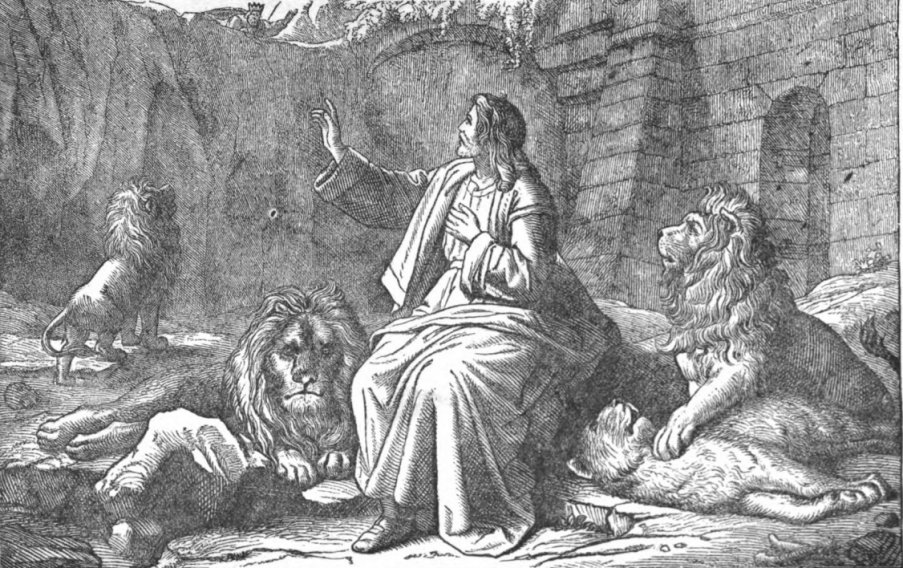
Though he was thrown into a lion’s den for his faithfulness to God, Daniel was not harmed, and the king was glad (6:23-27). Daniel went on to be promoted, and to prosper in the reign of Darius, and then, in the reign of Cyrus the Persian, who came to power in 546 BC (d. Dec. 4, 531 BC).

Daniel’s First Vision: Daniel 7:1-2
Because the narrative of Daniel is not consistently chronological, it must be remembered that Belshazzar was the grandson of King Nebuchadnezzar. It was during the reign of Belshazzar that Daniel too had a dream, which he wrote down when he awoke, and told others what he had seen (7:1). Perhaps those he told were his old friends, Shadrack, Meshack, and Abed-nego.

Daniel’s First Vision
First Beast / Daniel 7:3-4 / Babylon: A lion with the plucked wings of an eagle, the feet of a man, and a man’s heart.
Second Beast / Daniel 7:5 / Medes-Persians: A bear, raised on one side, with three ribs between its teeth was commanded to arise and devour flesh.
Third Beast / Daniel 7:6 / Greece: A leopard, with four wings, and four heads. Dominion was given to it.
Fourth Beast / Daniel 7:7-8 / Romans: A strong dreadful beast with iron teeth with ten horns. Out of the horns came another, a Little Horn who destroyed three of the original ten horns. In the Little Horn their eyes like the eyes of man, and an eloquent mouth.
The Ancient of Days: Daniel 7:9-14
As Daniel witnessed his own vision of the rise and fall of four great empires, they all were cast down to exalt the Ancient of Days whose garment was white as snow, and the hair of his head like pure wool: his throne was like the fiery flame, and his wheels as burning fire. This Ancient of Days is none other than the glorified Lord Jesus Christ.
Centuries later, the apostle John would write about this Ancient of Days in reference to Jesus.
“I was in the Spirit on the Lord’s Day, and heard behind me a great voice, as of a trumpet…12 And I turned to see the voice that spake with me. And being turned, I saw seven golden candlesticks; 13 And in the midst of the seven candlesticks one like unto the Son of man, clothed with a garment down to the foot, and girt about the paps with a golden girdle. 14 His head and his hairs were white like wool, as white as snow; and his eyes were as a flame of fire; 15 And his feet like unto fine brass, as if they burned in a furnace; and his voice as the sound of many waters. 16 And he had in his right hand seven stars: and out of his mouth went a sharp two-edged sword: and his countenance was as the sun shineth in his strength. 17 And when I saw him, I fell at his feet as dead. And he laid his right hand upon me, saying unto me, Fear not; I am the first and the last: 18 I am he that liveth, and was dead; and, behold, I am alive for evermore, Amen; and have the keys of hell and of death” (Rev. 1:10, 12-18).
Church of the Living Lord, do not miss the meaning of Daniel’s vision, or the Revelation of St. John. The resurrected Christ is the exalted ascended Ancient of Days, before whom all the kingdoms of this world are under His feet, as He sits by the right hand of God (Acts 2:33). While Jesus is Lord of all, He does not rule in an expected manner, for there is pain and suffering which He allows for His own good purposes. Even those who believe in a future Millennial reign of Christ on earth from Jerusalem concede there will be sorrow, death, and rebellion (Rev. 20:7-8).
Nevertheless, evil shall not always be present, for history is moving towards a great conclusion. One day there will be a new heaven and a new earth wherein dwells righteousness. Until then, God’s people are to be patient and never lose hope, or faith, that, our God reigns now, in this moment in time, and forevermore. Of His kingdom there shall be no end (Luke 1:33).
“How lovely on the mountains
Are the feet of him
Who brings good news, good news
Announcing peace, proclaiming
News of happiness.Our God reigns;
our God reigns!
Our God reigns!
Our God reigns!
Our God reigns!
Our God reigns!He had no stately form;
He had no majesty,
That we should be
drawn to Him.
He was despised,
and we took no account of Him,
Yet now He reigns
With the Most High.Our God reigns!
Our God reigns!
Our God reigns!
Our God reigns!Out of the tomb He came
With grace and majesty;
He is alive, He is alive.
God loves us so see here His hands,
His feet, His side.
Yes, we know
He is alive.”—Leonard E. Smith
Of particular interest to those who read John’s Revelation, is that the Terrible Beast which Daniel saw in his vision was a conquered Beast. It would not be long before this fact was realized, for what John saw was to shortly, or certainly, come to pass.
A Divine Interpretation: Daniel 7:15-28
Ironically, though Daniel could recall and interpret the dreams of others, he needed someone to explain his own dream-vision to him. While Daniel understood the angelic explanation, his heart was still troubled as he meditated in his heart on the future.

Daniel’s Second Vision: Daniel 8:1-2
Around the year 550 BC, while in a royal palace at Shushan, in the province of Elam, Daniel had a second vision concerning the future of two empires, the Medo-Persian Empire, and Greek Empire.


Observe
“The predominant distinction between goats and rams lies in the thickness of the coat, and the shape of horns. While sheep are covered in woolly fur, goats have a relatively thinner coat. Rams have iconic long, curved horns, and split hooves, whereas goats have slender and straight horns” (Animal Hype, on the web)
Daniel’s Second Vision
A Ram with two unequal horns / Daniel 8:3-4 / Medo-Persia
A He-Goat with a notable horn between its eyes / Daniel 8:5-12 / Greece

Out of one of the horns of the “goat”, representing Greece, comes a Little Horn, which became great in power and full of pride. Daniels saw this Little Horn would attack the Holy City and take away the daily sacrifices for 2, 300 days (Daniel 8:8-14). However, he too would be destroyed by God who would exalt His elect people.
An Angel Named Gabriel: Daniel 8:15-18
Once the vision was over, Daniel sought for understanding. Suddenly, there stood before him a personage in the appearance of a man. Then a voice came from between the banks of the River Ulai saying, “Gabriel, make Daniel to understand the vision.”


An Angelic Explanation: Daniel 8:19-26
What Gabriel explained to Daniel, is that the ram with two horns is the king of Media and Persia.
The He goat, or rough goat” is the king of Grecia (Greece). The great horn between the eyes of the He goat, is the first king of that particular dynasty, who would do many terrible deeds against the holy people. The 2, 300 days (8:14) refers to “the evening and the morning” (8:26), or 6 years, 6 months, and 18 days (Daniel 8:19-25).
The 2,300 Days in Daniel 8:14
- Are the 2, 300 days literal days?
- Are the 2, 300 days reprehensive days of years of human history?
- Are the 2, 300 days to be reduced to 1, 150 twenty-four-hour days based on Daniel 8:26?
Observe
There is no agreement among Bible scholars on the best way to understand the 2,300 days mentioned by Daniel the prophet.
The Baptist lay minister William Miller (Feb. 15, 1782 – Dec. 20, 1849) insisted that the year for day motif was the correct understanding of the 2,300 days, and convinced many people of his day that the 2, 300 days would end sometime between March 21, 1843 and March 21, 1844. “My principles in brief, are, that Jesus Christ will come again to this earth, cleanse, purify, and take possession of the same, with all the saints, sometime between March 21, 1843, and March 21, 1844.”
Dispensational guru C. I Scofield, in his Bible commentary on Daniel 8 states, “This prediction was fulfilled during the bitter persecution under Antiochus Epiphanies IV and in the cleansing of the sanctuary in Jerusalem.” Daniel is referring to a time-period that reaches from 168 B.C. to 162 B.C., historically known as the Maccabean revolt under Judas Maccabees.”
The problem with Scofield’s understanding is that, “according to 1 Maccabees 4:52-54, the rebuilt temple was purified, reconsecrated, and services resumed three years later on December 14, 164 B.C. II Maccabees 10:1-8 also confirms that temple services resumed at this time. In other words, the length of time between the purification of the rebuilt temple by Judas Maccabee, and the defilement by Antiochus is not even close to 2,300 days. This point alone should render Scofield’s view incorrect” (The 2300 Days of Daniel 8:14, Larry W. Wilson).
It is always best to be silent when the Scriptures are silent.
Astonishment without Understanding: Daniel 8:27
With the vision explained, but not fully understood, Daniel fainted, and was sick for several days. After recovering from his vision, the man of God went back to work, and did the king’s business, still wondering what the vision meant (Dan. 8:27).
We Are Going Home: Daniel 9:1-23
If Daniel did not understand his own vision, even when explained by the angel Gabriel, he did understand what another prophet had written. In the year 538 BC, while reading the scroll of Jeremiah, God the Holy Spirit illuminated the understanding of Daniel, so that we realized, “We are going home!” It was a, “Eureka!” moment for the man of God. He recorded the moment saying, “In the first year of his reign I Daniel understood by books the number of the years, whereof the word of the Lord came to Jeremiah the prophet, that he would accomplish seventy years in the desolations of Jerusalem.” It is a wonderful moment when a person can read God’s Word, and say, “I understand!”
“O what a wonderful, wonderful
day, day I will never forget;
After I’d wandered in darkness
away, Jesus my Savior I met.
O what a tender, compassionate
friend, He met the need of my heart;
Shadows dispelling, with
joy I am telling, He made
all the darkness depart.Heaven came down and glory
filled my soul,
When at the cross the Savior
made me whole;
My sins were washed away and
my night was turned to day,
Heaven came down and glory
filled my soul!Born of the Spirit with life from
above into God’s family divine,
Justified fully thru Calvary’s
love, O what a standing is mine!
And the transaction so quickly was
made, when as a sinner I came,
Took of the offer, of grace
He did proffer, He saved
me, O praise His dear name!
Now I’ve a hope that will surely
endure after the passing of time;
I have a future in heaven for sure
there in those mansions sublime.
And it’s because of that wonderful
day, when at the cross I believed;
Riches eternal and blessings supernal,
from His precious hand I received.Heaven came down and glory
filled my soul,
When at the cross the Savior
made me whole;
My sins were washed away and
my night was turned to day,
Heaven came down and glory
filled my soul!”
While Daniel contemplated the idea that the desolation of Jerusalem would come to an end after seventy years, he determined in his heart to pray, confess personal and national sins, and seek the face of God for more understanding. Daniel wanted to be prepared to go home. He wanted the blessing of God. He wanted the face of the Lord to shine once more on the Holy City.
Observe
When the angel Gabriel came to Daniel the second time and informed him of more things to come, the year was 538 BC. Jerusalem had fallen to Nebuchadnezzar in 586 BC. This meant there was still twenty-two more years of exile in Babylon before the evil ended, which, “under the whole heaven had not been done as had been done upon Jerusalem” (9:12).
Twenty-two more years would be a very long time for people in captivity. Twenty-two more years would be a long time for the Holy Temple to remain desolate (Heb. “shamem [shaw-mame’; ruined]).
The Greatest Prophesy Ever Given: Daniel 9:24-27
In answer to his prayer, the angel Gabriel informed Daniel that the rebellion of Israel has continued, despite the Fall of Jerusalem forty-eight years earlier. Because of this, the exile of the people and the oppression or desolation of Israel will continue seven times longer than what Jeremiah had anticipated (9:24). In other words, God determined to punish His people for 490 additional years. Certain events would be accomplished within distinct periods.
Three Distinct Periods Totaling 490 Years
- First Period / Seven weeks / 49 years
- Second Period / Sixty-two weeks / 434 years
- Third Period / One week / 7 years
Daniel’s River Vision: Daniel 10:1—12:13
Daniel was disturbed by what he had been told. For two years the information conveyed by the angel Gabriel was on his heart. Then, by the grace of God, more spiritual insight came to him in the third year of the reign of Cyrus, king of Persia (10:1). The year was 536 BC. On the 24th day in the month of Nissan (March / April), as Daniel stood by the Hiddekel River, a vision was given to him of a man clothed in linen, and girded with gold. Those with Daniel did not see what he saw, but they knew something spectacular was happening, and they were afraid (10:7).
A Royal Battle: The King of the South vs. The King of the North
In this final vision, Daniel was told once more about the Persian Empire, and then the Greek Empire of Alexander the Great, followed by various kings, with special attention given to the King of the North who was destined to invade Jerusalem, set up an idol in the Holy Temple, and exalt himself against God, only to be destroyed.
Observe
Once more, trying to understand the final vision is challenging. There are Bible scholars who associate the King of the North with the behavior of the Syrian king, Antiochus in the 160s BC, for he killed many Jews in Jerusalem in his mad quest for power, and, like others, set up idols in the Temple in the Holy City. Other Bible scholars associate the King of the North with the Roman Empire and their destruction of the Temple in AD 70. Still other students of the Bible anticipate a time in the future when these events will be fulfilled. It may not really matter, for the message of Daniel gives hope to all of God’s people, in every generation, that OUR God reigns!
 The Collected Works of Stanford E. Murrell