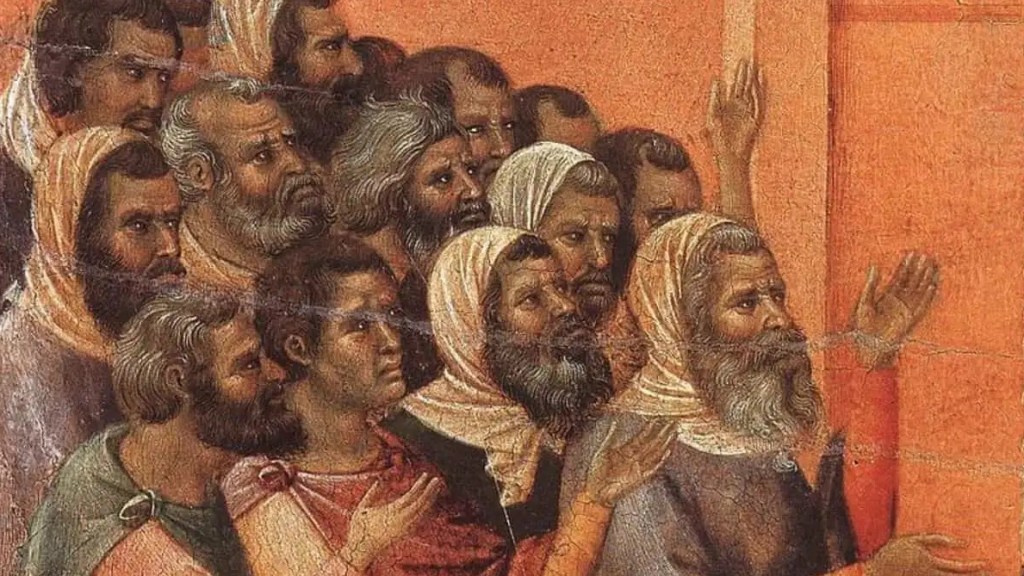
“Then came together unto him the Pharisees, and certain of the scribes, which came from Jerusalem. And when they saw some of his disciples eat bread with defiled, that is to say, with unwashen, hands, they found fault. For the Pharisees, and all the Jews, except they wash their hands oft, eat not, holding the tradition of the elders. And when they come from the market, except they wash, they eat not. And many other things there be, which they have received to hold, as the washing of cups, and pots, brasen vessels, and of tables. Then the Pharisees and scribes asked him, Why walk not thy disciples according to the tradition of the elders, but eat bread with unwashen hands?
He answered and said unto them, Well hath Esaias prophesied of you hypocrites, as it is written, This people honoureth me with their lips, but their heart is far from me. Howbeit in vain do they worship me, teaching for doctrines the commandments of men. For laying aside the commandment of God, ye hold the tradition of men, as the washing of pots and cups: and many other such like things ye do.
And he said unto them, Full well ye reject the commandment of God, that ye may keep your own tradition. For Moses said, Honour thy father and thy mother; and, Whoso curseth father or mother, let him die the death: But ye say, If a man shall say to his father or mother, It is Corban, that is to say, a gift, by whatsoever thou mightest be profited by me; he shall be free. And ye suffer him no more to do ought for his father or his mother; Making the word of God of none effect through your tradition, which ye have delivered: and many such like things do ye.” (Mark 7:1-13)
“One great design of Christ’s coming was to set aside the ceremonial law which God made and put an end to it,” said Matthew Henry. Though the ceremonial Law was part of that which was holy, just, and good (Rom. 7:12), it was never designed to last. The ceremonial law was established to present the gospel to people in a pictorial form.
To complicate matters, over the centuries, the traditions of the Elders had been added to the numerous ceremonial regulations (Mark 7:3). Apparently, the Pharisees were upset when word was received that neither Christ nor His disciples were honoring the traditions of the rabbis. Violation of social norms became a very emotional topic for the religious leaders of the land of Palestine.
Of particular concern to the Pharisees was the fact that the disciples did not wash their hands as often as the Pharisees thought they should. The Pharisees washed often.
Washing was practiced before eating.
Washing was practiced when coming back from the market.
Washing was practiced after visiting the halls of justice.
Washing was practiced before prayer.
While there is much practical and medical wisdom in washing often, there is a problem when the traditions are placed as divine mandates apart from revelation. In the Law of Moses there were many commandments regarding the washing of temple vessels and of the body, to these legitimate laws the Pharisees added and enforced the observance of their own rules and regulations. In this manner they over reached in religious zeal. They added to the Word of the Lord that which God did not speak while placing unnecessary burdens and guilt upon individuals.
Because Christ did not come to support such bad behavior He refused to observe the rituals of an unrighteous religion, as did His disciples. But there was a price to pay for such neglect and that price was public censure. One day a group of Pharisees from Jerusalem traveled 100 miles to find Jesus and ask what they regarded as a well thought out question. “Then the Pharisees and scribes asked him, Why walk not thy disciples according to the tradition of the elders, but eat bread with unwashen hands?” (Mark 7:5).
Regarding this question notice that the Pharisees were not seeking a legitimate answer for they were not making an earnest inquiry. The Pharisees came to accuse and to condemn, not to learn. They would make their charges in private or in public, it did not matter. Of most concern was that Jesus and His disciples be discredited in the public’s mind.
As a result of their determined hostility to hurt Christ their question—conceived in unholy passion—missed the mark of God’s holy will, and brought forth spiritual death (cf. Jas. :15) reflected in the immediate divine wrath that was unleashed. No one expected the sudden explosion of anger from the lips of Christ. Suddenly the gentle and kind Lamb of God that taketh away the sin of the world turned into the Lion of the Tribe of Judah and roared. Christ spoke directly to the Pharisees and then He spoke to the people. No one ever forgot what Jesus said that day.
Quoting Isaiah, the prophet Jesus applied words of the Old Testament to the present situation. In so doing, Christ exposed the Pharisees as religious hypocrites for as it is written, “This people honoreth me with their lips but their heart is far from me” (Isa. 29:13).
Having set forth the charge of a guilty heart against the Pharisees the Lord cites supporting evidence. “Howbeit in vain do they worship me, teaching for doctrines the commandments of men, “For laying aside the commandment of God, ye hold the tradition of men, as the washing of pots and cups: and many other such like things ye do” (Mark 7:7, 8).
This was no silly charge the Lord was leveling against the Pharisees. Jesus understood what was at stake. The integrity of the Law was being violated as well as the principle of divine illumination, not to mention ultimate sovereignty. Either men will live by the Law of God, or they will not. Either the Law of God is honored, without addition or correction, or it is set aside. But if the Law of God is set aside by the traditions of men, then God ceases to be God and the Word ceases to be of any consequence. Who needs divine revelation? Men will save themselves. Men will establish their own righteousness.
Lest the Pharisees cease to comprehend the seriousness of their sinful mindset and resulting conduct, the Lord gives a second illustration of an unrighteous religion.
And he said unto them, Full well ye reject the commandment of God, that ye may keep your own tradition. For Moses said, Honour thy father and thy mother; and, Whoso curseth father or mother, let him die the death: But ye say, If a man shall say to his father or mother, It is Corban, that is to say, a gift, by whatsoever thou mightest be profited by me; he shall be free. And ye suffer him no more to do ought for his father or his mother; Making the word of God of none effect through your tradition, which ye have delivered: and many such like things do ye” (Mark 7:9-13).
In simple language the Pharisees had found a way to circumvent the commandment which says that children are to honor their parents. One way to honor parents is to provide for them in time of genuine need. But the Pharisees, interested in getting more money for the Temple and in pleasing the people for political reasons found a clever way to circumvent both the letter and the intent of the Law of God. People were instructed to say that their money was Corban or dedicated to the temple. By targeting money for Temple activity, the financial resources could be kept without obligation to given anything in support of parents. All of this was too much for Christ and now the opportunity was present to issue a series of stern reprimands to the Pharisees.
First, the Lord took the Pharisees to task for not honoring the true basis of authority in life, the Word of God. Christ quoted the prophet Isaiah in contrast to the religious leaders who had no higher authority then the tradition of the Rabbis.
Second, the Lord rebuked the Pharisees as hypocrites for they pretended to honor God when in reality they had no intention of trying to please the Father from the heart. As a result their religious practices became all the more repulsive in the sight of heaven and other destructive in the sight of men. It is the nature of sin to destroy others as well as self.
In all of this a deep dark secret is learned. It is possible for the heart to be religious in public and unrighteous in private. The observation would not be incorrect that most people have a dual personality. There is the public persona and there is the private practice. Those who know others the best and love them the most do not tell all that is known, and so in a world of secrecy much sin is allowed to survive. The challenge for every professing believer is to have a consistent and integrated personality between the rhetoric of the lips and the reality of life in order for behavior to be consistent with the claims of the Christian life.
Third, the Lord rebuked the Pharisees for substituting symbolism over substance in spiritual matters. The symbolism of ritual washing was provided for in the Law of Moses as per Hebrews 9:10. But the ceremonial cleansing acts of the Law were designed to signify, as Matthew Henry notes, “that inward purification of the heart, from world lusts which God requires as absolutely necessary to our communion with Him.” Setting aside the spiritual dimension of religion the Pharisees added to the legal ceremonies and encouraged symbolism over substance.
Fourth, the Lord Jesus rebuked the Pharisees for rejecting the commandments of God. Jesus said that there was a conscious mental and moral decision by the Pharisees to dismiss God’s rule of Law in the life.
To say such a thing plainly is shocking and yet it still happens frequently in the lives of countless religious people. Young people make deliberate decisions to reject the moral rule of God in their lives by acts of rebellion against authority, and adults do as well. The process for each in the soul is the same. In adults, the thinking may be a little more sophisticated and cleverer but the end result is a rejection of the rule of God in the life.
God’s Word is doubted.
God’s essential goodness is questioned.
God’s fairness in placing any prohibitions on the soul is resented.
God’s just rendering of justice is denied.
By this mental process true truth is suppressed, the voice of conscience is silenced, the commandments of God are rejected, and the moment of sin takes place. Because it is so easy to have an unrighteous religion, we would do well to consider all that is being taught in this passage and commit ourselves afresh, by the grace of the Living God to the following.
Let us learn not only the Letter of the Law but also the spirit of the same.
Let us make a conscious decision NOT to reject the commandments of God.
Let us pay more attention to the spiritual side of salvation.
Let us be careful not to pray, “Lord, I thank thee I am not like the Pharisees.”
By way of Practical Application consider the following thoughts.
The Pharisees were willing to travel 100 miles to engage in a religious quarrel with Christ (cf. Eph. 4:15; Col. 4:6).
Religious activity does not translate into personal righteousness. We are to be zealous for the work of God, like Martha (Luke 10:40). But we are also to choose the best in life and sometimes the best course of action is to engage in less religious activity and more fellowship with the Father, the Son, and the Holy Spirit (cf. Luke 10:42).
The sins, which shock society, are not always the same sins which the Father and the Son find most abhorrent. In Proverbs 6:16-19 the seven sins that God hates the most are listed. In the Gospels, the sins which Christ challenged the most are the sins of an unrighteous religion.
A veil of authority can cover a corrupt heart. The Pharisees pretended to be zealous for the spiritual well being of the people. In reality they had a zeal for their own power and authority. They had a zeal for their own interest and pre-eminence.
There is a fine line between legalism and personal standards. A spirit of sensitivity is sometimes the only defense between some sin and spirituality.
Self-righteousness only produces more and more legalism. To the washing of the hands was added the handling of common vessels.
Those who define the terms in a conversation guide the discussion. It was the Pharisees who accused the disciples of not walking according to the tradition of the elders. The language that was used to make the accusation was subtle and therefore all the more powerful because of its implications. By the non-twisting of language, the Christian will stand in contrast to the world.
Insults usually follow unjust condemnation. The Pharisees accused the disciples of being rebellious and therefore divisive—and yet it was the Pharisees who were in error.
The conclusion is that there is a religion that is unrighteous. An unrighteous religion can be identified by the commandments of God being rejected, excessive legalism, a spirit of hostility, the burdens placed on others, and religious hypocrisy
From such an unrighteous religion may the Lord deliver us all.
 The Collected Works of Stanford E. Murrell