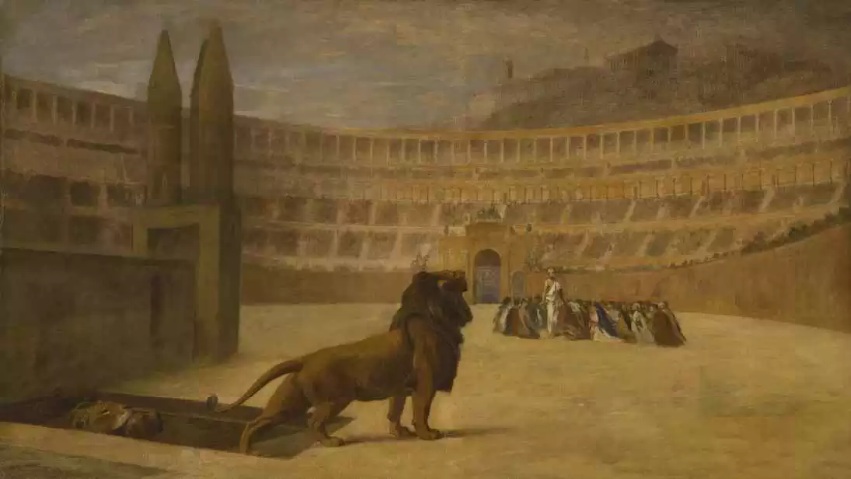
“Then shall they deliver you up to be afflicted, and shall kill you: and ye shall be hated of all nations for my name’s sake. And then shall many be offended, and shall betray one another, and shall hate one another. And many false prophets shall rise, and shall deceive many.” (Matt. 24:9-11)
Before the Fall of Jerusalem was complete, Christians in particular and Israel in general would experience loss of health and wealth, economic recession, personal depression, madness, murder, and mayhem, military defeat, and then the end would come. The nation would be conquered and the citizens relocated throughout the Empire in the Diaspora.
Fourth Sign
Severe Persecution
The events set forth in Matthew 24 convey a story within a story. There is the Great Story of the impending Fall of Jerusalem. History tells us that terrible event took place in AD 70. The beginning of the end of national Israel took place in AD 66 with a Galilean revolt against Roman authority. Before the First Jewish War ended, the holy Second Temple would be destroyed so completely, not one stone would be left on top of another.
However, before that happened, before the armies of Rome marched into Judea to surround Jerusalem, another Lesser Story took place beginning with the resurrection of Jesus in April of AD 33. It is the story of the persecution of the Followers of the Way (Acts 9:17); it is the story of the persecution of Christians.
Jesus said,
“Then shall they deliver you up to be afflicted.” (vs. 9)
Attention is given to those who delivered up the Christians to be hurt. They refer to the Jewish Community. The Jewish Community persecuted Christians for cultural reasons.
First, it was blasphemy for anyone to say that a man was the Son of God. Jesus made it clear He believed He was the Son of the Living God. His followers believed that also. Peter spoke for many when he said to Jesus, “You are the Christ, the Son of the living God” (Matt. 16:16).
Second, Christianity appeared to be opposed to the Law of Moses. The essence of Judaism was keeping Covenant with God and man. The Christian community preached the abolishment of the sacrifice and holy days because what they each represented was fulfilled in Christ.
Third, Christianity was perceived as provoking civil unrest. The disciples of Jesus said He was the Messiah, the true King of Israel. Rome would not tolerate civil unrest, or a rival to the emperor.
Fourth, Christians were persecuted by the Jews because of spiritual blindness supported by religious zeal. Saul of Tarsus sincerely believed he was doing a righteous deed by arresting men and women and putting them in prison.
As the Jewish community had reasons for persecuting Christians, so did the Romans.
First, the Romans persecuted the Christians because of the moral stand they took against many practices that were socially acceptable. Christians were known to speak against murder, violence in the colosseums, every form of sexual promiscuity, theft, magic, sorcery, infanticide, abortion, perjury, and coveting.
Second, Rome persecuted Christians for being subversive to the government, disrespectful to the gods, refusing to support the military, and being cannibalistic.
Third, Rome persecuted Christians to shift blame. After the Great Fire of Rome began on July 19, AD 64, in the merchant shops around Rome’s chariot stadium, the Circus Maximus, 71% of the city had been destroyed. The fire raged for six days and seven nights. Ten out of fourteen districts smoldered in ruins.
To divert attention from the policies of Rome, blame was placed on the Christians. It was an easy charge to make against followers of The Way, for Christians did believe the day of the Lord was to come as a thief in the night; in the which the heavens would pass away with a great noise, and the elements would melt with fervent heat, the earth also and the works that are therein were to be burned up (2 Peter 3:10).
It was easy for zealous Jews and Roman patriots to persecute the Christians because they were soft targets, and refused to fight back. The early Christians were pacifists because they wanted to practice turning the other cheek like Jesus, and they wanted to end the culture of violence.
Affliction
Jesus told the disciples they would experience great suffering because of their faith in Him, and the message of the Kingdom they would preach.

We know that physical suffering began to follow the Church soon after Pentecost. Peter and John were arrested and put in jail (Acts 4:3). In Acts 16, we read how Paul and Silas were severely beaten and cast into prison (v. 23).
When a flogging took place, a person was made to stoop, which would make cuts from the lashes from the shoulders to the waist. Deep laceration, torn flesh, exposed muscles; excessive bleeding would leave a person “half-dead” (Bible History). According to Jewish law the number of stripes was forty less one (Deut. 25:3). The rabbis allowed punishment by scouring before the judges for 168 actions; preaching the gospel of the Kingdom was one among many.

“They shall they deliver you up to be afflicted…” said Jesus, and shall kill you. Peter, James, John, and Andrew, “they shall kill you.”

Sometime around AD 64, Peter was crucified upside down in Rome during the reign of Nero. Age, 64.
James, was beheaded in Jerusalem c. AD 44. Age, c. 34.
John, out lived the other apostles, but several attempts were made on his life to kill him. He died in Ephesus c. AD 100, age 93-94
Andrew, was crucified on an X – shaped cross. He died, c. 60’s during the reign of Nero. Age, c. AD 50-60
Seven of the other eight disciples also suffered martyrdom.
Judas Iscariot, who betrayed Jesus, killed himself.
Though Judas was sorry for what he had done, it had been far better if he had never been born (Matt. 26:24).
Peter, James, John, and Andrew, they will kill you,
“and you will be hated by all nations for My name’s sake.” (vs. 9b)
It is without question that the apostles of Jesus were hated. The Jews hated the apostles because they turned their world upside down as they brought to an end the sacrificial system on which the Jewish economy relied (Acts 17:6). The sacrifices were no longer necessary because the Lamb of God had come, and was slain for the sins of the world.
The sacrifices under the Law of Moses were mere shadows of Jesus. Christ finished the work of redemption which no number of lambs and oxen could do. Let the sacrifices cease. The One Great Sacrifice has been made, and it is enough.
Telelesti! It is finished!
The apostles were hated because they opposed every form of idolatry used for making money.
In Acts 19 the story is told of a certain [Jewish] man named Demetrius, a silversmith, which made silver shrines for Diana, brought no small gain unto the craftsmen;
Whom he called together with the workmen of like occupation, and said, Sirs, ye know that by this craft we have our wealth.
Moreover, ye see and hear, that not alone at Ephesus, but almost throughout all Asia, this Paul hath persuaded and turned away much people, saying that they be no gods, which are made with hands:
So that not only this our craft is in danger to be set at nought; but also, that the temple of the great goddess Diana should be despised, and her magnificence should be destroyed, whom all Asia and the world worshipped.
And when they heard these sayings, they were full of wrath, and cried out, saying, Great is Diana of the Ephesians. (Acts 19:24-28).
The Jews did not want their world disrupted by apostolic teaching, and they did not want the gospel to take away an illicit form of making money.
There was something else Jesus referenced.
Jesus said that many would become ashamed of the gospel. Not a few, but many disciples of Jesus would fall away from the faith they once confessed.
A great falling away happened during the ministry of Jesus after He preached in the synagogue in Capernaum the doctrine of election. The story is told in John 6. We read in verse 66: “From that time many of His disciples went back, and walked no more with Him.”
On one occasion, even Peter was tempted to renounce the gospel, along with Barnabas, who was carried aways with the pressure from the Judaizers that came into the Church. Study Galatians 2:11-21.
Not only will many fall away from the gospel during a period of persecution, not only will the disciples of Jesus be hated, not only will the disciples be betrayed, but more deceivers than ever shall arise to deceive many. All of this would happen within a 37-year time frame.
Consider
First, the teaching of Jesus can be surprising. Peter, James, John, and Andrew, had to be astonished at what Jesus was saying.
The disciples sat and heard what Jesus was saying, but did not fully comprehend what it meant.
Events were moving too fast. The Temple was going to be destroyed. There were wars, and rumors of war. There were earthquakes. Murder, and hatred was in the air. Many were falling away. False prophets were emerging. It was all too much to digest.
The minds of the Apostles could not adjust to all that was being said, as the days to come would show. Study Acts 1:6
Second, despite fast moving events, the teaching of Jesus can have a calming effect.
One of the most terrifying facets in a time of crisis is uncertainty.
No matter how badly a situation might be, it is better to know what is to happen than to live in uncertainty.
Third, the teaching of Jesus solidifies His veracity or truthfulness.
One of the quickest ways to discredit a person and turn any their followers is to appeal to what they have said prophetically.
Dr. Walter Martin, who was a master teacher in dealing with the cults, such as the Mormons, Jehovah Witness, and Seventh Day Adventist, would tell Christians something effective.
If you want to witness to a cult member, the quickest way to gain their attention is to discredit their prophet.
Ask a Mormon about the failed prophesies of Joseph Smith, Jr.
Ask a Jehovah Witness to explain the many predictions of the end of the world set forth by Charles Taze Russell, and Judge Joseph Franklin Rutherford.
Ask a Seventh Day Adventist why Ellen G. White would tell so many falsehoods in her prophetic utterances.
It is hard to believe a person who has been proven to be a liar. That is the main point. Jesus is no liar. He is the Way, the Truth, and the Life. He can be trusted.
 The Collected Works of Stanford E. Murrell