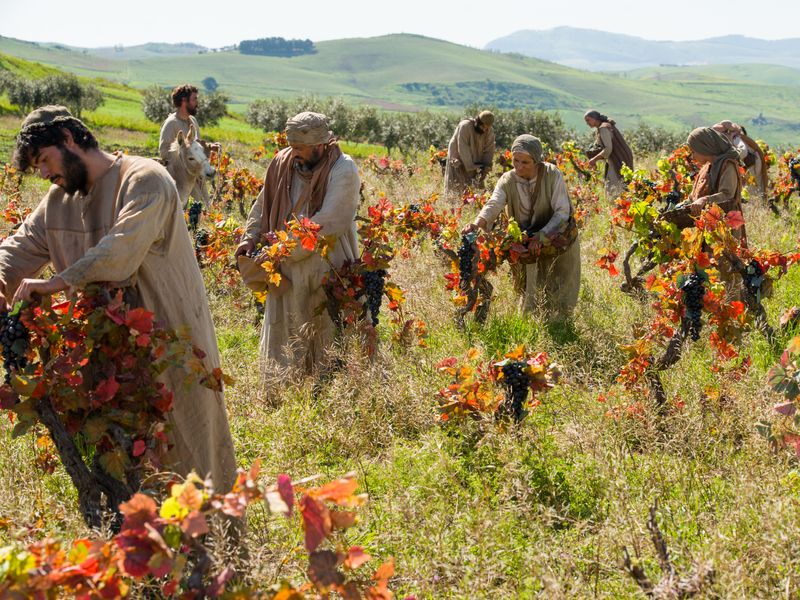
33 Hear another parable: There was a certain householder, which planted a vineyard, and hedged it round about, and digged a winepress in it, and built a tower, and let it out to husbandmen, and went into a far country:
34 And when the time of the fruit drew near, he sent his servants to the husbandmen, that they might receive the fruits of it.
35 And the husbandmen took his servants, and beat one, and killed another, and stoned another.
36 Again, he sent other servants more than the first: and they did unto them likewise.
37 But last of all he sent unto them his son, saying, They will reverence my son.
38 But when the husbandmen saw the son, they said among themselves, This is the heir; come, let us kill him, and let us seize on his inheritance.
39 And they caught him, and cast him out of the vineyard, and slew him.
40 When the lord therefore of the vineyard cometh, what will he do unto those husbandmen?
41 They say unto him, He will miserably destroy those wicked men, and will let out his vineyard unto other husbandmen, which shall render him the fruits in their seasons.
42 Jesus saith unto them, Did ye never read in the scriptures, The stone which the builders rejected, the same is become the head of the corner: this is the Lord’s doing, and it is marvellous in our eyes?
43 Therefore say I unto you, The kingdom of God shall be taken from you, and given to a nation bringing forth the fruits thereof.
44 And whosoever shall fall on this stone shall be broken: but on whomsoever it shall fall, it will grind him to powder.
45 And when the chief priests and Pharisees had heard his parables, they perceived that he spake of them.
46 But when they sought to lay hands on him, they feared the multitude, because they took him for a prophet. (Matt. 21:33-46)
It has been said that a parable is an earthly story with a heavenly meaning. Jesus loved to tell parables. It was one of His favorite teaching methods. In a parable, a simple truth can be told, while a spiritual lesson is learned. In the Parable of the Vineyard, the Lord told a story that everyone in the Temple could relate to in all of its parts.
The people knew how vineyards were planted, and then protected by a hedge of thorns. The thorn hedge was designed to keep out wild boars, and thieves. In addition to the hedge, most vineyards had a winepress nearby for pressing the grapes. And there was a tower built in the vineyard. From the tower, a careful 24-hour watch could be kept over the area for temporary lodging could be made. The vine yard was well protected because it could be very profitable for the owner. There were three ways an owner of a land could make money.
First, he could simply rent the land for a flat fee. We see this today. McDonald’s franchises typically lease the land and buildings from the corporation. Owning the land allows McDonald’s to generate recurring revenue through rent from franchisees. McDonald’s is fundamentally a real estate company, not just a fast-food chain. As of early 2025, McDonald’s has more than 41,800 restaurant locations in over 100 countries. As of September 26, 2025 McDonald’s worth is $217.82 billion.
Second, the owner of the land could require a certain percentage of the crop after it was taken to market. A significant part of American history is that of share-cropping, and is important to know.
Third, the owner of a vineyard could demand a fixed amount of the fruit. The Householder in the Lord’s parable had decided to take a fixed amount of the fruit. When the time of harvest was near, he sent his servants to receive the fruits of the vineyard. But the husbandman surprised the servant.
For whatever reason, the servant was beaten. Another was stoned, and still another servant was killed.
As the Lord told His simple story, the people of Palestine knew such things really did happen. Disputes between management and labor, with violence in the work-place, is as old as civilization.
In the Lord’s Parable, the owners of the vineyard sent more representatives to negotiate his business, but all of those that were sent were hurt.
In an ultimate act of good will, and as a sign of good faith, the householder sent his own son.
“Surely,” he thought, “they will honor him.”
But they didn’t. The workers of the vineyard were so angry, and unreasonable, they killed the heir to the vineyard, thinking that if they killed him, the owner would die in due time, and then the land would be up for public auction. Perhaps they could take it for themselves.
As contemporary as the Parable was to those who heard Christ speak, the spiritual overtones were not difficult to discern by the Chief Priests, and by the Pharisees.
The Certain Householder was God the Father.
The Vineyard was Israel.
The prophet Isaiah said, “For the vineyard of the LORD of hosts is the house of Israel, and the men of Judah his pleasant plant.” (Isaiah 5:7).
The covenant of circumcision, and the ceremonial Law, were a hedge, or a wall of partition around the Jewish church.
The altar of burnt offerings was the winepress, to which all the offerings were brought.
The Husbandmen were the Chief Priests, and the Pharisees. To them was the vineyard let out.
Meanwhile, the Father went into a far country. That happened spiritually, when the Shekinah (glory) was withdrawn from Israel (study Ezekiel 9–10).
Still, other servants were sent, a reference to the prophets. The prophets came to Israel because God was looking for fruit (Matt. 21:34). He expected it.
The expectations of God, says Matthew Henry,
“were not hasty, for the Lord did not demand pre-payment; nor were not high for the Lord did not put the laborers in peril of being penalized if they did not come to Him; and were not hard, for the Lord did not demand more than He Himself has planted.” The expectations of God were reasonable.
Nevertheless, the Servants of the Householder were treated cruelly.
Jeremiah was beaten.
Isaiah was cut in half.
Zechariah, the son of Jehoiada, was stoned in the Temple area.
Still God persevered in His goodness to Israel.
He sent other prophets.
He sent John the Baptist, who was beheaded.
And He sent the Twelve Apostles.
But the Religious Leaders of Israel were drunk with the blood of the saints.
Finally, the Householder sent his only son, the heir of all things. The Householder’s Son was Jesus Christ, who was to be honored.
But instead of showing the reverence He deserved, the Son was cast out of the vineyard and killed.
And that is exactly what happened to Jesus.
He was plotted against (Matt. 21:38). Pilate, and Herod, and the princes of the world, plotted against the Lord, but only because they knew Him not. “For if they had known, they would not have crucified the Lord of glory” (1 Cor. 2:8).
But the Chief Priests and the Elders knew who Jesus was. They understood this was the Heir. At least some of them understood, and still they said,
“Come, let us kill Him.”
Jesus was taken outside of the city of Jerusalem, and crucified.
Some wanted Jesus dead, out of envy. Some wanted Jesus dead, out of fear.
Others wanted Jesus dead, out of hatred.
The only question left to answer, was what should be done to the Husbandman and his helpers?
Should not those who hurt the servants, and killed the Son, be punished? And should not the vineyard be given out to others?
While the Chief Priests, and the Pharisees were considering all the spiritual interpretations of the words of the first parable, the Lord told another one. Jesus spoke of the Stone which the builders rejected, the same became the head of the corner. Again, the Chief Priests, and the Pharisees understood immediately.
In this parable, Jesus was the Chief Stone.
The builders were the religious leaders of Israel. They had rejected him, but He was still to become the most important part of the national life of Israel, no matter what. Though the builders would stumble over Him, as men stumble over hidden stones, Jesus would grind them to power, as a large boulder can easily crush a man.
The rejected Stone crushed Israel, because the people pulled judgment down upon their own heads, when they cried out before Pilate,
“Let His death be upon our heads and upon our children.”
And so, it happened.
In these brief parables lies many truths about God, man, and Jesus Christ.
Concerning God, we discover that God is great. The greatness of God is revealed in the fact of His creation. It is incomprehensible in its beauty, and complexity. Man has turned his mind outward, and subdued creation. He has channeled his energies downward, through the microscope, to discover the world of viruses, and find cures for cancers. Man has gone down into the oceans, to touch the bottom of the sea. Now man is turning his eyes, and energies outward, in earnest, and discovering the wonders of the stars, and galaxies.
As God is great, so God is good. The goodness of God is revealed in the work, and provision He gives to His creation. God has given adequate resources for the work He has called man to do.
He has entrusted all His resources to man, asking only that proper respect, and honor, be returned to Him. As we learn that God is great, and God is good, we also discover something about man.
First, man has many privileges. The vineyard was equipped with everything- the hedge, the winepress, and the tower, which would make the task of labor easier to discharge. The Father has not only given man a task to perform, but He has also provided the means to do the task. Man is very fortunate.
Second, man is a free agent.
“God,” says William Barclay, “is no tyrannical task-master; He is like a wise commander who allocates a task and then trusts a man to do it.” Man is therefore responsible for his attitude and actions concerning Christ.
Third, man is accountable.
To all men there is coming a day of reckoning. We will have to answer to God for the way in which we have carried out the tasks entrusted to us by God. Every idle word will be evaluated. Every intention of the heart will be investigated. There will be no secrets in the Day of Judgment. The Books will be opened, and the record will be read.
One fact that the record will reveal about man is how deliberate his sin may be. The Religious Leaders of Israel, like the husbandman of Christ’s parable, carried on a deliberate policy of rebellion, and disobedience toward the Master.
But they did not always do that, for the time came when the Father made the hurting to stop. And then the privileges of the Religious Leaders were taken away from them, and given to others. “The Stone which the Builders rejected is become the head of the building.” The exaltation of the rejected Stone is declared to be something majestic, and marvelous, and so it is. Today, in the eyes of millions, Jesus is precious, and He is marvelous.
To the artist, He is the One altogether lovely.
To the architect, He is the Chief Cornerstone.
To the astronomer, He is the Sun of Righteousness.
To the baker, He is the Living Bread.
To the banker, He is the Hidden Treasure.
To the biologist, He is the Life.
To the carpenter, He is the Sure Foundation.
To the builder, He is the True Cornerstone.
To the doctor, He is the Great Physician.
To the educator, He is the Great Teacher.
To the farmer, He is the Sower and the Lord of the Harvest.
To the florist, He is the Rose of Sharon and the Lily of the Valley.
To the geologist, He is the Rock of Ages.
To the horticulturist, He is the True Vine.
To the judge, He is the Righteous Judge.
To the juror, He is the True Witness.
To the jeweler, He is the Pearl of Great Price.
To the editor, He is the Good Tidings of Great Joy.
To the occulist, He is the Light of the Eyes.
To the philosopher, He is the Wisdom of God.
To the printer, He is the True Type.
To the servant, He is the Good Master.
To the student, He is the Incarnate Truth.
To the toiler, He is the Giver of Rest.
To the sinner, He is the Lamb of God that taketh away the sin of the world.
To the Christian, He is the Son of the Living God, the Saviour, the Redeemer and Lord.
Jesus Christ is precious.
While the Chief Priests, and the Pharisees, plotted the death of Christ, He claimed that they could not deny Him His honor, for in reality, they were His servants. He was the Son of the Living God.
This passage contains one of the clearest claims of Jesus ever made, to be unique. Jesus claimed to be different from even the greatest of the servant prophets who went before Him. He is very God of very God. This passage also reveals the sacrificial reality Jesus knew awaited Him.
The Lord knew He would be taken outside the city of Jerusalem and killed. He did not die because He was compelled to. Jesus died because He knew what the Father had sent Him to accomplish. The Father wanted Him to create a chosen generation, a royal priesthood, a holy nation, a peculiar people, that should show forth the praises of Him who hath called individuals out of darkness into His marvelous light (1 Pet. 2:9).
There is something majestic, and marvelous, in all that Christ has done, and is doing, from His work at Calvary, to upholding the universe from all eternity. As there is something majestic, and marvelous in the work of redemption, so there is Someone, who is the same.
He is the Father’s Son.
He is the Chief Cornerstone.
He is our Lord and Savior.

