Sixth Sign: Lack of Love
“And because iniquity [anomia, lawlessness] shall abound, the love of many shall wax cold. And because iniquity shall abound, the love of many shall wax cold. But he that shall endure unto the end, the same shall be saved. And this gospel of the kingdom shall be preached in all the world for a witness unto all nations; and then shall the end come. When ye therefore shall see the abomination of desolation, spoken of by Daniel the prophet, stand in the holy place, (whoso readeth, let him understand:).” (Matt. 24:12-15)
One of the signs of the time Jesus foretold would come to pass prior to the Fall of Jerusalem was a greater degree of lawlessness.
There would be physical lawlessness.
Despite its value of law and order, Roman society was filled with violence. Ancient authors write of murderers, guilds of criminals, and a network of assassins who killed their victims with poisoned needles. One reason why such individuals abounded was because the culture of Rome made bloodshed and violence acceptable.
In the criminal courts, a person could be crucified for having the wrong political belief, showing disrespect to a god, or speaking against the emperor. It takes a cold and cruel heart to drive nails through a person and hang them alive on a tree.
In the world of entertainment, in the colosseums, gladiators fought one another, to the death. Wild beasts were also put into the arena for the crowd to watch as men were pitted against lions, bears, crocodiles, elephants, tigers, and panthers.
It is a heartless and cruel society that thrives on such entertainment. A mindset is established that might makes right, regardless of what anyone says, including Roman law. With the rise of lawlessness, love is diminished. When love grows callous, the heart is hardened to the point that God eventually gives an individual over to a reprobate mind to freely engage in inappropriate behavior.
There is moral lawlessness.
If there is a question about what moral lawlessness is, an appeal is made to Scripture.
Romans 1:29-31
Covetousness,
Maliciousness (trouble)
Full of envy
Murder
Debate (strife)
Deceit
Malignity (bad character)
Whisperers
Backbiters
Hateful to God
Despiteful (insolent)
Wickedness
Proud (haughty)
Boastful
Inventors of evil things
Disobedient to parents
Without understanding
Covenant breakers
Without natural affection
Unmerciful
The New Testament Epistles were written to exhort Christians not to hurt one another, and to show love according to gospel principles (1 Cor. 13:1-8).Jesus promised His disciples if they listened to Him, and kept His commandments, and protected love in their hearts, they would prevail over social unrest, spiritual apostasy, political upheaval, the increase in lawlessness, and coldness of heart.
“But he that shall endure unto the end, the same shall be saved.” (vs. 13)
The disciples of Jesus who guarded their hearts would not be destroyed by Jewish hostility; they would not be consumed by the Roman Wars with the Jews.
Seventh Sign: Global Evangelism
“And this gospel of the kingdom shall be preached in all the world for a witness unto all nations [ethnos (eth’-nos); i.e. a tribe; people or races] and then shall the end come.” (vs. 14)
The proclamation of the death, burial, and resurrection of Jesus had to be made to all the world in order for the end of the Jewish era to come. The Greek word for “world” (oikoumene)is best translated as “inhabited earth,” meaning, the “known world,” which would be primarily the world of the Roman Empire.
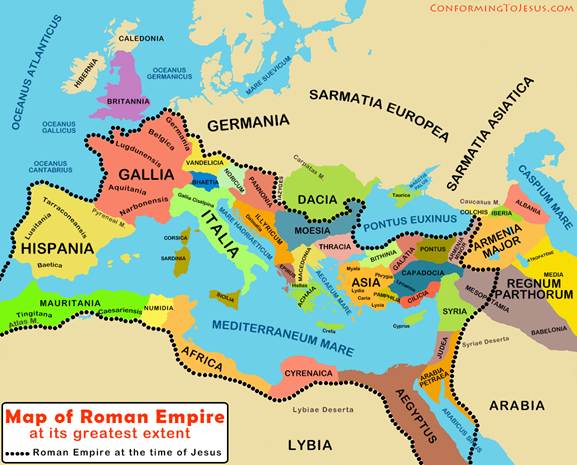
The limited use of the term “world” is reflected in Scripture.
Luke
And it came to pass in those days, that there went out a decree from Caesar Augustus, that all the world should be taxed.2 (And this taxing was first made when Cyrenius was governor of Syria.) 3 And all went to be taxed, every one into his own city (Luke 2:1-3).
Acts
And there stood up one of them named Agabus, and signified by the spirit that there should be great dearth throughout all the world: which came to pass in the days of Claudius Caesar [41 AD – 54 AD]. (Acts 11:28)
And when they found them not, they drew Jason and certain brethren unto the rulers of the city, crying, These that have turned the world upside down are come hither also. (Acts 17:6)
Prior to the Fall of Jerusalem, the gospel went throughout the “known earth” and touched every race. The gospel penetrated the Roman Empire, and prophesy was fulfilled. On the Day of Pentecost, Peter preached the gospel to devout men in Jerusalem from every nation under heaven.
Now there were dwelling in Jerusalem Jews, devout men from every nation under heaven (Acts 2:5).
Colossians
Which is come unto you, as it is in all the world; and bringeth forth fruit, as it doth also in you, since the day ye heard of it, and knew the grace of God in truth (Col. 1:6).
Consider
Colossians was written around AD 62, eight years before the destruction of Jerusalem. The world Paul knew included the lands around the Mediterranean Sea.
Romans
First, I thank my God through Jesus Christ for you all, that your faith is spoken of throughout the whole world (Romans 1:8).
But I say, Have they not heard? Yes verily, their sound went into all the earth, and their words unto the ends of the world. (Rom. 10:18)
Whensoever I take my journey into Spain, I will come to you: for I trust to see you in my journey, and to be brought on my way thitherward by you, if first I be somewhat filled with your company. When therefore I have performed this, and have sealed to them this fruit, I will come by you into Spain (Rom. 15:24-28).
But now is made manifest, and by the scriptures of the prophets, according to the commandment of the everlasting God, made known to all nations for the obedience of faith (Romans 16:26).
2 Timothy
Notwithstanding the Lord stood with me, and strengthened me; that by me the preaching might be fully known, and that all the Gentiles might hear: and I was delivered out of the mouth of the lion (2 Tim. 4:17).
Before AD 70, the gospel did go forth to all known nations, just as Christ had foretold. After the Fall of Jerusalem, because of the Diaspora, the gospel of the kingdom continued to be preached in all the world for a witness to all nations.
Eighth Sign: Abomination of Desolation
“When ye therefore shall see the abomination of desolation, spoken of by Daniel the prophet, stand in the holy place, (whoso readeth, let him understand:)” (vs. 15)
It is the will of the Lord that His disciples understood the reference to the abomination of desolation and how it applied to what He was saying. In order for that to happen, a simply application of logic is appealed to provided by William of Ockham: “Entities are not to be multiplied without necessity.” And, “Of two competing theories, the simpler explanation of an entity is to be preferred” (aka, “Ockham’s Razor”).
Ockham’s Razor is popularly understood to mean, “When faced with competing hypotheses, the one that makes the fewest assumptions should be selected.”
Assume: supposed to be the case, without proof.
When the principle of Ockham’s Razor is applied to the words of Jesus in Matthew 24:14, with a divine commentary in Luke 21:20, chaos and confusion can be avoided.
There is no need to assume Jesus was talking about an event in the 21st century, or beyond.
There is no need to assume there will be a rebuilding of a Third Temple.
There is no need to assume there will be a future Anti-Christ who is going to make a treaty with Israel and then break it after three-and-one-half years.
There is no reason to assume the great tribulation of which Jesus spoke reaches beyond the first century AD.
Attention is turned to what does not need to be assumed.
Jesus plainly stated two times that the generation to which He spoke, would not pass away until all the signs which He gave would be fulfilled. Study Matthew 23: 36; 24:34
One of the signs Jesus gave for the impending destruction of the Jerusalem Temple was…
The Abomination of Desolation
“So, when you see the abomination of desolation spoken of by the prophet Daniel, standing in the holy place (let the reader understand), then let those who are in Judea flee to the mountains.” (Matt. 24:15,16, ESV)
The parallel passage that allows the reader to understand what Jesus meant is found in the Gospel of Luke.
“But when you see Jerusalem surrounded by armies, then know that its desolation is near. Then let those who are in Judea flee to the mountains, let those who are in the midst of her depart, and let not those who are in the country enter her.” (Luke 21:20, 21 NKJV)
Because Matthew was written to a Jewish audience, he could reference Daniel the prophet, and a historical event which took place in 167 BC. In 167 BC, a Seleucid ruler over Israel named Antiochus IV (175–164 BC) put a statue of Zeus in the Holy Temple in Jerusalem. Antiochus wanted to promote Hellenistic (Greek) culture on the Jews.
Before the statue of Zeus, Antiochus offered the blood of a pig. This was an abomination to the Jews, and to God. Antiochus called himself “Epiphanies” which means the “illustrious one” or, “god manifested.”
To the Jews, Antiochus was saying that he was a god, and he presented himself this way while standing in the sacred Temple.
Antiochus went even further in his atrocities, slaughtering a great number of the Jews, and selling others into slavery. Then, Antiochus issued decrees forbidding circumcision, and requiring Jews to sacrifice to pagan gods and eat pig meat.
These atrocious actions triggered a revolt by Jewish fighters led by Judas Maccabee and his family. Bloodshed and violence came to Israel with a vengeance. During the days of Antiochus, the Temple had been violated and much of the land of Judea had been made desolate, or laid to waste.
The Jewish disciples understood what Jesus meant when He referred to the abomination of desolation spoken of by the prophet Daniel. Jesus was saying that history was going to repeat itself. Herod’s Temple would be desecrated, and the city of Jerusalem would become a desolate wasteland.
In contrast to Matthew’s Gospel, Luke primarily wrote to a Greek audience, represented by Theophilus, a Gentile of high social standing (Luke 1:1-4).
As a Greek, Theophilus would not be familiar with Jewish history. Theophilus would not understand the allusion to the abomination of desolation spoken of by Daniel the prophet, or its fulfillment, according to some, by Antiochus IV.
What Luke wanted Theophilus to know was that Jesus, as a Prophet, said something terrible was going to happen to the Jewish people in general, and the Temple in particular. One day, armies would come to destroy Jerusalem and desecrate the Temple. When the Roman soldiers were finally able to enter the city of Jerusalem, they went to the Temple.
They established in the Holy of Holies their legionary standards, emblazoned with emblemsof heathen gods.Then, Roman armies laid waste to all that was holy and sacred.
The Temple treasure was taken, later commemorated by the Arch of Titus, which still stands.
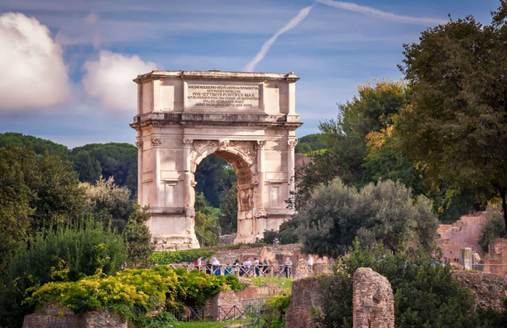
A relief panel on the inside of the arch shows the spoils of Jerusalem being brought into Rome
The confiscated treasury would finance the construction of the Colosseum in Rome, which began to be built in AD 72 and was completed in AD 80.
By comparing Matthew 24 with Luke’s account, the time when the abomination of desolation was to happen is determined with precision. And Jesus said, [Jewish and Gentile disciples of Mine] … when you see Jerusalem surrounded by armies, then know that its desolation is near.
21 Then let those who are in Judea flee to the mountains, let those who are in the midst of her depart, and let not those who are in the country enter her (Luke 21:20-21, NKJV).
In AD 68, when the Jewish and Gentile disciples of Jesus saw Jerusalem surrounded by armies, they did know the destruction of the Temple was at hand. The disciples of Christ were to flee to the mountains. This was counter-intuitive for in the ancient world, safety was found behind massive city walls.
However, because the Christians remembered the commandment of Jesus to flee to the mountains, they set aside their natural intuition and fled to safety. The Christians could flee because of a miracle that occurred. When the War of the Jews began
in AD 66, the Roman general, Cestius Gallus marched on Jerusalem.
Cestius surrounded the city and, many thought, was settled for a long siege. Then, suddenly, and for no known reason, Cestius withdrew his forces and went back to Rome. The remanent of Roman soldiers left behind became an easy target for the Jewish rebels.
The Roman legionnaires were slaughtered without mercy. The Zealots believed this victory proved God would deliver Jerusalem from Roman conquest. Christians seized on the sudden withdrawal of Cestius Gallus as an opportunity to obey the word of Jesus.
They left Jerusalem and fled to the mountains, which was counter intuitive because Jerusalem was a well-fortified city of safety.Christians fled and found safety in the mountainous region of Pella.
The prophetic word of Jesus saved many, according to promise. This is the teaching of the Lord.
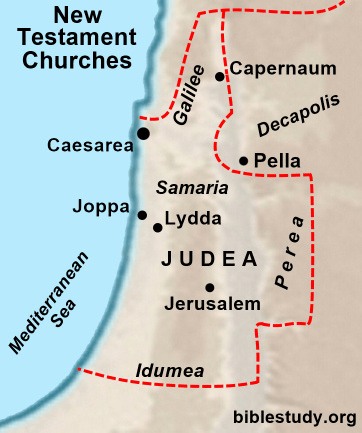
Pella is 81 miles N of Jerusalem
The flight of Christians to Pella is noted in historical accounts, particularly by early church historians like Eusebius (d. AD 30 May 339), who documented that Christians heeded warnings to leave Jerusalem before its destruction.
The Gospel was Proclaimed to all Nations on the day of Pentecost 50 days after Jesus Rose from the Dead
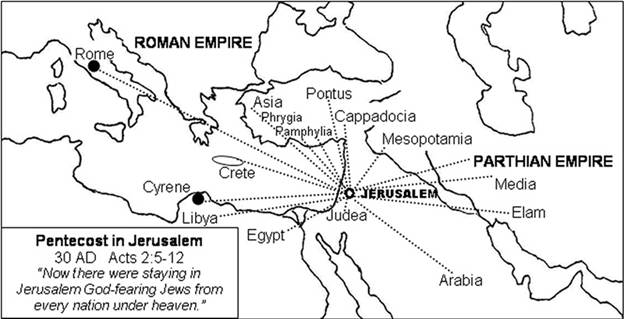
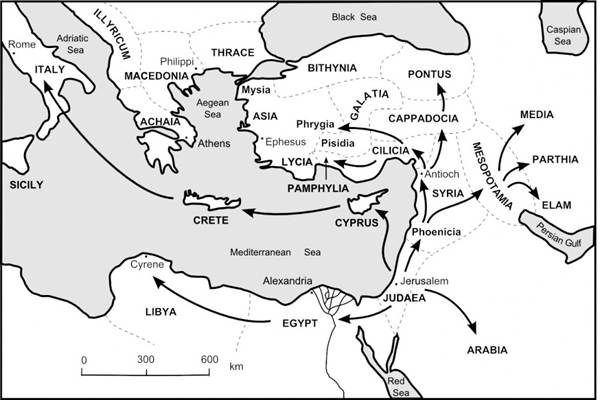
Acts 2:1-11 tells us that when the day of Pentecost was fully come, they were all with one accord in one place. And suddenly there came a sound from heaven as of a rushing mighty wind, and it filled all the house where they were sitting. And there appeared unto them cloven tongues like as of fire, and it sat upon each of them. And they were all filled with the Holy Ghost, and began to speak with other tongues, as the Spirit gave them utterance.
And there were dwelling at Jerusalem Jews, devout men, out of every nation under heaven. Now when this was noised abroad, the multitude came together, and were confounded, because that every man heard them speak in his own language. And they were all amazed and marvelled, saying one to another, Behold, are not all these which speak Galilaeans? And how hear we every man in our own tongue, wherein we were born?
Parthians
Medes
Elamites
Mesopotamia
Judaea
Cappadocia
Pontus
Asia
Phrygia
Pamphylia
Egypt
Libya about Cyrene (located in N Africa)
Rome
Jews and proselytes
Cretes
Arabians
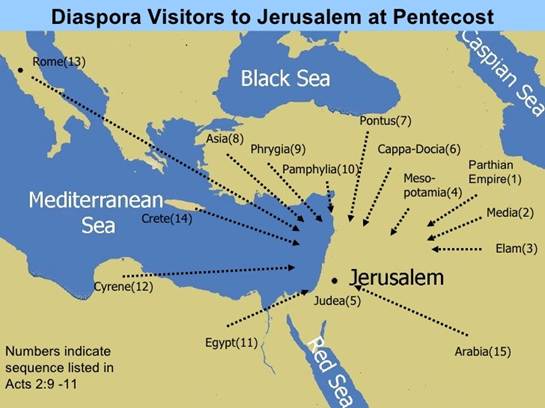
After the Fall of Jerusalem, the Gospel was spread wider than ever before
 The Collected Works of Stanford E. Murrell