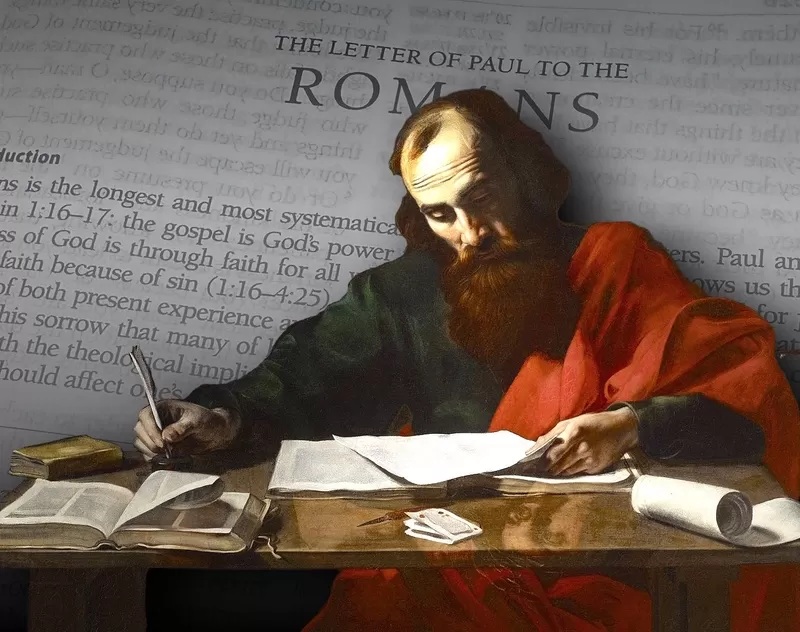
Paul’s Pastoral Heart: Romans 9:1-5
The life of Paul, as presented in Scripture, suggests that he was a very emotional personality. There is pathos, there is energy to the apostle that surges through the Divine narrative, as the record of his life is revealed. The emotional intensity that characterized the man also characterized his writings. At times, Paul tumbled out one thought after another, in an eager attempt to say something majestic (Eph. 2:1-19). He was not opposed to interrupting himself or simply switching to another topic, which is what he did in Romans 9, 10, and 11.
In this section of Scripture, there is no immediate connection to the narrative of Romans 8, and the preceding verses. What happened was that a new thought came to Paul as he meditated on all that God will do for His own.
- But was not Israel considered God’s own people?
- Does God have nothing for Israel?
- What shall happen to his brethren according to the flesh?
- Have they failed God to the point that they are no longer part of His eternal plan?
In Romans 9, 10, and 11, Paul argues that Israel did indeed fail God. Israel failed to enjoy all of the privileges associated with the Person, and work, of Jesus Christ. The reason for their spiritual failure was pride, and self-sufficiency. Israel had neglected to read the Scriptures properly, or interpret them accurately. As a result, Israel began to trust in their own good works, by the deeds of the Law.
They were proud of their own fleshly heritage to the point there was no repentance of sin, and there was no worshipping of the Lord in sincerity. In short, they failed God. However, Israel’s failure is not to be considered total for souls do come to faith. Many Jews are converted to Christ. Nor is Israel’s failure final. All Israel shall yet be saved in the glorious future to come.
Consider
Keeping in mind Paul’s elliptical style of writing, his burden for national Israel, and his ministry to the Gentiles, the main challenge for biblical commentators is to determine what Paul means when he teaches that “all Israel shall be saved”. Is all Israel a reference to a particular generation of nationalistic Jews, or does all Israel refer to the Church as a whole, Jew and Gentile?
In developing the future of Israel, whom Paul calls “my brethren, my kinsmen according to the flesh” (Rom. 9:3), the apostle expresses the deep anguish of his heart, testified to by the “witness in the Holy Ghost” (Rom. 9:1). Here is an amazing thing really for the people to whom Paul agonizes over, are the very ones who sought to kill him (Acts 21:31).
Despite repeated attempts on his life, Paul writes, that his heart is so burdened for the Israelites, that he was even willing to be cut off from Christ Himself, if such action would lead to the conversion of others (Rom. 9:3).
With these words, Paul reveals the pastoral heart that he possessed and which others have possessed before him. Moses had such a heart.
When the Lord was angry with the Israelites for their idolatry, only the prayer life of Moses stood between himself and his brethren, and the nation was spared (Exod. 32:9-14).
A pastoral heart, in spiritual leaders, that does not want to see others perish, reflects the heart of the Great Shepherd Himself, who one day had a need to go through Samaria.
There was a lost sheep that had wondered astray and needed to be rescued from sin, and shame.
There was a woman who would draw water from the well at noontime, and Jesus had to meet her, and offer her living water so that she would never thirst again (John 4:1-26).
In the early days of America’s history, there was a great missionary to the Indians, by the name of David Brainerd (1718-1747). Well-educated, and personable, David could have accepted a comfortable church position as pastor in a large town. However, with reckless abandonment he gave his health, and therefore his life, preaching in the wilderness to the Indians. “I dream of lost souls, he wrote. I care not what sufferings I undergo as long as I see souls saved.”
Brainerd did suffer. He contracted tuberculosis, and perished in the prime of his productive life.
Faithful pastors, and concerned Christians, can understand what Paul meant when he wrote, “For I could wish that myself were accursed from Christ for my brethren, my kinsmen according to the flesh” (Rom. 9:3). In the words of Richard Baxter, Paul had “tears in his voice” when he uttered these words.
Eight Privileges of a Chosen People
The agony of Paul’s soul was intense, because the apostle understood how great were the privileges his brethren had, historically. He mentions eight great particular privileges, associated with national Israel (Rom. 9:4-5).
Israel had the adoption of God. There was a time when the Jews were not the sons of God. But then one day God laid His mighty hand upon Abraham.
God sovereignly chose a devil worshipper from Ur of the Chaldees to save in order to bring forth a people of His delight. The Lord adopted national Israel as a son (Exod, 4:22, 23)
Israel had the glory. There was the Shekinah (dwelling)—a visible manifestation of the presence of God. Although the word is not found in the Bible, it occurs frequently in extra biblical Jewish writings. It refers to the times when God manifested Himself openly to Israel at Mt. Sinai (Exod. 24:9-18), in the Holy of Holies of the Tabernacle, and in Solomon’s Temple.
The Shekinah was a resplendent cloud that stayed above the altar in the place of worship and gave light to the room. When the Babylonians destroyed the Temple in 586 BC, the Shekinah glory deceased. There was no Shekinah, in the Second Temple reconstructed later under Zerubbabel (c. 516 BC) and Herod, governor of Judea (374 BC).
In addition to the Shekinah glory, Israel was led by the glory of a cloud by day and a pillar of fire by night during their wilderness journeys (Exod. 12:20-22; 16:10).
What a miracle that was.
They had The Glory Cloud to give protection by day from the burning sun and warmth at night from the frigid air. As long as Israel followed The Glory Cloud, they were safe and secure in the Lord. If, at night, they moved without the pillar of fire, they would walk in darkness. Individuals always walk in darkness when they do not go with God.
Israel had the covenants. There was the Abrahamic Covenant, whereby God promised to give Abraham a seed, a name, and a land (Gen. 12, 13).
There was the Davidic Covenant whereby God promised a seed to sit upon the throne forever (2 Sam. 7).
There was the New Covenant (Jere. 31), which was to undergird, in righteousness, all the covenants including the Mosaic Covenant of works (Exod. 20).
Some Bible students like to speak of these covenants, as being unconditional, in the sense that God made certain promises He would keep, regardless of the behavior of the Israelites.
However, it can be pointed out that even to Abraham, God says, that His blessings were bestowed because of Abraham’s obedience and unswerving faith in the promises of God and in the God of promise.
“And [God] said, By myself have I sworn, saith the Lord, for because thou hast done this thing, and hast not withheld thy son, thine only son: That in blessing I will bless thee, and in multiplying I will multiply thy seed as the stars of the heaven, and as the sand which is upon the seashore; and thy seed shall possess the gate of his enemies; and in thy seed shall all the nations of the earth be blessed; because thou hast obeyed my voice” (Gen. 22:16-18).
Covenants are intrinsically conditional. God made certain promises to Abraham, and to his descendants, and kept them.
The name of Abraham did become great. The seed of Abraham prospered, and the Land of Promise was taken (Josh. 21:43-45; 24:14).
In turn, Abraham kept the faith. He wavered not at the promises of God, but his descendants did. Time after time they became faithless, despite the fact they had the covenants.
Israel had the Law. To have the Law of the Lord, written by the finger of God, was a great blessing indeed (Exod. 31:18; Ps.). During the days of Paul, the nation looked upon the Law as its most holy possession. Individuals would memorize the entire Torah.
Israel had the service of God. The Tabernacle in the desert, and the Temple in the land, provided a platform for spiritual service. Israel had a glorious priesthood, to structure the worship, and to process the offerings that were given to God.
There were much beauty and pageantry in the holy ceremonies and services that were conducted on a daily basis. Special high, and holy days, enhanced the glory associated with the services of the Lord, especially when the High Priestly garments were worn.
Israel had the promises. In particular, there were the Messianic Promises of a Priest to come, a Prophet to come, and a King to come (Gen. 3:15; Num. 24:15-19; Deut. 18:15-22).
The Prophet, Priest, and King would come in One humble Servant of the Lord (Isa. 53). A Child would be born, a Son would be given, and the government would be placed upon His shoulders (Isa. 9:6).
There were great and glorious promises that Israel had concerning the Messiah who would suffer in a vicarious (Isa. 53:49), and victorious manner (Isa. 53:10-12).
Israel had the fathers. Most Americans are proud to honor George Washington as the Father of this Country. Other Founding Fathers are held in high esteem: Thomas Jefferson, Benjamin Franklin, James Madison, James Monroe, and Paul Revere. The list is long and lustrous. But Israel had the fathers of the faith: Abraham, Isaac, Jacob, Moses, Noah, and David. What a privileged people they were.
Israel had the Messiah. Best of all, Israel had Christ the Messiah, who is God, blessed. Amen. And yet, despite all of their spiritual advantages and blessings, Israel took the Lord of Glory and crucified Him. Israel killed the Messiah King. Israel despised the Son of the Living God. Israel did not believe that, in Christ, all of the prophecies were fulfilled.
Scripture Interpreting Scripture: Romans 9:6-13
The historical fact, of Israel killing the Lord of Glory, raises a theological inquiry.
“How did it happen that Israel did not recognize her Messiah?”
Moreover,
“What shall become of the nation?”
These unspoken questions, which Paul anticipates, are not easy to answer. The best Paul can do is to turn to various Old Testament passages to show several reasons why Israel rejected the Messiah—despite the promises, and general expressions of love by God, in so many ways.
The people of Israel failed as a nation to see their need for a personal Savior. They held an erroneous belief that the act of circumcision, in association with keeping the Law, and being a physical descendant of Abraham was enough to secure salvation (Rom. 9:6-29).
The lack of spiritual discernment led the Jews to pursue righteousness by works rather than by faith. This was united with an innate sense of self-righteousness to produce a hardness of heart toward the Gift of Heaven (John 6:31-35; Rom. 9:30-33).
The Jews had a zeal for God, but it was not based on knowledge (Rom. 10:2, 3). Israel failed to discern that there is a spiritual, as well as a physical seed of Israel, and the true Israel of God is to be found in the spiritual seed.
To prove that there are two seeds of Abraham the apostle cites four Old Testament passages and comments upon them: Romans 9:7; Genesis 21:2; Romans 9:9; Genesis 13:10, 14; Romans 9:12; Genesis 25:23; Romans 9:13; Malachi 1:2.
The Two Seeds of Israel
In Romans 9:7, the apostle begins, by acknowledging that there is a physical seed of Israel consisting of all the direct descendants of Abraham, Isaac, and Jacob.
Also, to be numbered in the physical seed of Israel, are Gentiles, who have been proselytized to the Law of Moses. Nevertheless, They are not all Israel, which are of Israel (Rom. 9:6).
In the sight of the Lord, there is a spiritual seed to consider. Attention is focused upon the promise given by God to Abraham, that he would have a son. “Nevertheless, because they are the seed of Abraham, are they all children: but, in Isaac, shall thy seed be called” (Rom. 9:7).
Isaac would be a child of promise.
Isaac would be a child of faith.
Isaac would be the prototype of the spiritual seed, through which the Messiah would ultimately come.
It is the spiritual seed of Israel that Paul wants to emphasize, by noting the distinguishing grace of the Sovereign God between one part of Israel, and another.
The spiritual seed of Israel includes all Jews, and all proselytized Gentiles, such as Rehab, and Ruth (Hebrews 11:31; Ruth 1:16), who have the faith of Abraham, Isaac, and Jacob.
Hostility to the Doctrine of Election
By making this dramatic distinction between the physical seed of Abraham, and the spiritual seed, Paul knows that this facet of the truth will not be well received by the Jews. The doctrine of election, the doctrine of distinguishing grace, is a doctrine that is neither wanted, nor appreciated by the natural man, despite the fact that the doctrine is designed to manifest the free mercy of God and reveal His glory, while humbling those who are the objects of His grace.
Even when Jesus preached the doctrine of distinguishing grace, hostility was shown (Luke 4:25-29). The doctrine of election strikes at the root of man’s self-righteousness. In his natural religious arrogance, man cannot help but believe, that there is something about himself that is so wonderful, God must move to love and receive him. Had the Jews read the Scriptures more carefully they would have realized that this is not true.
The prophet said “All we like sheep have gone astray; we have turned everyone to his own way” (Isa. 53:6). “The Bible says there is none righteous, no not one” (Romans 3:10; Ps. 14:13 with Ps. 53:13). The only hope for lost souls to be saved is for the Good Shepherd to come and rescue whom He wills.
The Basis of Divine Election
In eternity past, in matchless sovereign grace, God did decide to save some members of the fallen race of Adam, but not all. So, God made a choice between Ishmael and Isaac (Rom. 9:7, 8), and between Esau and Jacob (Rom. 9:10-13). That choice was not based upon foreseen faith, nor upon good works, but upon God’s own good pleasure. “For the children being not yet born, neither having done any good or evil that the purpose of God according to election might stand, not of works, but of his that calleth” (Rom. 9:11).
Had God based His election upon the goodness of a person, then He probably would have chosen Esau over Jacob, for in many ways, Esau was a better man. It was Jacob, who cheated Esau of the blessing. It was Jacob, who was always scheming and plotting to get ahead in life, at the expense of others. God did not choose Jacob because he was basically a good or better person than Esau. God chose Jacob according to His own sovereign will. God never chooses anyone on the basis of some personal goodness.
Nor does God base His election upon foreseen faith. If God basis His election upon the foreseen faith of a person, then He does not chose anyone according to grace, but according to works, for faith is a good work. Faith is something that pleases God. If man has innate faith or the ability to believe in God, then God is not sovereign in choosing whom He wills after all, for God is under a moral obligation to save and to show mercy to all who perform the good work of faith—even when it is expressed in the flesh. But that is not possible. The Scriptures teach, those who are in the flesh, cannot please God (Romans 8:8). The scriptures teach that God operates according to His own good pleasure (Ephesians 1:5; 1:9). God does whatsoever He wills (Ephesians 1:11). And faith? That too is a gift of divine grace (Ephesians 2:8, 9). The ultimate basis of election is not the goodness of any person, nor foreseen faith, but divine grace.
“Marvelous grace of our loving Lord,
Grace that exceeds our sin and our guilt,
Yonder on Calvary’s mount outpoured,
There where the blood of the Lamb was spilt.Grace, grace, God’s grace,
Grace that will pardon and cleanse within;
Grace, grace, God’s grace,
Grace that is greater than all our sin.”
—Julia H. Johnson
Is There Unrighteousness with God? Romans 9:14-33
While trying to understand, and convey, the meaning of the message of Romans 9, Dr. Donald Gray Barnhouse asked the Lord to give him a human illustration that would cover the great revelation of divine election. What the Lord provided was a wonderful reminder that God’s word, on any given matter, is sufficient even when there is not clear understanding of what the words mean. “Let us imagine,” said Dr. Barnhouse, “a small boy has a pet dog which he loves very dearly. He plays with that dog every day and the dog sleeps beside him at night. One day the boy opens the door of the family garage just in time to see his father kill the dog. The fatal shot rings out and the boy screams and rushes toward the dog. The father catches the boy who kicks and screams against him. ‘You killed my dog! You killed my dog! I hate you! I hate you!’ The father carries the boy into the house and says, ‘My son, I will tell you why I had to kill him.’ But the boy runs away from his father, screaming, ‘I hate you! I hate you! You killed my dog!’”
In the years to come, when the child grew up, he began to understand something about the nature of disease. He was given a newspaper clipping that showed that there had been an epidemic of rabies in his neighborhood. A mad dog bit several other dogs in the neighborhood, and so it was necessary for local dog owners to destroy their pets. “From his maturity the boy can look back on his childhood, and see how warped were his opinions of his father. He had carried hatred of his father through the years because his father had crossed his childish will when he was four or five years old. Yet now, he sees the evidence that his father was acting in wisdom and love, and that his pet dog might have bitten him and caused his own death.”
Many people are theologically like that little boy. They hear the doctrine of election and are offended with God. In emotional anger God is charged with being unkind and unrighteous. An explanation is demanded for murder and rape, tornadoes and war, floods and famine. When no immediate rational explanation is given, frustration is directed against the Lord. “Where is God?” Hurting hearts ask. “Surely God must be unrighteous to allow bad things to happen to good people!” One atheist was even so bold as to tell a Christian, “Your God is my devil.” Ugly remarks are made because men are children before Almighty God. Men do not understand sin, death, disease, election, and divine sovereignty. Instead of bowing before the Creator in humility, in infantile ignorance, God is accused of being unrighteous—until there is growth in grace and knowledge of spiritual things. ‘Is there unrighteousness with God?” Not when we understand Him.
The Strategic Point of Conflict
While individuals rage and charge God with unrighteousness, while answers are demanded, the Lord is not intimidated. Nor is God pressured into answering life’s ultimate questions too readily. In the area of salvation, God does not explain in His Word why He selects one person over another. Perhaps one day He will.
For now, God calls upon souls to submit to the principle of His right to rule in the universe the way that He sees fit. Submission to the sovereignty of God is needed because it is the very starting point of spirituality, and a right relationship with the Lord. It was because Adam did not submit to the sovereignty of God that all of humanity has been affected by The Fall.
As the story is told in Genesis 3:17, the Lord told Adam not to eat of the fruit of the Tree of Knowledge of Good and Evil. Encouraged by Satan, to violate the known will of the Lord, Adam rose up in rebellion against God, and partook of the forbidden fruit. In this manner, a sin nature was acquired, so that Adam, and his posterity, has become responsible for the just judgment that was rendered. Had Adam submitted to the righteousness of God, to organize, and control His universe as He saw fit, there would have been no Fall.
The strategic battleground for the sons of Adam is the sovereignty of God. The most foundational truth of the Christian faith is that God exists (Heb. 11:6), and He rules supreme according to the good pleasure of His will. Until this point is resolved, nothing else really matters. Jesus said, ‘And why call ye me Lord, Lord, and do not the things which I say” (Luke 6:46).
A Fundamental Lesson of Faith
The sovereignty of God is taught to all of God’s children, for therein lay their comfort, security, humility, and submission to the Savior. Absolute divine sovereignty was taught to Moses. ‘For he saith to Moses, I will have mercy on whom I will have mercy, and I will have compassion on whom I will have compassion” (Rom. 9:15). Moses had no power to persuade people to follow him. When he tried in his own power to lead, he was a failure (Gen. 2:11-14; Acts 7:22-29). Moses had to learn that only God can change hearts according to His omnipotent power. Only God can deliver His people from the bondage of slavery. Only God can show mercy upon the many.
And God said, “I will. I will have mercy. I will have mercy upon whom I will have mercy. I will have compassion. I will have compassion on whom I will have compassion. So then, it is not of him that willeth, nor of him that runneth, but of God that showeth mercy.” (Rom. 9:16; John 1:13) Tragically, much of the modern evangelical community does believe that it is of him that willeth, especially in the area of salvation. But the Word of the Lord is plain. Salvation is of the Lord. All who are born again are the objects of the God that showeth mercy to whomsoever He wills (Rom. 9:16).
The Plight of Pharaoh
To press home the absolute sovereignty of God, Paul brings to the forefront the plight of Pharaoh, the mighty monarch of the Exodus Generation. Pharaoh thought that he was the ruler of millions and the ultimate master of the multitudes. Pharaoh thought he could treat his subjects in any manner that he pleased. Proud Pharaoh thought he held life, and death, in his hands. If he wanted to practice ethnic cleansing, he would do just that. The royal order was given (Exod. 1:8-22). The Hebrew male children were to be murdered, but one baby, in particular, God said in His secret counsel (Deut. 29:29), “Touch him not,” and Moses was spared. Time passed and truth crystallized: Pharaoh’s free will was subject to the Sovereign will of God.
In fact, as the Plan of God unfolded, Pharaoh was nothing more than a vessel, fitted to destruction! (Rom. 9:22). “For the scripture saith unto Pharaoh, Even for this same purpose have I raised thee up, that I might show my power in thee, and that my name might be declared throughout all the earth. Therefore, hath he mercy on whom he will have mercy and whom he will he hardeneth” (Rom. 9:17, 18).
Opposition to Absolute Authority
Now if it is true, that salvation is of the Lord, if it is true, that God wills who is to be shown mercy and who is not, “Thou sayest then unto me, Why doth he yet find fault? For who hath resisted his will?” (Rom. 9:19) This is a natural question, and it is an old question. It was asked 2,000 years ago and it is still being raised today. How is the Christian to respond? The answer is this Christian: stay close to the Scripture.
The Sovereign needs no Human Security
The temptation comes to Christians to try and protect the character of God. This is usually done by making God out to be less sovereign than He is. But God needs no human protection. God takes full responsibility for His universe and all that happens in it including sin, sorrow, and suffering. “That they may know from the rising of the sun, and from the west, that there is none beside me. I am the Lord, and there is none else. I form the light, and create darkness: I make peace, and create evil: I the Lord do all these things (Isa. 45:6, 7). The greatest evil of all was Deicide, in the killing of Christ, and yet even that was foreordained before the foundation of the world” (1 Pet. 1:18-20).
Under the Royal Reign
Despite the sovereignty of God, the Lord still holds individuals responsible for their attitude and actions—which is what prompted the question of Romans 9:19. “Why doth He yet find fault? For who hath resisted his will?” To fallen humanity, there is a sense of frustration, to be told that God is sovereign, and yet individuals are still held accountable for what they say, and do. It does not seem fair, until it is remembered, that there is a parallel in human affairs. Consider the evidence. A man and a woman meet, fall in love, and desire to get married. Included in their marriage plans are children. Once the children are born, and reach a certain level of maturity, what happens?
They are often assigned household chores, and then they are held accountable for their job performance. A resourceful child might think about this someday and decide to protest, and ask some interesting questions. “Why do you hold me accountable for these things? I never asked to be a member of this family. I never asked to be born. You could have taken steps to prevent my birth. How can this be fair?” While the questions deserve attention, they will not change reality. Once the decision was made to create a child, in love by a married couple, then all the dynamics involved in that decision were engaged, including teaching the offspring to accept responsibility.
In a similar way, once God decided to create the universe the way He did, He has the right to hold His creation to whatever level of accountability He chooses. Discussion ends for, “Shall the thing formed say to him that formed it, Why hast thou made me thus? Hath not the potter power over the clay, of the same lump to make one vessel unto honor, and another unto dishonor?” (Rom. 9:20b-21)
The Greatness of Divine Glory
Though God does make vessels fitted for destruction, He is also pleased to make many vessels of mercy in order to make known His glory. The greatness of the glory of God is revealed in part against the black backdrop of sin. We would never know anything about grace if it were not for sin and the agony of the Savior. We would never know anything about mercy and infinite love apart from sin. The angels do not know about mercy and grace, which is one reason why they are curious about the things associated with salvation (1 Pet. 1:12). Those who are the heirs of salvation are a privileged people. What a blessing it is to understand something about the, “riches of his glory on the vessels of mercy, which he had afore prepared unto glory” (Rom. 9:23). What a privilege it is for Gentiles in particular to be united with the spiritual remnant of elect Jews (Rom. 9:27-29) in order to discover a righteousness that was never sought. Only sovereign grace has made it possible for the Gentiles to be converted. Only sovereign grace has made it possible for a remnant of Jews to remain alive in order to be saved. Only sovereign grace has kept stumbling souls from the second death. (Rev. 20:6) Only sovereign grace has devised a system of salvation so that, “whosoever believeth on him [Christ] shall not be ashamed” (Romans 9:33). Believe on Christ and you will never be ashamed. Believe on Christ and you will know you are numbered among the elect (1 Thess. 1:4).
 The Collected Works of Stanford E. Murrell