“Then answered all the people, and said, His blood be on us, and on our children.” (Matt. 27:25)
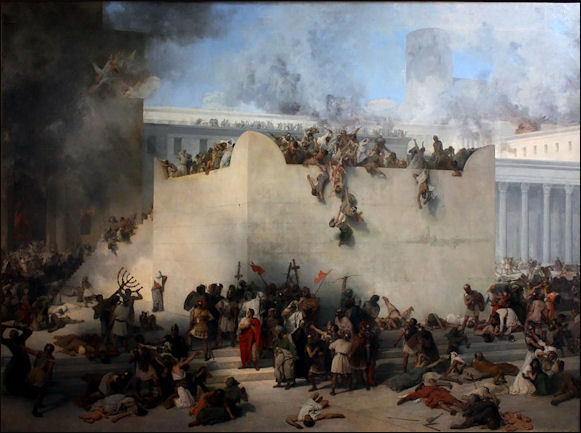
The year is AD 70 and the armies of Rome, numbering 60,000 soldier, have converged on a small providence on the eastern region of the Roman Empire. The Holy City of that providence called Judah is burning. Smoke rises from the Temple Mount, thick, black, suffocating. The place has become an infernal of death and destruction.
Faith is lost as people flee in terror. The God of Abraham, Isaac, and Jacob, has forsaken His people. Judgment has come to those who killed the Son of God, and persecuted the prophets.
These are days of vengeance. Those who invited the blood of Christ to be on them and their children are having their imprecatory prayer answered (Matt. 27:25).
Those who shed the righteous blood of the prophets, from Zechariah, son of Berekia, to John the Baptist, are now the object of retributive justice as the sins of the parents are visited on the children (Matt. 23:35, 36; Deut. 5:9).
The instrument of divine judgment was Rome. Thousands scream as Roman soldiers run through the streets. From house to house, Jews are sought out to be slaughtered. Women are raped. Mothers try to protect their children. Both are butchered where they fall. Men cannot protect themselves, let alone others. The sound of steel clashes with steel. The fires grow stronger, and rage with more intensity, consuming homes, businesses, and the Holy Temple.
Inside the Temple, flames climb the marble columns. The beautiful fabric separating the Holy Place from the Holy of Holies goes up in flames like a torch being lit. What was once the central focus point of a nation, is being consumed by fire.
From a divine perspective, God was disciplining His people, and prophesy was being fulfilled.
Forty years earlier Jesus of Nazareth had warned of this devastation. While sitting on the top of the Mount of Olive, Jesus had foreseen the future of Jerusalem, and wept, saying:
O Jerusalem, Jerusalem, thou that killest the prophets, and stonest them which are sent unto thee, how often would I have gathered thy children together, even as a hen gathereth her chickens under her wings, and ye would not! Behold, your house is left unto you desolate. (Matt. 23:37, 38).
From a human perspective, Jerusalem was being destroyed because Jewish nationalist had dared to revolt against the rule of Rome. The Senate of Rome was not about to let rebels against Roman authority go unchallenged. When the revolt in Judeah was brought to the attention of the emperor, Nero, he ordered the rebellion be put down in such a severe way, the people would never revolt again. By crushing the rebels in Judah, other conquered territories would learn to fear and submit to Roman authority. There was to be peace in the empire.
To understand why the Jews revolted against Rome, one must travel back to the year 6 BC when Judeah was officially made a province of the expanding empire. Once more a foreign power had come to rule over the Jews, take the wealth of the nation through taxation, and enslave its citizens.
Governors of Judeah, such as Gessius Florus, treated the Holy Temple as their personal treasury, for the Jews had been taught to tithe to the Lord, and to give sacrificial offerings. Great wealth poured into the coffers of the Temple. The Jews believed the Romans were defiling holy ground, while showing no respect to the citizens of God.
The spark that began the Jewish Wars, as they would become known to history, took place in AD 66 in the city of Caesarea. A mob of pagan Greeks profaned a Jewish synagogue by sacrificing birds in front of it; and the Roman garrison did nothing to intervene.
When word reached Jerusalem, the people were furious. If Rome would not protect their most Holy Temple, they would defend it themselves. Jewish people stormed the Antonia Fortresses which garrisoned Roman soldiers and drove the representatives of the Empire out of the city. For the first time since 63 BC, when the Romans first arrived in Israel, the Judeans were free.
However, their freedom did not last long because the Rome’s most capable general, Vespasian, and his son, Titus, were sent to restore the Pax Romana, the “Peace of Rome.”
When the legions of Rome moved, the earth shook at the trampling of foot soldiers, the clamping of horse hooves, and the rattle of chariots. Behind the legionaries came siege engines, catapults, and massive battering rams.
Despite fierce resistance at the Battle of Beth Horon (AD 66), and the Battle of Jotapata (AD 67), the armies of Vespasian proved irresistible. Thousands were crucified as a warning not to resist. However, the Jewish resistance refused to be intimidated. Every defeat only drove individuals South towards Jerusalem, a threefold walled city that was considered to be unconquerable.
For almost a century, the Holy City had expanded and reinforced itself against any invasion. Massive walls were constructed. Water supplies were created that could not be corrupted. Grains were stored in abundance. Rome had invested tremendous wealth to make the city beautiful and secure; surely, they would not want to destroy what they had built. Or, so it was falsely believed.
Still, the armies of Rome surrounded the Holy City. The legionnaires unfurled their insignia flags.
The wind blew and the people inside the city could see signs of eagles flapping on fabric Christians remembered the words of Jesus.
Where the eagles are gathered, there will the carcass be. (Matt. 24:28).
The Christians also remembered Jesus told His disciples when they saw Jerusalem surrounded by the armies, they were to flee to the mountains for they would know that its desolation is near (Luke 21:20). And so, the Christians fled to safety in a place called Pella.

One reason why Christians were able to flee to safety was because in the providence of God, in 68 AD, the emperor of Rome died. Nero, the Beast, committed suicide in a villa near Rome on June 9, AD 68.
There was a pause in the attack on Jerusalem. The Christians fled to safety while non-believing Jews remained in the Holy City with a renewed, but false hope, Judea might escape destruction.
But God had other plans. Vespasian did leave Judea. He returned to Rome to become emperor in July of AD 69, after Galba, Otho, and Vitellius failed to secure that exalted place of authority.
However, the general left his son Titus in Judea to finish the work of conquest of Jerusalem. Titus was equal to the task. There would be no delay in completing the subduing this troublesome province. There would be no more negotiations with the rebels inside the city walls. The intermediatory work of Josephus, the Jewish General turned Roman collaborator, was finished.
Jerusalem must fall. There would be no more mercy. Jerusalem was not going to be conquered with as much difficulty as Titus expected because within the city, there was civil war. Jerusalem was collapsing from within. Its social, financial, religious, and economic fabric was being torn apart. Chaos ruled. Inside the city walls, the Jewish rebels who once fought against Rome, turned on each other over how to negotiate with the enemy outside the gates of Jerusalem.
The Sanhedrin, which had worked closely with Romans officials, were willing to submit to Roman rule. The alternative was to die, they argued.
The Zealots, led by men like John of Gischala, and Simon Bariora, were infuriated by this idea. They had fought too hard, and for too long, to suddenly abandon Jerusalem. Compromise was betrayal. They executed anyone who spoke of surrender, or who whispered hopes of peace. Priests were put to death in the Temple itself. Rivulets of blood ran down the steps leading up to the altar of God. Bodies piled up in areas once dedicated for prayer. There was madness in the air.
To gain leverage over other rivals, food stores were burned. Water supplies were poisoned. People began to go hungry. Every creature was consumed; dogs and rats were eaten. Shoes, and belts made of leather, were boiled and eaten. Bread grain mixed with sawdust was consumed. Cannibalism broke out. Babies were cooked for food. The objective was to compel the people to fight Rome to the last breath.
When Titus began his final assault against Jerusalem, he did not find a united people; he found individuals starving. And yet, as a whole, the city did not surrender. There was still a force of rebels, 20,000 strong. These Jewish warriors were willing to go forth and engage portions of the Roman army, and then scurry back behind the safety of the city walls. Those captured by Roman soldiers were crucified outside the walls. Their screams pierced the air. Their broken and bloodied bodies lingered in the hot sun.
To stop the forays and ensure more starvation inside the city, Titus had a wall, 5 miles long, built around the city. No one could buy, or sell, to the Jews without his permission. No food, no water, no escape.
The days passed. In April of AD 70, Titus was ready to breach the walls of Jerusalem. His battery rams pounded the thick walls. Giant fireballs were lobbed over the city walls like comets falling from the sky. Towers that could not be set on fire were constructed and brought near the walls for soldiers to climb over the parapets and open the various gates of Jerusalem.

Damascus Gate: A major entrance on the northern side, still in use today.
Herod’s Gate: Located on the northern wall, named after King Herod.
Lions Gate: Also known as St. Stephen’s Gate, located on the eastern wall.
Golden Gate: An important gate on the eastern wall, often associated with messianic prophecies.
Dung Gate: Located on the southern wall, used for refuse disposal.
Zion Gate: Found on the southern wall, leading to Mount Zion.
Jaffa Gate: A primary entrance on the western side, leading to the port city of Jaffa.
The protective towers were needed because prior to those structures the Jewish defenders on the wall of Jerusalem rained down on the Roman soldiers below arrows, stones, and boiling oil. While the breaching assault continued on the outside, inside Jerusalem, famine and starvation brought sickness.
Fatal epidemic diseases spread, especially the bubonic plague. The Romans tightened their hold and finally, in the summer of AD 70, the city walls were breached. Jerusalem fell in AD 70 on the 9th of Av (July / August). Centuries before, Jerusalem had fallen to the Babylonians on 29 July 587 BC. Now, the Second Temple fell.
The Romans poured into a city like a flood of iron. Enraged by the prolonged Jewish resistance, soldiers were uncontrollable. The siege turned into a mindless slaughter. Street by street, the Romans fought their way to the Temple mount. Upon arrival, a solider took a torch and threw it into the Temple. Soon, the holy structure was blazing in a gulf of fire.
The golden items inside the Temple melted (1,948 F) and flowed over the marble stones and into the streets.
No less than one million Jews perished, for the city was crowded with those who had come for the Passover to worship. Titus had wanted to spare the Temple. But his command was disobeyed in the violence of the moment. Priest tried to save the sacred scrolls. Soldier began to fight over the gold they saw in the streets.
The roof of the Temple collapsed.
The symbol of a thousand years of faith fell into rubble.
The Temple was being destroyed.
The Holy of Holies, the Ark of the Covenant, the Altar of Incense, and the Altar of Sacrifice were gone.
Josephus wrote, “the hill itself seemed to be burning. The flames rose so high, they could be seen from miles away. And with them, Jerusalem’s last hope disappeared into the smoke.”
After the smoke cleared, the Romans brought idols into the rubble of the Temple and offered sacrifices to their gods: Jupiter, and Mars in particular. The Roman soldiers then tore down the city walls, with one exception. A retaining wall was left standing on the Western side of the Temple Mount to show generations to come how difficult the siege had been. Titus ordered that all surviving warriors, and anyone who united with the Zealots were to be killed, along with any old or sick people.
The remaining captives were divided into two groups.
Those over seventeen were sent to work in Egyptian copper mines.
Those under seventeen were to be sold as slaves.
Some of the captives were sent to circuses to fight hungry lions before cheering crowds.
Seven hundred of the tallest Jewish youths were targeted to be marched through Rome in a victory parade with Titus in the lead as the conquering general.
In AD 71, Titus sailed home. An Arch of Triumph was constructed, engraved with the Jewish captives carrying the vessels of the Temple.
With the fall of Jerusalem in in AD 70, Jesus was proven to be a Greater Prophet than Moses.
Let the word go forth. Jesus is worthy of more glory than Moses, and prophesy is fulfilled.
A New Prophet, Like Moses
“The Lord your God will raise up for you a Prophet like me from your midst, from your brethren. Him you shall hear, according to all you desired of the Lord your God in Horeb in the day of the assembly, saying, ‘Let me not hear again the voice of the Lord my God, nor let me see this great fire anymore, lest I die.’
“And the Lord said to me: ‘What they have spoken is good. I will raise up for them a Prophet like you from among their brethren, and will put My words in His mouth, and He shall speak to them all that I command Him. And it shall be that whoever will not hear My words, which He speaks in My name, I will require it of him” (Deut. 18:15-19, NKJV).
The Prophet Greater than Moses
“For this One has been counted worthy of more glory than Moses, inasmuch as He who built the house has more honor than the house. For every house is built by someone, but He who built all things is God” (Heb. 3:3-4, NKJV).
 The Collected Works of Stanford E. Murrell