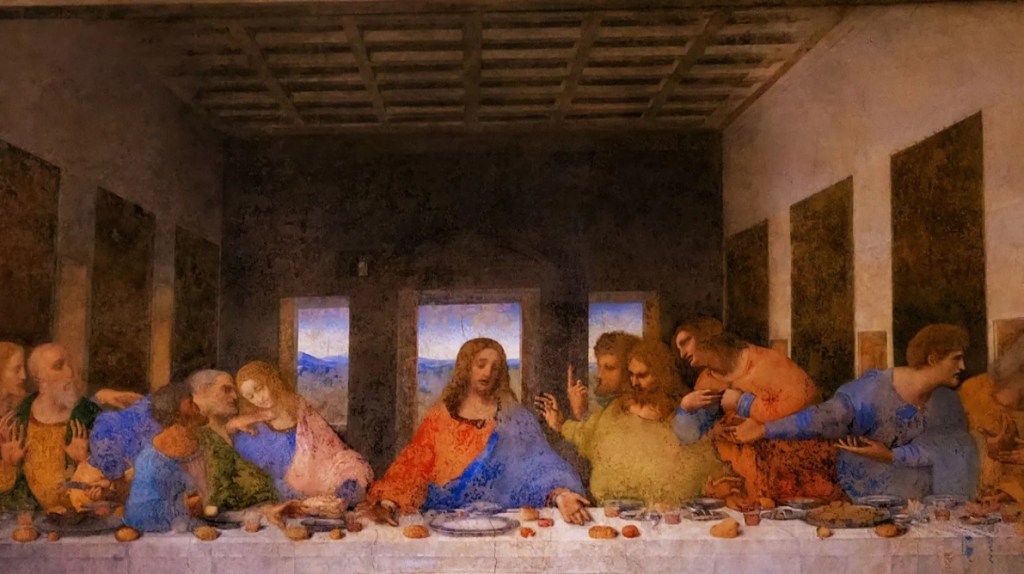
“And the first day of unleavened bread, when they killed the Passover, his disciples said unto him, Where wilt thou that we go and prepare that thou mayest eat the Passover? And he sendeth forth two of his disciples, and saith unto them, Go ye into the city, and there shall meet you a man bearing a pitcher of water: follow him. And wheresoever he shall go in, say ye to the goodman of the house, The Master saith, Where is the guest chamber, where I shall eat the Passover with my disciples? And he will shew you a large upper room furnished and prepared: there make ready for us. And his disciples went forth, and came into the city, and found as he had said unto them: and they made ready the Passover. And in the evening he cometh with the twelve. And as they sat and did eat, Jesus said, Verily I say unto you, One of you which eateth with me shall betray me. And they began to be sorrowful, and to say unto him one by one, Is it I? And another said, Is it I? And he answered and said unto them, It is one of the twelve, that dippeth with me in the dish. The Son of man indeed goeth, as it is written of him: but woe to that man by whom the Son of man is betrayed! Good were it for that man if he had never been born. And as they did eat, Jesus took bread, and blessed, and brake it, and gave to them, and said, Take, eat: this is my body. And he took the cup, and when he had given thanks, he gave it to them: and they all drank of it. And he said unto them, This is my blood of the new testament, which is shed for many. Verily I say unto you, I will drink no more of the fruit of the vine, until that day that I drink it new in the kingdom of God. And when they had sung an hymn, they went out into the Mount of Olives.” (Mark 14:12-26)
The events leading to the death of Christ began to accelerate with the observance of the Passover. This Passover would be of tremendous importance because it would be the last Passover in many ways.
First, this would be the last Passover meal Christ would celebrate with His disciples. For three years the Twelve disciples had followed Jesus. Together they had traveled the land of Palestine, and some of the regions beyond. Together they had kept the weekly Sabbaths. Together they had celebrated the various Jewish holidays. Together they had eaten past Passover meals. All of that was coming to an end. This was the last Passover meal Jesus would eat.
Second, this was to be the last Passover of the Old Testament economy in the sight of God. A new age was dawning. The old ways of acceptable spiritual worship were coming to an end. In the will of God the Father, fundamental changes were to take place whereby He would be honored in spirit and truth, and not with rules and regulations, sacrifices and ceremonies in a building made with hands.
When the law was initially given to Moses for Israel on Mt. Zion, with the detailed revelation of how to offer sacrifices, the divine intent was for the ceremonies to last until Messiah came. In type, the Old Testament offerings and rituals were designed to communicate spiritual truths concerning the Person and work of the coming Prince. The blood sprinkled on the doorposts to the house anticipated how souls must come to God through the blood of His Son. The slaying of the lamb without spot or blemish anticipated the innocent Lamb of God who would be crucified for the sins of the world.
In many ways, both great and small, the types of the Old Testament foreshadowed the substance of the coming Savoir. And now Christ, in the fullness of time, had come. After this night there would be no more need for a ritual Passover meal, for the sunshine of spiritual reality embodied in the Son of the living God would dispel the shadows of the twilight of the Mosaic era. The Old Testament economy was coming to a close.
Third, this would be the last Passover the disciples would be together as an official unit with Christ. As the eyes of Jesus looked around the table during the Last Supper it is not hard to imagine He briefly reflected on each man and their past, present, and future. Jesus taught about each one.
Simon Peter (Cephas, Bar-Jona). Bold and impetuous, Peter would still be a rock for the church to rest upon.
Andrew. Three times in the gospels the name of Andrew is mentioned, and each time he is found bringing someone to Christ.
Andrew brought Peter to Christ. John 1:40-42, “One of the two which heard John speak, and followed him, was Andrew, Simon Peter’s brother. He first findeth his own brother Simon, and saith unto him, We have found the Messias, which is, being interpreted, the Christ. And he brought him to Jesus.” Andrew brought a little child to Christ. John 6:8-9, “One of his disciples, Andrew, Simon Peter’s brother, saith unto him, There is a lad here, which hath five barley loaves, and two small fishes: but what are they among so many?”
Andrew brought Greeks to Christ. John 12:20-22, “And there were certain Greeks among them that came up to worship at the feast: The same came therefore to Philip, which was of Bethsaida of Galilee, and desired him, saying, Sir, we would see Jesus. Philip cometh and telleth Andrew: and again Andrew and Philip tell Jesus.” Andrew would always be the man who wanted to win souls to the Savior.
John. This son of thunder would become the apostle of love.
Philip.
James.
Bartholomew (perhaps same as Nathanael).
Thomas (Didymus). Thomas was a man with lingering doubts. But he would do well once convinced.
Matthew (Levi). The former tax collector that once loved money more than reputation or social status now gave what he had to feed the poor and preach the gospel. He had come to realize what another martyr would understand: “He is no fool to give up what he cannot keep in order to gain what he cannot lose” (Jim Elliot).
Simon the Zealot.
Jude (Thaddaeus).
James the Less.
And, Judas Iscariot.
The eyes of the Lord lingered on Judas, for here was His archenemy. Beside the Lord sat a man who allowed the devil to be incarnate in his life.
“Then entered Satan into Judas surnamed Iscariot, being of the number of the twelve” (Luke 22:3).
“And after the sop Satan entered into him” (John 13:27). Of no one else in Scripture do we read that Satan entered them. When this Son of Perdition walked out of the Upper Room that night, when Judas left the last Passover, he closed the door on his own last chance to be converted. What he had to do he was to do quickly. What he had to do would confirm him in his sin. It is a terrifying thought, but there is a last opportunity for salvation. God does not call forever individuals to repent and turn from their wicked ways.
Finally, the last Passover provided another compelling opportunity for the disciples to comprehend the full divinity of Christ. Huston Smith notes, in The World’s Religions, that only two people ever astounded their contemporaries so much that the question they evoked was not, “Who is he?” but “What is he?” They were Jesus and Buddha. The answers these two gave were exactly opposite.
Buddha said unequivocally that he was a mere man, not a god—almost as if he foresaw later attempts to worship him. Jesus, on the other hand, claimed in many ways to be divine. The claims of Christ are shockingly strong.
Jesus called Himself the “Son of God”—that is, of the same nature as God. A son is of the same nature, the same species, the same essence, as his father. Jesus called God his Father. “Whoever has seen me has seen the Father” (John 14:9). “I and the Father are one,” He said in John 10:30.
Jesus also claimed to be sinless: “Which of you can convict me of sin?” (John 8:46).
Jesus claimed to forgive sins—all sins, against everyone. The Jews protested: “Who can forgive sins but God alone?” (Mark 2:7). The only one who has the right to forgive all sins is the only One who is offended in all sins, namely, God. I have a right to forgive you for your sins against me, but not for your sins against others.
Jesus claimed to save us from sin and death. He said, “I am the resurrection and the life. He who believes in me will never die.” He said he had come from heaven, not just earth, and that he would return from heaven at the end of the world to judge everyone. Meanwhile, he gave us his flesh to eat, and said that this would give us eternal life.
Jesus changed Simon’s name to Peter. For a Jew, changing names was something only God could do, for your name was not just a human, arbitrary label, but your real identity, which was given to you by God alone. In the Old Testament, only God changed names, and destinies—Abram became Abraham, Sarai became Sarah, Jacob became Israel. An orthodox Jew who got his name legally changed was excommunicated.
Jesus kept pointing people to Himself, saying “Come unto me.” Buddha said, “Look not to me; look to my dharma (doctrine).” Buddha also said, “Be ye lamps unto yourselves.” Jesus said, “I am the light of the world.”
Buddha, Confucius, Muhammad and other religious founders performed no miracles and did not rise from the dead. Jesus offered His many miracles and His resurrection as evidence for His divinity.
Most clearly and shockingly of all, Jesus invited crucifixion (or stoning) by saying: “Very truly, I tell you [i.e., I am not exaggerating or speaking symbolically here; take this in all its force], before Abraham was, I am” (John 8:58).
Jesus spoke and claimed the sacred name that God revealed to Moses, the name God used to name himself (Ex. 3:14). If he was not God, no one in history ever said anything more blasphemous than this; by Jewish law, no one ever deserved to be crucified more than Jesus.
“Who then was Jesus, really?”
You cannot even ask the question without implicitly choosing among answers. The very wording of the question, in the past tense (“Who was Jesus?”) or the present (“Who is Jesus?”), presupposes its own answer. For those who believe His claim do not say that He was divine, but is divine. Divinity does not change or die or disappear into the past. Furthermore, if He really rose from the dead, He still is, and is very much alive today.
Because Christ lives we must commit ourselves to telling others about Him, and beyond that by dying with Him to sin. The first is easy, the second is not. Nevertheless, as A. W. Tozer (1897-1963) reminded his generation,
“In every Christian’s heart there is a cross and a throne, and the Christian is on the throne till he puts himself on the cross; if he refuses the cross, he remains on the throne. Perhaps this is at the bottom of the backsliding and worldliness among gospel believers today.
We want to be saved, but we insist that Christ do all the dying. No cross for us, no dethronement, no dying. We remain king within the little kingdom of Mansoul, and wear our tinsel crown with all the pride of a Caesar; but we doom ourselves to shadows and weakness and spiritual sterility.”
In as far as Christians seek to be identified with Christ in His death, they partake of the Last Passover. Oh yes, the last Passover has survived in form to become the Communion service of the Church, but there is new meaning now to the ordinance. When Christians partake of the fruit of the vine and the bread that was used during the ancient Passover meal, the purpose is to remember the end of the conflict of the ages. “It is finished!” cried Jesus from Calvary, and the battle was won.
I have read that Bedouin tribesmen hold a ceremonial feast called a sulha to mark the end of a blood feud. We hold a new feast called the Lord’s Supper to mark the end of our struggle against God, and to celebrate His victory, and our surrender (Robert C. Shannon).
Have we surrendered to God? Have we committed our lives to Christ? Have we identified ourselves with the significance of the Last Passover even the death of Christ at Calvary? May God grant that each of us join ourselves to Christ at the Last Supper for there will never be another divinely sanctioned Passover meal.
 The Collected Works of Stanford E. Murrell