From that time forth began Jesus to shew unto his disciples, how that he must go unto Jerusalem, and suffer many things of the elders and chief priests and scribes, and be killed, and be raised again the third day. Then Peter took him, and began to rebuke him, saying, Be it far from thee, Lord: this shall not be unto thee. But he turned, and said unto Peter, Get thee behind me, Satan: thou art an offence unto me: for thou savourest not the things that be of God, but those that be of men. Then said Jesus unto his disciples, If any man will come after me, let him deny himself, and take up his cross, and follow me. For whosoever will save his life shall lose it: and whosoever will lose his life for my sake shall find it. For what is a man profited, if he shall gain the whole world, and lose his own soul? or what shall a man give in exchange for his soul? For the Son of man shall come in the glory of his Father with his angels; and then he shall reward every man according to his works. Verily I say unto you, There be some standing here, which shall not taste of death, till they see the Son of man coming in his kingdom. (Matt 16:21-28)
In Matthew 16:20, the Lord gives what appears to be an unusual command. He instructs the disciples not to be telling others that He was Jesus the Christ. The reason for this is very simple.
Even though the disciples now understood, and believed, that Jesus was the Messiah, their concept of the Messiah was still inadequate.
To the disciples, the Messiah was to be a warrior Messiah-King, who would sweep the Romans from power, and establish Israel to be politically great among the nations of the earth. Had the disciples gone forth preaching this view, there would have been rebellion, violence, and disaster; civil war would have irrupted in the country. Many Jews were always willing to follow a charismatic leader who promised power, glory, and freedom.
Before the disciples could openly preach about Christ, they had to understand His ultimate mission. That mission was to die on a cross. It was the message about the suffering Messiah that the disciples had to understand clearly. We read in Matthew 16:21 that Jesus was going to die. He knew it, and now the time had come to inform His disciples. They must know it as well.
It was not an option for Jesus. For this reason, He had come into the world. Other men are born to live. Jesus was born to die. To that end Jesus must go to Jerusalem. In the Holy City, the most unholy sin would be committed. The greatest act of iniquity would take place where the eternal God had been pleased to dwell in the Temple. Jesus knew that He must suffer many things. The Lord of Glory was not going to suffer little. He was to suffer many things.
There was to be physical suffering. The hands of rough soldiers would one day grab Jesus and tie His hands. Out of the fear of the moment, the cords of the rope would be pulled tightly, almost cutting off the circulation of the blood in the hands. At that precise point, the physical sufferings would begin. Until that happened, no one would ever seriously touch Jesus in hostility. Some tried, such as Herod, but no one succeeded.
Once Jesus was bound, the bodily pain would be intensified with a slap of frustration in the face before the High Priest, for Jesus knew that He would be silent before His accusers. An order would be given to scourge Jesus. His back would be laid bare as a cold-blooded man took a whip and lashed out at Him. With every sting of the whip, the thought would pass through the Lord’s mind, “I must suffer these things. It is the Father’s will.”
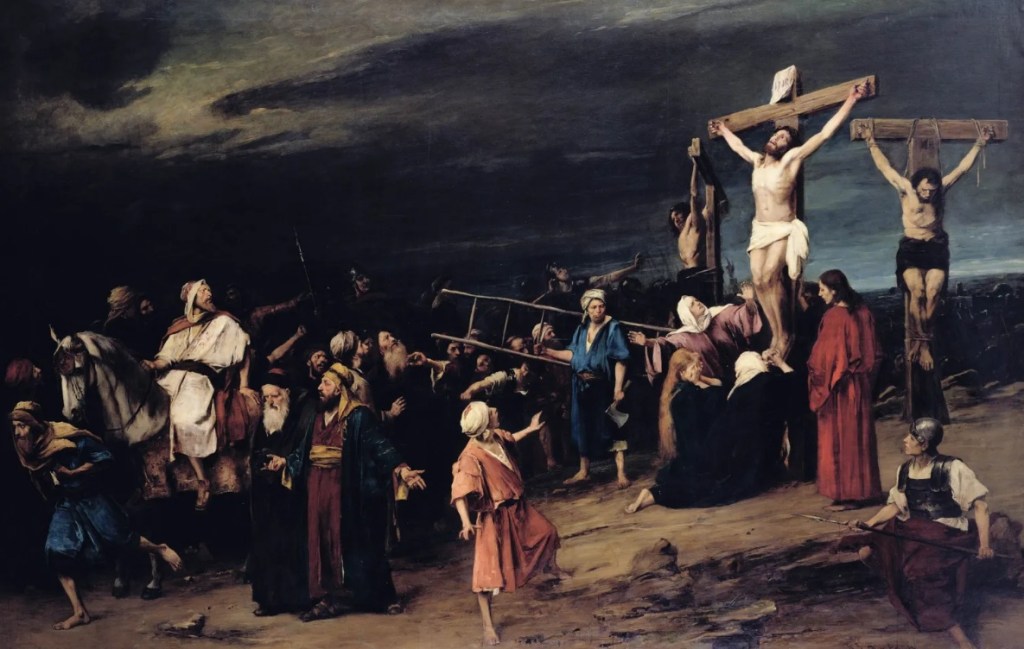
After the binding of rope, after the punching by mocking soldiers, after the brutal whipping that would leave whelps and scars, Jesus was to be crucified. Under a heavy beam He would stagger towards Golgotha. Once there, Jesus would be thrown to the ground. A man would pick up a mallet. He would pick up a spike. The hands of Jesus would be stretched out across the beam.
Too exhausted to resist, Jesus would feel the cold touch of the spike on His throbbing wrists. A strong arm would be raised, and with sudden force, the spikes would be driven through the flesh and into the wood. The spike would be hammered again until it was buried deep.
Moving quickly to the other side of the beam, again the strong arm of injustice would be raised. The hatred of fallen humanity would be surging through the veins of the executioner as he pounded the second nail into the flesh. Soldiers would watch with indifference. Public spectators would be allowed to linger nearby. The demons of hell would howl in delight. Holy angels would watch in horror. God the Father would also watch, and be pleased. The prophet Isaiah foresaw the suffering Messiah and wrote that it would please the Father to crush Jesus with pain (Isa. 53:10). His Son would be the sacrificial Lamb for the sins of the world.
In addition to the physical suffering, Jesus must also face mental anguish. The anticipation of being tortured is emotionally excruciating. In the Garden of Gethsemane, Jesus would cry out to the Father, and sweat great drops of blood for the capillaries in his skull would burst. This medical condition is known as Hematidrosis.
To add to the mental and physical suffering, there was spiritual suffering. Though the Father was determined that His Son be sacrificed, when the event happened, the Father would no longer look openly upon His Son. Jesus would become sin personified. The Father would make Jesus to be sin for us, who knew no sin; that we might be made the righteousness of God in him (2 Cor. 5:21). The darkness of the abyss would cover the land. The sun would be blotted out.In the darkness the voice of Jesus would be heard to scream,
“MY GOD! MY GOD! WHY HAS THOU FORSAKEN ME?”
Jesus would know why. The Father was to give His Son to secure eternal redemption for you and me. All these things, and more, Jesus knew must happen to Him.
Quietly the Lord began to explain this to His disciples. Jesus could do that now, because Peter and the others perceived that He was the Christ, the Son of the Living God. However, no sooner had Peter heard the beginning of the Lord’s future than he became alarmed.
Taking Jesus aside, Peter invoked God’s name to oppose the concept of a wounded Messiah. Literally Peter said,
“GOD FORBID! LORD THIS SHALL NOT BE!”
“GOD FORBID?”
The way of redemption was the Father’s plan! Shaking off Peter’s physical grasp, Jesus began to rebuke His disciple, and for good reason. Peter’s comment was really a temptation for Christ to bypass the cross for a crown. At the beginning of His ministry, Jesus had been tempted by Satan to take power and glory, while by-passing the Cross.
“Give the people bread,” said Satan. “Give them material things and they will follow you.”
But Jesus responded, “Man shall not live by bread alone but by every Word that precedes out of the mouth of God.”
“Then give them sensations,” said the Devil. “Show the people signs and wonders and they will follow you.”
But Jesus would not, for example, throw Himself off of cliffs so that the angels could swoop down, rescue Him, and impress angels and people.
“Well,” said the sly Serpent, “at least reduce your standards. Love this world.
Worship me and I will give you the kingdom. The nations will honor You, and You do not have to go to the Cross.” Temptations like these were never far from Christ as Luke records (4:13). “And when the devil had ended every temptation, he departed from Him until an opportune time.” The Devil found in Peter an opportune moment to tempt Christ again. From the mouth of Peter was coming the philosophy of Satan himself, and that was, “Do not go to the Cross!”
The words of Peter caused him to be, in that moment, an adversary of God’s will, and in that sense, he was Satan. Peter’s idea was not God’s, but mans. The disciple meant well. His words were that of protective love, and protective love is the hardest temptation of all to resist. There are times when love can deflect us from the dangers that are sometimes found in the pathway to God.
Nevertheless, authentic love does not keep the warrior at home, but sends him out to obey instructions of the Commander-in-Chief when the greater good of the nation is at stake. Peter had to restrain his arm of protective love for Christ so that the pain could be inflicted. Out of the pain and suffering would come salvation.
Peter had to learn something else, according to the church father, Origen of Alexandria (c. 185–c. 253), He had to learn to get behind Jesus. In this matter of an ultimate objective, Peter was in front of Christ. He was not following the Lord, but was trying to lead Him However, Peter’s place was not to lead, but to follow.
Jesus wanted Peter to follow. Moreover, he wanted the spirit of Satan in Peter to go away forever, and told him so plainly (Matt. 4:10). The Lord wanted Peter to become His follower again.
Eventually, Peter did what Satan could never do. The apostle got behind Jesus and followed Him.
By way of application, anyone who wants to follow Jesus and to live the Christian life, must do three things.
First, he must deny himself. To deny one’s self means in every moment of life to say no to what self wants, and yes to the known will of God.
Second, a person who wants to follow Christ must take up his cross. This sounds easy enough. It sounds mystical and spiritual. But soon, the honest heart must admit how stubborn self can be, and how cruel the cross can be. The flesh does not die easily. As long as possible, self will not be denied!
But, if God is gracious, and the heart has a desire to be changed, a life can be made different. When self is placed upon the cross,
- Love can replace hatred.
- Joy can replace sadness.
- Peace can banish emotional unrest.
- Long-suffering can subdue impatience.
- Gentleness can be expressed rather than harshness.
- Goodness can banish evil.
- Faith can triumph over doubt.
- Meekness can oppose pride.
When self is placed upon the cross daily, the burden of sacrifice might include taking the time and effort to serve somewhere, visit the sick, or call upon the lonely. It is not the great moments of sacrifice that counts the most, but the daily, constant awareness of the demands of God upon our lives.
Then third, a person who wants to be a Christian and follow Christ, must render perfect obedience to Jesus. This is the great and worthy objective that we are called. Are we following Christ? Have we ever made a sober evaluation of what it costs to be a good Christian? Will we deny ourself for the good of the Church, and the glory of the Lord?
Jesus asks the same questions this way. “For what is a man profited if he shall gain the whole world, and lose his own soul? or what shall a man give in exchange for his soul?” The answer is obvious. Only those who are willing to lose everything for Christ will find eternal life. Two hundred and fifteen years ago, a man decided to take up his cross and follow Christ. His name was Robert Raikes (1735–1811).
 The Collected Works of Stanford E. Murrell