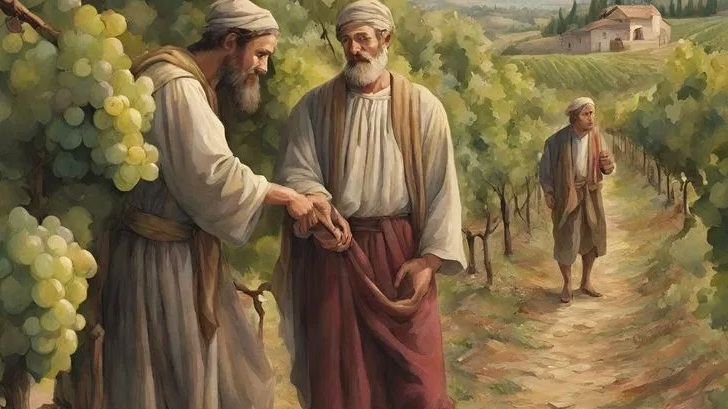
28 But what think ye? A certain man had two sons; and he came to the first, and said, Son, go work today in my vineyard.
29 He answered and said, I will not: but afterward he repented, and went.
30 And he came to the second, and said likewise. And he answered and said, I go, sir: and went not.
31 Whether of them twain did the will of his father? They say unto him, The first. Jesus saith unto them, Verily I say unto you, That the publicans and the harlots go into the kingdom of God before you.
32 For John came unto you in the way of righteousness, and ye believed him not: but the publicans [tax-collators]and the harlots [prostitutes] believed him: and ye, when ye had seen it, repented not afterward, that ye might believe him. (Matt. 21:28-32)
In order to understand this passage, it is important to remember Jesus was in the Temple in Jerusalem when He spoke. The Lord had returned from Bethany to the Holy City to celebrate the Passover. It would be the third Passover of His public ministry, and His last. In less than 72 hours Jesus would be arrested, put on trial, sentenced to death, and quickly crucified.
Inside the Temple area with Christ, were the Chief Priests, and the Elders. They engaged Jesus in the Court of the Gentiles. The Religious Leaders wanted to discredit the Lord before the people, only to find themselves on the defense. Jesus had asked the Religious Leaders a question concerning John the Baptist, which they refused to honestly answer.
These men knew that to tell the truth about what they believed would bring disfavor from the people, who were listening to the exchange with Jesus. The Religious Leaders decided to be silent, and let Jesus continue to speak. Jesus raised His voice to speak to the gathering crowd that was listening to the exchange. He had something important to say, and He would say it by telling three parables.
- Parable of the Better Son – Matthew 21:28–32
- Parable of the Vineyard – Matthew 21:33–46
- Parable of the Wedding Garment – Matthew 22:1–14
All three parables had a central point, which was directed at the Religious Leaders, who perceived the Lord was speaking about them. They were correct in this belief, which fueled their hatred of Jesus.
Like most people, they did not want to be corrected, no matter how valid the correction may be.
Ideally, God’s people will want to listen to their ministers, even when difficult topics have to be addressed.
Ideally, God’s people will want to repent of behavior, which clearly is in conflict with the known will of the Lord. They will not despise instruction.
Ideally, the first response when faced with any situation will be to ask, “What does God’s Word say on matter?”
Realistically, human behavior is quite different. When we read the Pharisees, and the Chief Priests, heard the Lord’s parables, and perceived that he spoke of them, we are also being told the reason why the Religious Leaders wanted to lay hands-on Jesus and hurt Him.
The Lord’s message was too personal, and that made the Chief Priests and the Pharisees angry.
They wanted to physically hurt Jesus. They wanted to spit on Him. They wanted to kill Him. They wanted to see Him crucified for they knew how violent a death that was.
What restrained the Religious Leaders from arresting Jesus was a fear of popular opinion. The Chief Priests and Pharisees feared the multitudes, because the people believed Jesus, like John, was a prophet from God. The fear of the Religious Leaders is interesting, because it provides a study in contrast as to what they did not fear.
First, the Religious Leaders did not fear Jesus. Though they had knowledge of His great power to perform miracles, the Chief Priests, and Pharisees were willing to lay hands on Christ. What restrained them was the face the common people who knew Jesus had never used His divine powers to hurt anyone. The power of Christ was used to cure the sick who asked for mercy. True, Jesus did overthrow some tables with tarnished coins. And He did take a whip to men’s backsides, but He did not use His Divine powers to destroy others, or to defend Himself.
Second, the Religious Leaders did not fear the Law of God, which contained all the commandments for holy living. The Law of God was not respected. The Religious Leaders set aside the concepts of truth, justice, and righteousness, in order to place heavy burdens on the people.
In practice, the Religious Leaders had a fundamental contempt for God’s Word.
They did not fear, nor respect the Scriptures.
They believed the Word of God was whatever they said it was.
Justice Oliver Wendell Holmes Jr. (1841–1935) is often associated with the phrase “the law is whatever we say it is.” Chief Justice Charles Evans Hughes concurred and said,
“We are under a Constitution, but the Constitution is what the judges say it is” (Charles Evans Hughes [1862–1948]).
“This statement reflects a pragmatic view of law, emphasizing that legal interpretations and rulings are determined by the courts rather than being fixed or absolute.”
This statement also reflects a hubris that is dangerous and destructive. Long ago the Religious Rulers of Israel said in essence, “The Law of Moses is whatever we say it is!”
Third, the Religious Leaders did not fear their own hearts. The Bible tells us the heart is deceitful above all things, and desperately wicked. Jesus said that out of the heart comes forth the desire to hurt, and murder others (Matt. 15:19). Had the Religious Leaders been more afraid of their own hearts, they could have reconsidered what they were doing.
However, “When you believe in nothing greater than your own righteousness, the only thing left is to destroy those who challenge your certainty” (William Bennet). Jesus was challenging the hypocrisy of the Chief Priests and Elders. He had to be destroyed. Despite their hostility to Him, Jesus had something to say to the common people about the Chief Priests and Elders.
As was His custom Jesus would make a point by telling a parable. There was a central point to each of them: the Chief Priests, and The Pharisees, were not worthy to be members of the kingdom of God. The evidence for this was compelling, illustrated in the story of two sons.
As Jesus told the tale, a father had two sons. With parental authority, the father went to the first child, and said, “Son, go and work in my vineyard.”
To the father’s surprise, the son answered with a great deal of defiance, and said, “I will not.”
Perhaps there was shock on the father’s face at the son’s response. Parents are always disappointed when their children are rude. But the father did nothing, except to go to the second child, and say, “Son, go and work in my vineyard.”
Unlike his brother, the second son replied to the father with gushing sincerity: “I will go,” but he went not.
The second son had his own agenda, and so he engaged in passive defiance. Passive defiance is characterized by telling people what they want to hear, and then doing what one wants to do anyway. The right words can disarm people, and then there is freedom to work one’s own will.
In the parable Jesus told, the Pharisee knew that He was talking about them.
They were the second son.
They had told God they would keep His Law, but they didn’t.
They had promised to serve the people, but they weren’t.
They were responsible for receiving the prophets of God, but instead they rejected them.
In contrast to the Chief Priests, and the Pharisees, were the publicans, and harlots. They were like the first son. When told by God to keep His commandments, they said, “NO! “But then they heard the Word of God through John, and through Jesus, and they repented.
Matthew wanted to stop exploiting people. He quit the religious IRA of his day.
Zaccheus wanted to stop stealing from people. “Lord, if I have taken from any one, I will repay fourfold.”
Mary Magdalene became a lady of great grace.
The woman at the well became a witness before the men of the town.
The stories are endless, as to how the publicans and harlots repented, and were therefore allowed to go first into the kingdom of heaven. By sovereign grace, by redeeming love, they became worthy of the gospel.
In the final analysis, all people are characterized by either the first son, or the second son.
The only question is this: “Which child are we?”
When the Father asks us to serve Him with our spiritual gifts, will we? When the Fathers asks us to obey His commandments, as they are recorded in Holy Scripture, without question, will we? When the Father pleads with us to love His Church and love His people, will we?
We might wound others with our words.
We might even wound the Father, disobey the Son, and grief the Holy Spirit, but will we repent, and go and do what the Lord wants us to do?
The Sons and daughters of God are needed for service.
The Father has made His request.
Now, He is waiting for His will to be done on earth as it is in heaven. “Who will go and work in His field today?”
I, the Lord of sea and sky,
I have heard My people cry.
All who dwell in dark and sin,
My hand will save.
Whom shall I send?Here I am Lord, Is it I Lord?
I have heard You calling in the night.
I will go Lord, if You lead me.
I will hold Your people in my heart.
 The Collected Works of Stanford E. Murrell