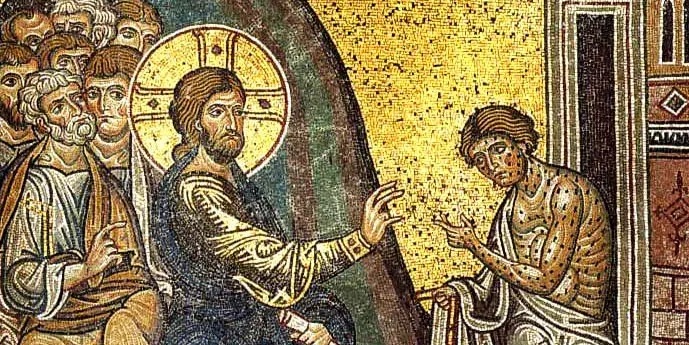
“When he was come down from the mountain, great multitudes followed him. And, behold, there came a leper and worshipped him, saying, Lord, if thou wilt, thou canst make me clean. And Jesus put forth his hand, and touched him, saying, I will; be thou clean. And immediately his leprosy was cleansed. And Jesus saith unto him, See thou tell no man; but go thy way, shew thyself to the priest, and offer the gift that Moses commanded, for a testimony unto them.” (Matt. 8:1-4)
After Jesus completed His Sermon On The Mount, the Bible says there were two reactions by the multitude which had gathered.
The first response was one of amazement. An astonishment fell over the audience. There was a momentary holy hush (Matt. 7:28, 29). Jesus commanded such reverence for He taught the people as one having authority. To teach with such authority is significant. It was the custom of the Jewish Rabbis and other religious teachers to always qualify what they said, or at least document what they taught with recognized and respected scholars.
We still do that today. Sometimes we quote a well-known Bible teacher, or a source of information.
But Jesus did not quote anyone, He did not document anything, apart from Scripture, and He did not qualify what He had to say. Jesus never said, “That is just my opinion,” on any given topic. He was dogmatism personified. With the wisdom of omniscience, Jesus spoke. As God incarnate, He spoke. With majestic utterance He spoke, and the people listened.
The people listened as Jesus explained to them the way of inner happiness. They listened as Jesus demanded their righteousness exceed that of the Scribes and the Pharisees. They listened as the Lord established high and holy standards regarding marriage, the use of personal language, prayer, and faith. The people listened and responded with wonder.
The second response of the multitude following the completion of the holy sermon is recorded in Matthew 8:1: “When He was come down from the mountain, great multitudes followed Him.” People seem to want to be near a man with a message. People will follow someone who knows where they are going, and invites others to join them. The Church has recognized this concept over the centuries and sang about.
“Come, we that love the Lord,
And let our joys be known;
Join in a song with sweet accord,
And thus surround the throne.We’re marching to Zion,
Beautiful, beautiful Zion;
We’re marching upward to Zion,
The beautiful city of God.”~Isaac Watts
Jesus had a message, and people stayed near Him to hear more of what He had to say. As the multitude lingered, they soon realized something else. Jesus was not only a great orator with unusual authority and wisdom, He was also kind and compassionate, for there came to the Lord a leper and worshiped Him.
Leprosy was a dreaded disease among the people of Palestine. It was the plague most feared as AIDS, COVID, or cancer is feared today. The people feared leprosy for a good reason. E. W. G. Masterman writes: “No other disease reduces a human being for so many years to so hideous a wreck.”
Dr. William Barclay observes that leprosy might begin with little nodules which go on to ulcerate.
The ulcers develop a foul discharge; the eyebrows fall out; the eyes become staring; the vocal cords become ulcerated, and the voice becomes hoarse, and the breath wheezes. The hands and feet ulcerate. Slowly the sufferer becomes a mass of ulcerated growths. The average course of that kind of leprosy is nine years, and it ends in mental decay, coma and ultimately death.
There is another form of leprosy that begins with the loss of all sensation in some part of the body; the nerves are affected; the muscles waste away; the tendons contract until the hands are like claws.
There follows ulceration of the hands and feet. Then comes the progressive loss of fingers and toes, until in the end a whole hand or a whole foot may drop off. The duration of that kind of leprosy is anything from twenty to thirty years. It is a kind of terrible progressive death in which a man dies by inches.
There was more.
In the Jewish world, by Law, the leper had to dress in clothing that was torn. His hair was to be left uncombed. He had to cover his upper lip and as he walked, he had to cry out,
“UNCLEAN! UNCLEAN!”
The leper was banished from Jerusalem and all towns with walls. In the synagogue, the place of worship, there was provided for the leper a little isolated chamber, ten feet high and six feet wide, called the Mechitza (Heb. partition). The Law listed 61 different contacts with a leper which could defile a person.
If a leper merely leaned his head into a house, that house became unclean. Even in the open air, no one was allowed to come closer than 18 inches to a leper. If the wind was blowing towards a person from a leper, the leper was to stand 5 1/2 feet away. The Rabbis who made the rules for the people led the way in being hostile towards lepers.
One Rabbi would not eat an egg that had been purchased in a street where a leper had passed by. Another Rabbi boasted that he hurled rocks at lepers to keep them away. Other Rabbis hid themselves, or literally ran at the sight of a leper in the distance. So vile was a leper that the prophets used leprosy as an illustration to preach against the sins of the nation.
Isaiah cried out that the Israelites were sick.
“From the sole of the foot even unto the head there is no soundness in it; but wounds, and bruises, and putrefying sores; they have not been closed, neither bound up, neither mollified with ointment” (Isa. 1:6).
Whether speaking spiritually, or physically, the composite picture of a leper is someone who was isolated, loathsome, outside the fellowship and friendship of others.
But here in our text is the wonderful thought.
The Bible says that such a person worshipped Jesus. My own heart rejoices, for I look inward and am convicted of personal corruption. My conscience is smitten and I know I deserve to be cast outside the fellowship of God and of His people forever. The Bible says that sin has corrupted every heart. The sin of Adam is the sin of his posterity.
Sin has come to destroy and distort all that was once good and holy before God. Like the people of Israel of old there is to be found a sickness, “from the sole of the foot even unto the head.” And yet, despite this condition, like the man in our passage, we can still come and worshipped the Lord and plead for divine healing, spiritually, and physically.
The text continues and says that the man not only worshipped Jesus with confidence in his heart, he prayed. His prayer was based upon His understanding of the Lordship of Christ. “Lord!” the leper cried.
This is the first occurrence in the New Testament of the word “Lord” being applied to Jesus Christ.
The word means “master,” but is used over 650 times in the New Testament as a Divine title. It is not wrong to believe that this leper realized by faith that in Jesus he had found his Lord and his God. He longed to be mastered by the Master and so he cried out and he prayed. “LORD, if thou wilt, thou canst make me clean.”
This humble petition was subordinate to the will of Christ for he said, “if thou wilt.” It is not uncommon for a person to pray and demand God answer in a positive way. But sometimes the Lord does say, “No!” Sometimes the Lord says, “Yes!” Sometimes the Lord says, “Wait.”
This leper claimed no healing. This leper demanded nothing. This leper did not quote Scripture to argue his case. He simply and with true humility asked in faith. The faith of the leper was in the absolute sovereignty of Christ to do with His own as He saw fit. What a beautiful scene we have here. The Creator standing before the creation. The servant bowed low before the Sovereign of the Universe. The Lord of Glory near a defiled human.
How will Jesus respond in the presence of this outcast of society?
He could respond with impatience.
How dare this leper interrupt His teaching ministry.
Jesus has people to see, places to go, sermons to preach.
But Jesus is not bothered.
The Bible says that the Lord put forth His hand and touched the one person the world would never touch. The caress of Christ must have shocked both the leper and the multitude. People recoiled from lepers. They did not reach out and touch them. But Jesus did and by so doing demonstrated to His disciples how all who would be like Him must act in a similar situation.
The Christian must be ready to reach out and love the unlovely, help the hurting, and consider the outcast. The touch of Jesus was the touch of kindness and compassion requested. Perhaps it had been years since anyone had put a finger on this man in love. How sad that would have been.
As humans, we need the touch of tenderness.
We live in a world filled with violence and bloodshed. The statistics are numbing as the reports come in how many wives are battered, how many children are molested, and how many lives are taken each day.
We live in a world that engages in sexual harassment. We live in world where life is cheap and the heart is hardened to bloodshed and violence. Video games have conditioned a whole generation to be cruel and heartless, sassy to parents, and addicted to harmful images. The movies and television programs promote every form of perversion including profanity.
We live in a day in which society has by and large forgotten how to be kind. In 1988 President Bush called for a kinder and more gentle society. His words went unheeded. We need Someone like Jesus to teach us to love again, to reach out and to touch someone.
Not only did Jesus touch the untouchable but He spoke the unspeakable, saying,
“I will heal you, be thou clean.”
Jesus was always saying, “I will.”
“I will,” said Jesus to the Father, and He came to die on Calvary’s Cross.
“I will,” said Jesus to the Holy Spirit, and He was led into the hot, burning desert for forty days and forty nights.
“I will,” said Jesus to the sick, and the incurable were cured.
In the moment of humble request, there was no debating the issue.
There was no uncertainty.
A man prayed and Jesus answered.
A man worshipped and Christ was honored.
A man believed and it pleased the Lord.
Our text says that immediately the leprosy was cleansed.
When Jesus speaks there is no question as to what will happen.
His will is done on earth as it is in heaven, and the healed-on earth sing.
“Shackled By A Heavy Burden
‘Neath A Load Of Guilt And Shame
Then The Hand Of Jesus Touched Me
And Now I Am No Longer The Same.He Touched Me
Oh He Touched Me
And Oh The Joy That Floods My Soul
Something Happened And Now I Know
He Touched Me And Made Me Whole.Since I Met This Blessed Saviour
Since He Cleansed And Made Me Whole
I Will Never Cease To Praise Him
I’ll Shout It While Eternity Rolls.He Touched Me
Oh He Touched Me
And Oh The Joy That Floods My Soul
Something Happened And Now I Know
He Touched Me And Made Me Whole.”~William Gaither
The Lord instructed the man what He was to do.
First, he was to testify to no one what had happened. “See thou tell no man.” It was not the intent of Jesus to call undue attention unto Himself. Not all that God does in our lives has to be shared.
Sometimes the miracles of sovereign grace are better left to silence unless the Master gives permission to speak.
Second, the man was instructed to comply with the provisions of the Mosaic Law by showing himself to the priest. The Law of Moses had strict provision for those people with the terrible disease. The ritual is described in Leviticus 14. The leper was examined by a priest. Two birds were taken, and one was killed near running water. In addition, there was taken cedar, scarlet and hyssop. These things were taken, together with the living bird, and dipped in the blood of the dead bird, and then the living bird was allowed to go free. The man washed himself and his clothes, and shaved himself. Seven days were allowed to pass, and then he was re-examined. he must then shave his hair, his head, and his eye-brows.
Certain sacrifices were then made consisting of two male lambs without blemish, and one ewe lamb; three-tenths of a deal of fine flour mingled with oil; and one log of oil.
The restored leper was touched on the tip of the right ear, the right thumb, and the right great toe with blood and oil. He was finally examined for the last time, and if, the cure was real, he was allowed to go with a certificate that he was cleansed. The leper who bowed before Jesus was to go and fulfill the demands of the law. He was to get a certificate.
Spiritually, there is a certificate that is given to every person who is cleansed of sin by the Saviour.
It may be presented at the portals of heaven and this is what it will say: “Cleansed by the blood of the Lamb. Enter the joys of the kingdom.”There are two main lessons we might learn from this narrative.
First, the story reminds us that as Christians we need to be people of compassion. A large portion of the problems of the world could be solved with more compassion being demonstrated.
Second, the true Christian will break any convention and will take any risk to help someone who desires help. We need to pray and to ask that the Lord will heal each of us personally, not only of our physical diseases, but more of our spiritual leprosy of sin. We need to ask the Holy Spirit to teach us to show compassion towards others.
Perhaps you have a need for healing. It may be a physical healing that is needed. It may be a spiritual healing that is needed. It may very well be that Jesus will show tender mercies to you as He did to the leper. He does not have to. But if we ask without demands, maybe, just maybe the Lord will give us the deepest longing of our hearts as we recognize His sovereign grace.
 The Collected Works of Stanford E. Murrell