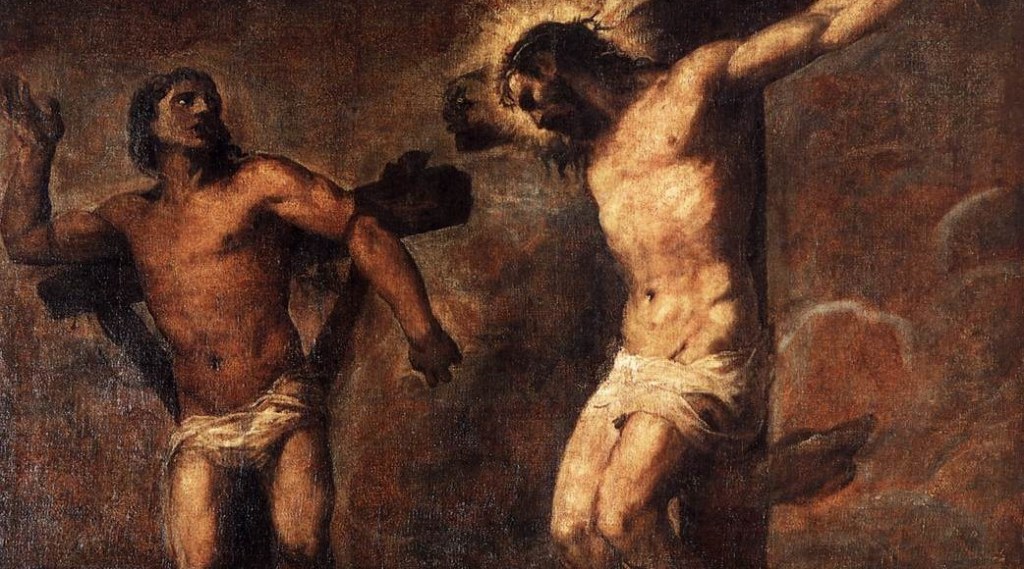
At that time two robbers were crucified with Him [Jesus], one on the right and one on the left. And those passing by were hurling abuse at Him, wagging their heads and saying, “You who are going to destroy the temple and rebuild it in three days, save Yourself! If You are the Son of God, come down from the cross.” In the same way the chief priests also, along with the scribes and elders, were mocking Him and saying, “He saved others; He cannot save Himself. He is the King of Israel; let Him now come down from the cross, and we will believe in Him. ‘HE TRUSTS IN GOD; LET GOD RESCUE Him now, IF HE DELIGHTS IN HIM; for He said, “‘I am the Son of God.’” The robbers who had been crucified with Him were also insulting Him with the same words. (Matt. 27:38–44)
One of the criminals who were hanged there was hurling abuse at Him [Jesus], saying, “Are You not the Christ? Save Yourself and us!” But the other answered, and rebuking him said, “Do you not even fear God, since you are under the same sentence of condemnation? And we indeed are suffering justly, for we are receiving what we deserve for our deeds; but this man has done nothing wrong.” And he was saying, “Jesus, remember me when You come in Your kingdom!” And He said to him, “Truly I say to you, today you shall be with Me in Paradise.” (Luke 23:39–43)
Today, I would have us see Jesus, through the eyes of a thief. The Bible says that two criminals were crucified with Jesus. Initially, both were cruel in their comments against Christ. The robbers listened to those who were passing by the cross of Jesus, and joined in mocking Him. “You who are going to destroy the temple and rebuild it in three days, save Yourself!” (Matt. 27:40).
The idea uniting Jesus with the destruction of the Temple, was a memorable thought in the collective conscience of the Jews in Jerusalem. These words were initially uttered soon after the first miracle that Jesus performed in Canaan of Galilee, where He had turned water into wine, and where His disciples first believed in Him (John 2:11).
The Bible tells us that after attending the wedding, Jesus went 75 miles down to Capernaum, He and His mother, and His brothers, and His disciples; and they all stayed in Capernaum for several days. Then, because the Passover of the Jews was near, Jesus went back up to Jerusalem.
When Jesus arrived at the majestic Temple, He found those who were selling oxen and sheep and doves, and He saw the money changers seated at their tables. A righteous anger suddenly came upon Jesus. The Temple of God was being abused. A holy place was being dishonored.
Looking around, Jesus gathered up some material to personally make a phragellion,a small whip or scourge made of twisted cords, out of rushes or reeds. As a gifted carpenter, able to work with His strong hands, Jesus would know how to make a sturdy weapon to drive out of the Temple courtyard, the money changers, with the sheep and the oxen, which He did.
Jesus took leather pouches filled with coins and poured them out. He overturned tables the money changers sat behind. Then, to those who were selling the doves, Jesus had something specific to say: “Take these things away; stop making My Father’s house a place of business” (John 2:16). The dove appears in Scripture as a symbol of hope, peace, and purity.
When Noah wanted to know if the wrath of God against humanity had ended, he sent forth a dove that eventually returned with an olive leaf in its beak, “So, Noah knew that the water was abated from the earth” (Gen. 8:11–12).
Life would continue. A covenant would be made, confirmed by a beautiful rainbow. Hope lived.
When the Psalmist became fearful and the horrors of life overwhelmed him, he cried out in anguish, “Oh, that I had wings like a dove! I would fly away, and be at rest” (Ps. 55:6). The flight of a dove would bring peace.
When Jesus was baptized, “the heavens were opened, and he saw the Spirit of God descending as a dove and lighting on Him” (Matt. 3:16). The purity of the Holy Spirit, symbolized by a dove, rested upon Jesus.
Is it any wonder that Christ specifically spoke against those who were selling doves? Hope, peace, and purity are the gifts of God, for the people of God. The dove was allowed to be offered to the Lord as a sacrificial offering (Lev. 1:14–17), but the gentle bird was not meant to be a source of commercial gain.
As the disciples of Jesus watched Him lash out at the commercialism in the courtyard of the Holy Temple, His disciples were caused to remember that it was written of the Messiah, “ZEAL FOR YOUR HOUSE WILL CONSUME ME” (Ps. 69:9).
If Jesus came to the Church today, what would He drive out of His Father’s house? How much of the world has come into the Holy Temple? That is a discussion worth having.
Because Jesus dared to cleanse the Temple, the religious leaders approached him to ask, “What sign do You show us as your authority for doing these things?” (John 2:18). Jesus answered the Jews by saying, “Destroy this temple, and in three days I will raise it up” (John 2:19). The Jews were astonished, and alarmed. They did not understand what Jesus was saying spiritually, but they never forgot His words (John 2:12–19).
Three years later, when Jesus was arrested and brought before Caiaphas the high priest, someone remembered the words He had spoken about the Temple, and leveled a false accusation against Him.
And when Jesus was put on the Cross, His words were still being remembered, and quoted in mockery, because they were still a mystery to many, including the two robbers.
However, for one of the thieves, the mystery was about to be solved. Despite excruciating pain, one of the criminals was still able to think about Jesus, and his thoughts were changing. There was a dawning awareness that the Man in the Middle was uniquely different from themselves, and all others. The dying criminal heard what the people passing by were saying; but He also heard what Jesus was saying at the apex of His suffering, as the Lamb of God slain for the sins of the world.
It was about the ninth hour, or 3:00 PM when Jesus cried out from the cross, “Eli, Eli, lama sabachthani? that is to say, ‘My God, my God, why hast You forsaken me?’” (Matt. 27:46).
In Scripture, when a person’s name is repeated twice, it is for emphasis. There are at least seven times in the Bible where names were called twice.
Abraham! Abraham! And Abraham said, “Here am I” (Gen.22:11).
Jacob! Jacob! And Jacob said, “Here I am” (Gen. 46:2).
Moses! Moses! And Moses said, “Here I am” (Ex. 3:4).
Samuel! Samuel! And Samuel said, “Speak, for Your servant is listening” (1 Sam. 3:10).
Simon! Simon! behold, Satan has demanded permission to sift you like wheat; but I have prayed for you, that your faith may not fail; and you, when once you have turned again, strengthen your brothers” (Luke 22:31–32).
Saul! Saul! “Why are you persecuting Me?” And Saul said to Him, “Who are You, Lord?” (Acts 9:4–5).
Martha! Martha! “You are worried and bothered about so many things” (Luke 10:41).
By calling out, “My God! My God!” an emphasis was placed on the suffering of the Savior.
It was proper that Jesus should utter this heartfelt cry to the Father at the ninth hour, “for this was the time of the regular evening sacrifices, as well as the time of evening prayer among the people of ancient Israel.
It was at this hour that Elijah prayed to God against the prophets of Baal on Mount Carmel, and God answered by fire from heaven (1 Kgs. 18:36–39). This was also the hour of Ezra’s great prayer of confession and intercession, followed by a wonderful revival among the backslidden people of Israel (Ezra 9:5). When Daniel uttered his own prayer of confession and intercession, [it was] about the time of the evening oblation, God sent the angel Gabriel to answer his prayer (Dan. 9:21).
In the New Testament, “Peter and John went up together into the temple at the hour of prayer, being the ninth hour, “and the result was the first apostolic miracle (Acts 3:1). The first Gentile convert to Christ was Cornelius, who was praying, ‘about the ninth hour of the day’ when he, like Daniel, received a visit from an angel of God to tell him to send for Peter, who would lead him to Christ” (Acts 10:3; “The Ninth Hour” Henry M. Morris).
There was something else the dying thief overheard. He listened as Jesus prayed, “Father, forgive them, for they do not know what they are doing?” (Luke 23:34).
The Holy Spirit illuminated the heart of the dying thief. Like a flash of lightening into his soul, the gospel was understood. In death, Jesus was dying with the wrong-doer, but far more than that, Jesus was dying for him. Herein is the doctrine of particular atonement. It is good to say, “Jesus died for sinners. “It is far better to say, “Jesus died for me.”
When the other malefactor railed against Jesus saying, with a voice of contempt and sarcasm, “Are you not the Christ? Save yourself and us!” the newly converted criminal rebuked him, saying, ‘Do you not even fear God, since you are under the same sentence of condemnation? And we indeed are suffering justly, for we are receiving what we deserve for our deeds; but this Man has done nothing wrong’” (Luke 23:39–41).
And then the dying thief said, “Jesus, remember me when you come in Your kingdom” (Luke 23:42). And Jesus said unto him, “Truly I say to you, today you shall be with me in Paradise” (Luke 23:39).
“If that isn’t Love
The ocean is dry
There’s no stars in the sky
And the sparrow can’t fly
If that isn’t Love
Then heaven’s a myth
There’s no feeling like this
If that isn’t love.”~Dotti Rambo
Because of the words of the converted criminal, and because of the grace extended to him, we would have you see Jesus through the eyes of a thief. Do not look at Jesus through the eyes of the chief priests and Pharisees. Do not look at Jesus through those citizens passing before the Cross wagging their heads. Look at Jesus through the eyes of a thief.
People often look at Jesus and see in Him things that are not true. Some have looked at Christ and seen Him as a great Moral Teacher. In their estimation, Jesus is to be classified with Socrates, Confucius, and the Buddha. Like Hammurabi and Moses, Jesus is the Great Lawgiver of moral life. However, if Jesus is not the Son of God, as He claimed to be, then He is not a great moral Teacher. He is a monster for giving so much false hope. This was the point C. S. Lewis made in 1942, when he wrote the following:
I am trying here to prevent anyone saying the really foolish thing that people often say about Him [Jesus]: “I’m ready to accept Jesus as a great moral teacher, but I don’t accept his claim to be God.” That is the one thing we must not say. A man who was merely a man and said the sort of things Jesus said would not be a great moral teacher. He would either be a lunatic—on the level with the man who says he is a poached egg—or else he would be the Devil of Hell.
You must make your choice. Either this Man was, and is, the Son of God, or else a madman or something worse. You can shut him up for a fool, you can spit at him and kill him as a demon or you can fall at his feet and call him Lord and God, but let us not come with any patronizing nonsense about his being a great human teacher. He has not left that open to us. He did not intend to (Mere Christianity, C, S. Lewis, 1942).
Others look at Jesus and see nothing but a religious fraud, who was able to deceive the masses. In 1965, The Passover Plot was published. The author, Hugh J. Schonfield, contended that Jesus plotted His own death, by provoking the Jewish and Roman officials into executing Him, so that He could become a martyr. Simply put, Jesus was a zealous fraud who willingly died to deceive others in order to be heroic in death.
However, there are others, like the thief on the cross, who see Jesus with the eye of faith, and confess that He is the Son of the Living God. There are those who can see, by faith, that Jesus can forgive sins, and take a soul to Paradise.
The criminal on the cross, dying beside Jesus, was a terrible person. By his own confession, he deserved to be crucified. He deserved to be severely punished, according to the Law. The thief was getting what he deserved, but what he desired after death was grace. So, he turned to Jesus and said,
“Lord, remember me, when you come into Your kingdom.”
“Lord, remember me, as a great sinner who confessed, ‘You are the Christ, the Son of the Living God!’”
“Lord, remember me, as I repent of my sins.”
“Lord, remember me, for I confess you as my Lord and Savior.”
That is all the dying thief said. He did not have time to be baptized. He did not have time to join a church. He did not have time to perform good works. He only had time to believe, and Jesus said, “Today you shall be with me in Paradise.”
What a lovely thought. The first-person Jesus took with Him to Paradise was that thief. That criminal. That man who deserved hell. The gospel message is crystal clear. On the cross Jesus was dying for people like him, like you, like me.
Now attention is draw to the word, Paradise, because it speaks of a place of great beauty and peace. It is a Persian term, used in the Old Testament to speak of the forest owned by the ruler, Artaxerxes (c. 464–425 BC; Neh. 2:8). Paradise was the Garden of the king.
In the New Testament, “paradise” occurs three times, and refers to the dwelling place of the righteous dead; it refers to heaven (Luke 23:43; 2 Cor. 12:4; Rev. 2:7). Since Florida is often called, “Heaven’s Waiting Room,” some of us are encouraged by believing in a heavenly place, called Paradise. The Bible says, “to be away from home in the body, is to be at home in the Lord” (2 Cor. 5:8).
Our home with the Lord is Paradise. It is the garden of the King of kings. And one day we will ask Jesus to take us to Paradise. Holy angels will come to escort us to our heavenly home. There, in Paradise, we shall see those who have gone before us, provided, we see Jesus through the eyes of a thief.
Over the centuries, countless individuals have seen Jesus, through the eyes of a thief, and desired to learn more about Him. In the fourth century AD, Gregory of Nazianzus (in Turkey, AD 330 – 389) learned more about Jesus. He learned that…
Jesus began His ministry by being hungry, yet He is the Bread of Life.
Jesus ended His earthly ministry by being thirsty, yet He is the Living Water.
Jesus was weary, yet He is our rest.
Jesus paid tribute, yet He is the King.
Jesus was accused of having a demon, yet He cast out demons.
Jesus wept, yet He wipes away our tears.
Jesus was sold for thirty pieces of silver, yet He redeemed the world
Jesus was brought as a lamb to the slaughter, yet He is the Good Shepherd.
Jesus died, yet by His death He destroyed the power of death.
Three questions now come.
First, have you personally seen Jesus, through the eyes of the converted thief on the cross?
Second, do you have any hope of being taken to Paradise, in due time?
Third, do you desire to know more about Jesus, in all His grace and glory? Are you growing in knowledge of our Lord and Savior? If not, “Why not?”
The gospel invitation comes to behold, embrace, and love Jesus who died for you. In his book, Written in Blood, Robert Coleman tells the story of a little boy whose sister needed a blood transfusion. The doctor explained that the child had the same disease the boy had recovered from two years earlier. Her only chance for recovery was a transfusion from someone who had previously conquered the disease. Since the two children had the same rare blood type, the boy was the ideal donor. “Would you give your blood to Mary?” the doctor asked. Johnny hesitated. His lower lip started to tremble. Then he smiled and said, “Sure, for my sister.”
Soon the two children were wheeled into the hospital room—Mary, pale and thin; Johnny, robust and healthy. Neither spoke, but when their eyes met, Johnny smiled. As the nurse inserted the needle into his arm, Johnny’s smile faded. He watched the blood flow through the tube. With the ordeal almost over, his shaky voice broke the silence. “Doctor, when do I die?”
Only then did the doctor realize why the boy had briefly hesitated, why his lip had trembled when he agreed to donate his blood. The boy thought that giving his blood to his sister meant giving up his life. Still, in that important moment, he had made his great decision. Fortunately, the child did not have to die to save his sister.
Each of us, however, has a condition more serious than Mary’s, and it required Jesus to give, not just His blood, but His life. Long before Calvary, before the foundation of the world, Jesus made a great decision. He would be the Lamb of God slain for sinners. The dying thief understood this, but do you?
Have you seen Jesus through the eyes of a thief? If not, come and ask for spiritual eyes to see, a heart to believe, and a faith that embraces the hope of enjoying eternal life in the Garden of the King.
My Jesus, I love Thee, I know Thou art mine;
For Thee all the follies of sin I resign;
My gracious Redeemer, my Savior art Thou;
If ever I loved Thee, my Jesus, ’tis now.
I love Thee because Thou hast first loved me,
And purchased my pardon on Calvary’s tree;
I love Thee for wearing the thorns on Thy brow;
If ever I loved Thee, my Jesus, ’tis now.I’ll love Thee in life, I will love Thee in death,
And praise Thee as long as Thou lendest me breath;
And say when the death dew lies cold on my brow,
If ever I loved Thee, my Jesus, ’tis now.In mansions of glory and endless delight,
I’ll ever adore Thee in heaven so bright;
I’ll sing with the glittering crown on my brow,
If ever I loved Thee, my Jesus, ’tis now.~ William R. Featherston

