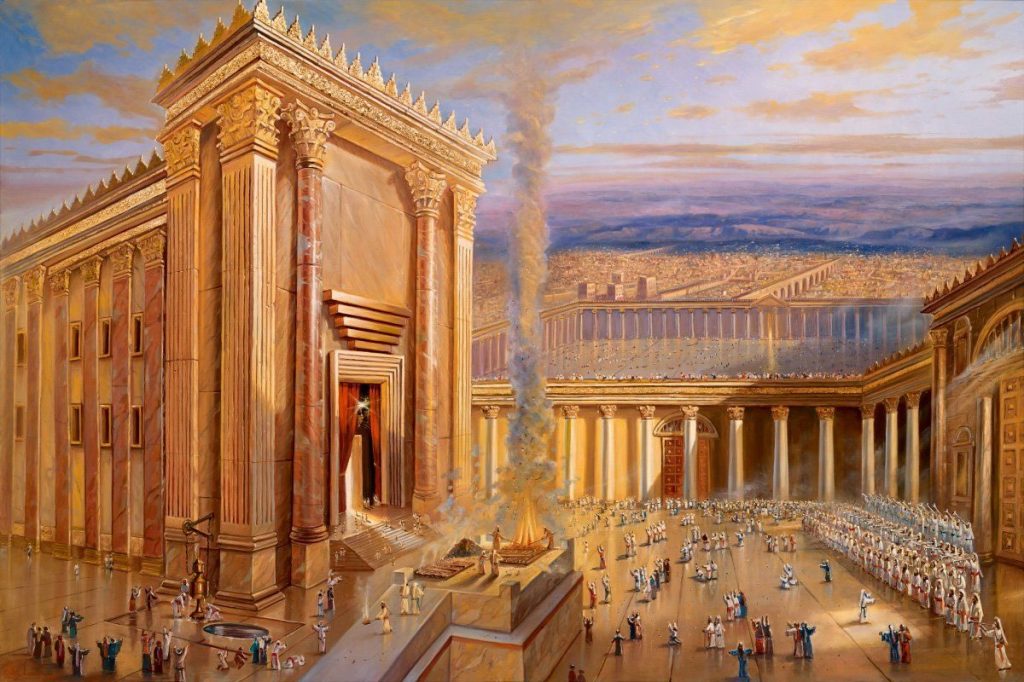
“And Jesus went out, and departed from the temple: and his disciples came to him for to shew him the buildings of the temple. And Jesus said unto them, See ye not all these things? verily I say unto you, There shall not be left here one stone upon another, that shall not be thrown down. And as he sat upon the mount of Olives, the disciples came unto him privately, saying, Tell us, when shall these things be? and what shall be the sign of thy coming, and of the end of the world? And Jesus answered and said unto them, Take heed that no man deceive you. For many shall come in my name, saying, I am Christ; and shall deceive many.” (Matt. 24:1-5)
Prior to the Olivet Discourse, there was an incident that captured the Lord’s attention. Luke records in chapter 21 of his gospel what Jesus saw. And Jesus looked up, and saw the rich men casting their gifts into the treasury. And he saw also a certain poor widow casting in thither two mites [1/8th of a US penny].
And Jesus said,
‘Of a truth I say unto you, that this poor widow hath cast in more than they all. For all these have of their abundance cast in unto the offerings of God: but she of her penury [destitution] hath cast in all the living that she had’ (Luke 21:1-4).
After commenting on the virtue of the widow giving her two mites to God, Jesus turned His full attention to His disciples because they wanted to point out to Him the beautiful buildings surrounding the Temple. The Temple and surrounding structures were majestic. Miles before people reached Jerusalem, they could see the beautiful white façade where God was said to dwell among His people. Hearts trembled and the pace quickened in joy and anticipation when the Temple was seen.
“Beautiful for situation,
the joy of the whole earth, is mount Zion,
on the sides of the north,
the city of the great King.”
~Psalm 48:2
Herod had begun renovative work on the Temple (c. 20 BC); 46 years later construction was still going on during the ministry of Jesus (John 2:20).
The Temple would finally be finished in AD 63, just seven years before its destruction in AD 70, as Jesus would now reveal.
Jesus said unto them, See ye not all these things? verily I say unto you, There shall not be left here one stone upon another, that shall not be thrown down.
“And as He sat upon the mount of Olives, the disciples [Mark 13:3 Peter, James, John, Andrew] came unto Him privately, saying, Tell us, when shall these things be? and what shall be the sign of thy coming, and of the end of the world? And Jesus answered and said unto them, Take heed that no man deceives you. For many shall come in my name, saying, I am Christ; and shall deceive many.” (Matt. 24:3-5)
Between AD 66 and AD 70, the prophetic utterances of Jesus began to be fulfilled.
Briefly the known facts can be stated.
In the summer of the year AD 66, a Jewish revolt broke out in Jerusalem. Led by fanatical Zealots (Zicari), this revolt took place against the overbearing Roman procurator [governor] named Gessius Florus. Showing no respect to Jewish culture or religion, Gessius had gone to the Holy Temple in Jerusalem and forcibly taken 17 talents of gold and silver from the sacred treasury. The collection of taxes was the pretense for this robbery of more than one million dollars in today’s value.
The real reason for the political theft was to subjugated the Jews to Roman authority, and personal greed. From May through November of AD 66, the Jews verbally and violently reacted against the oppressive reign Gessius Florus. There were protests, destruction of property, assaults on Roman emissaries, and blood in the streets. As a result, Nea-poli-tan-us, a Roman military tribune, consisting of 600 soldiers, was sent from Antioch by Cestius Gallus, the Roman governor of Syria, to try to calm the Jews.

The Jews still refused to be pacified resulting in even more soldiers being sent to the area. The dark situation was escalating. In the battle that followed, the Jews gained a surprising advantage against the 30,000 Roman troops of the governor of Syria. Cestius Gallus had to order a retreat, much to the delight of the Jews. It was not long before word finally reached the emperor Nero in Rome about the explosive situation unfolding in Israel.
After deliberation, Nero commissioned a seasoned general, Vespasian, to put down the revolt against imperial Rome and to restore the Pax Romana (Roman peace).
War against the Jews in Jerusalem was officially declared in February, AD 67, when Vespasian received his commission from Nero.
In the Spring of AD 67, Vespasian arrived to take charge of the operations in Jerusalem.
But the Jews proved to be a strong and resourceful people, not easily subdued.
Nationalism beat strongly in their hearts.
The Jews desperately wanted to be free of Roman bondage and were willing to fight and die for the cause of freedom.
History records that Jerusalem did finally fall to Titus, the son of Vespasian, who took charge of the siege in the late summer of AD 70.
For about forty-two months the Jewish people held out against the greatest military power on the face of the earth.
Then the walls of Jerusalem were breached, and the final conquest began.
In broad strokes this was the terrible picture of death and destruction, violence and chaos between AD 66 and AD 70.
The words of Jesus in Matthew 24, Mark 13, and Luke 21 can be used to paint in the details of this period.
What will be reviewed is a historical fulfillment of the horrors that Jesus predicted would come upon the generation He ministered to.
These were days of vengeance as God poured out His wrath on those who dared to kill His Son (Matt. 27:25; Luke 21:22).
These were days of retributive justice for those who had killed the prophets and sages and teachers,
from the blood of righteous Abel to the blood of Zechariah, whom the Jews murdered between the temple and the altar (Matt. 23:29-35).
“Truly I tell you; all this will come on this generation….Jerusalem, Jerusalem, you who kill the prophets and stone those sent to you, how often I have longed to gather your children together, as a hen gathers her chicks under her wings, and you were not willing. Look, your house is left to you desolate. For I tell you, you will not see me again until you say, ‘Blessed is he who comes in the name of the Lord.’” (Matt. 23:36-39, NIV)
Those who were eyewitnesses of the events of AD 70, testify to the judgment of God upon the land. One of the leading eyewitnesses for the history of this time, was an unusual individual known to history as Flavius Josephus. Josephus was born Joseph ben Matthais in AD 37 or AD 38He grew up to become a Jewish priest, and soldier, and then a Roman citizen and writer of history.
He is considered to be a reliable historian, despite his critics. It is noteworthy that the Christian community preserved the works of Josephus and not the Jewish community for many Jews considered Josephus to be a traitor. The works of Josephus were preserved by the Christians because he made reference to Jesus Christ. Josephus recorded those events that the early Church came to believe were the fulfilled prophecy of Christ in Matthew 24, Mark 13, and Luke 21.
Returning to the gospel the biblical narrative is very clear. Jesus and His disciples were in the Temple courtyard of Jerusalem. The disciples were impressed with the splendid structure and with the significance of the Temple itself. From the moment Abraham was willing to sacrifice his only son to God on the site of Mount Moriah (2 Chr 3:1; i.e. Mount Zion), the place has been the most sacred spot to the nation of Israel.
Here the Temple of Solomon was built.
Here the Second Temple was rebuilt after being destroyed in 586 BC by the Babylonians.
Here was the place where God met with His people (Haggai 2:3). Time passed and the Second Temple stood unchanged until the days of Christ, under the reign of Herod the Great. Despite His disciples being impressed with the buildings that constituted the Second Temple, Jesus was not. The Lord began to tell them what would happen to that which so many loved more than the Messiah. The words of Jesus are vivid and precise.
“And Jesus said unto them, See ye not all these things? Verily I say unto you, There shall not be left here one stone upon another, that shall not be thrown down.” (Matt. 24:2)
History records that just as Jesus predicted, the holy Temple was essentially destroyed.
Josephus records the terrible scene.

The Taking of the Tower which Protected the Holy Temple
600 ft. away
“So, Titus retired into the Tower of Antonia [named after Mark Antony], and resolved to storm the Temple the next day, early in the morning, with his whole army, and encamp round about the holy house;
but, as for the house, God had for certain long ago doomed it to the fire; and now that fatal day was come…
As the flames went upward the Jews made a great clamor, such as so mighty an affliction required, and ran together to prevent it;
and now they spared not their lives any longer, nor suffered anything to restrain their force…” (The War of the Jews, Book 6, Chapter 4:5-7).
The Temple was looted and burned.
In AD 30, when Jesus spoke of the destruction of the Temple, the disciples could not fully appreciate what the Lord knew was going to happen.
They could not envision the bloodshed and violence, the fire and destruction that was to come.
“To be forewarned is to be forearmed,”
is a proverb not always true. However, when Jesus spoke in AD 30, the disciples were curious enough and alarmed enough to ask Him for more details.
As Jesus sat upon the Mount of Olives, four disciples came to Him privately, saying,
‘Tell us when shall these things be?
And what shall be the sign of thy coming… [coming, παρουσία parousía, par-oo-see’-ah, an advent (often, return; specially, of Christ to punish Jerusalem, or finally the wicked) …and the end of the world [αἰών aiṓn: properly, an age]?’ (Matthew 24:3).
Two basic questions were asked (Mark 13:4; Luke 21:7).
First, “When shall the Temple be destroyed?”
Second, “What sign shall there be when these things come to pass?”
While the disciples asked for a single sign for His coming and the end of the age,
in grace Jesus gave them several signs that would characterize the period between AD 30 and the destruction of Jerusalem (Luke 21:22). Jesus also gave the specific sign they were to look for because the sacrificial age of Judaism was coming to an end.
Out of Judaism God intended to bring forth the New Testament expression of the Church, just as He brought His Chosen People out of Egypt long ago.The initial sign Jesus gave to characterize the specific period in question (AD 30 – AD 70) was the rise of false Christs and deceivers.
First Sign: Spiritual Deception
“And Jesus answered and said unto them, Take heed that no man deceive you. For many shall come in my name, saying, I am Christ; and shall deceive many.” (Matt. 24:4-5)
The Jewish historian Josephus writes that many pretenders arose prior to the Fall of Jerusalem; each one was claiming Divine inspiration.
These individuals deceived the Jews by declaring that God would show the miraculous signs of deliverance from the Roman armies. The testimony to the rise of false Christ’s and deceivers is recorded in the book of Acts.
Simon Magus is spoken of in Acts 8:9, 10. St. Jerome (c. 342–420) quotes him as saying,
“I am the Word of God, I am the Comforter, I am Almighty, I am all there is of God.”
The work of Judas of Galilee is mentioned in Acts 5:37.After this man rose up Judas of Galilee in the days of the taxing, and drew away much people after him: he also perished; and all, even as many as obeyed him, were dispersed.
On the island of Paphos, Paul confronted the false prophet Bar-Jesus (Elymas), who was a “sorcerer” (Acts 13:6-12).
In secular history, Origen (d. 254 AD) mentions a deceiver by the name of Dositheus. He asserted he was the Messiah spoken of by Moses (Deut. 18:15-19).
One of the false prophets was a young girl who said something that was true, and a lesson is learned. Sometimes the truth can be spoken by the Devil, by one of his demons, or by one of his children. Her story is told in the book of Acts.
And it came to pass, as we went to prayer, a certain damsel possessed with a spirit of divination met us, which brought her masters much gain by soothsaying:
The same followed Paul and us, and cried, saying, These men are the servants of the most high God, which shew unto us the way of salvation.
And this did she many days. But Paul, being grieved, turned and said to the spirit, I command thee in the name of Jesus Christ to come out of her. And he came out the same hour. (Acts 16:16-18).
In Acts 16, the girl possessed by a “spirit of divination” is often referred to as having a “pythonical spirit.” This term relates to the myth of the Pythian serpent, which guarded the oracle at Delphi.
The girl earned money for her masters through fortune-telling, indicating that her abilities were linked to this demonic presence.
Paul sensed that though a truth was being proclaimed, something was wrong, and in time cast the spirit of divination from her.
The sign of false prophets, and prophetesses, appearing prior to the fall of Jerusalem in 70 AD confirmed that Jesus was Himself a true Prophet.
 The Collected Works of Stanford E. Murrell