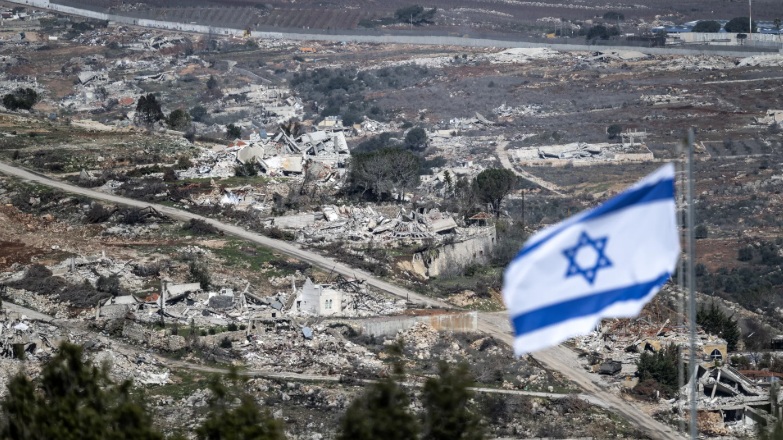
In his Epistle to the Romans, Paul made an astute observation when he declared that “they are not all Israel, which are of Israel” (Rom. 9:6).
In context, the apostle was making a dramatic distinction between a Racial Jews, a Religious Jews, and a Regenerate Jew.
A Racial Jew is one who is a descendent of Abraham whose heritage can be traced back through one of the twelve sons of Jacob then through him to Isaac, and, through Isaac to Abraham.
A Religious Jew is one who may be a descendent of Abraham and keeps the Law, or is a proselyte to Judaism. In the genealogy of Jesus, Rahab, a Gentile and former prostitute from Jericho, and Ruth, a Moabite widow, embraced the God of Abraham, Isaac, and Jacob. These women were Proselytes of Righteousness, meaning they were individuals who were fully committed to Jewish Law and Customs. Acts 2:10 mentions proselytes present at Pentecost. The reference may have been to Proselytes of the Gate, or Gentiles who honored some Jewish practices but were not fully converted to Judaism. Study Matthew 23:15.
A Regenerate Jew is one who has the faith of Abraham and believes in Jesus as the Messiah and Savior of the world.
After Jerusalem fell in AD 70, the Roman government dispersed the Jews to various parts of the empire.
The centuries passed and Jews intermarried with Gentiles to such a degree that tracing one’s lineage back to a Jewish patriarch is not without controversy.
However, many modern Jews sincerely believe they can trace their ancestry to biblical patriarchs.
This belief is held by specific groups within Judaism, such as the Cohanim (descendants of priests) and Leviim (Levites). Distinct genealogical lines are appealed to.
In addition, Genetic Studies suggest that modern Jews share a particular genetic ancestry with ancient populations including the Canaanites. A historical continuity is argued for.
The Cultural Identity of modern Jews with the patriarchs is less controversial. Wherever they have been compelled to settled, or forced to live through displacement, a Jewish culture has been maintained by design, which is why they have been hated throughout the centuries.
An ancient Egyptian Pharoah ordered the killing of Hebrew baby boys (Exodus 1:15-22). The Jews were shunned by Medieval Europe. One-third of all Jews living in the 1930’s was liquidated in the Holocaust.
Hundreds of thousands of Jews were killed by mass shootings. In the summer of 1941, following German’s attack on the Soviet Union (Operation Barbarossa), mass graves were filled by German SS (Einsatzgruppen) in small towns such as Ejszyszki (Eyshishok), small cities such as Kamenets-Podolsk (23, 600), and large cities such as Kiev.
German photos, films, and records confirmed the shootings as a matter of national honor, military obedience, and personal mementos. On September 29-30, 1941, SS and German police units took the Jewish population from Kiev to Babyn Yar, a ravine located just outside the city and proudly reported killing 33, 771 Jewish men, women, and children during this two-day period. Between 1941 and 1943, 100,000 people would be slaughtered and buried at Babyn Yar.
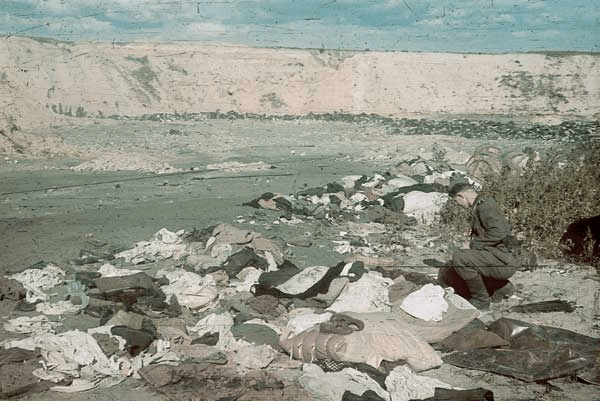
A Nazi’s Photographs of the Massacre at Babyn-Yar
Multitudes of Jews were driven around in gas vans designed to kill Jews through asphyxiation. This method was employed in part to save bullets and reduce the personal trauma of blowing heads apart.
Jews were forced into ghettos, concentration camps, and killing centers where they were systematically and deliberately starved, worked to death, and allowed to perish through various diseases which went untreated by medicine.
After World War II ended, Soviet and American armed forces found the concentration camps and filmed the horror of hundreds of thousands of corpses yet to be buried by the living skeletons of survivors. It was determined by Allied Forces that six main camps were responsible for no less than three million people, mainly Jews to die: Auschwitz-Birkenau, Chełmno, Majdanek, Bełżec, Sobibór, and Treblinka. These camps were just a small part of the 44,000 sites in the Nazi System to implement “The Final Solution.”
How many Jews perished in the Holocaust is open to speculation. The figure of six million was first mentioned in a statement by Eliezer Ungar in 1944, with the war still raging.
The true number of Holocaust (Gk. “burnt offering”) varies with the researcher, some of whom are more honest than others. Keep this in mind. There is no exact figure for the number of people killed in WWII. We do not even have an exact number for the death toll of the 1900 Galveston, Texas hurricane – estimates range from 6,000 to 12,000, with 8,000 being the most widely-used figure. So, it is not at all surprising or unusual that the estimates of Holocaust victims range from 4.2 to 7 million. This fact is recognized by the Jewish Virtual Library on line.
What is certain is that since World War II, a Jewish community has continued to survive, though not without controversy and hatred.
The Jewish identity is maintained by an Ashkenazi heritage (93 % of American Jews), Sephardic, Mizrahi, and other Jewish communities.
Ashkenazi Jews (lit. “fire like sprinkles”) represent a distinct ethnic group within the Jewish diaspora. They emerged around the 10th century in Central and Eastern Europe in the Rhineland (western Germany) and Northern France. They later migrated eastward to Poland and Lithuania, especially after the Crusades.
Sephardic Jews (Heb. “Iberia”) form another distinct Jewish group from Spain, Portugal, North Africa, and the Middle East.
What unites all the Jews is a common cultural identity, not a genetic code. No single genetic code unites all Jews.
And yet, they are hated. Why?
Sometimes Jews are hated out of envy because so many have excelled in finances, art, movies, music, literature, and intellectual pursuits.
Sometimes Jews are hated because of institutionalized stereotyping. Documents like “The Protocols of the Elders of Zion” perpetuate these harmful stereotypes.
Sometimes Jews are hated for theological reasons. Initially Martin Luther was sympathetic towards Jews. In his 1523 essay, “That Jesus Christ Was Born a Jew,” he condemned the inhumane treatment of Jews. However, by 1543, Luther’s patience with the Jews changed reflected in his work, “On the Jews and Their Lies.” Luther was disappointed the Jews did not convert to Christianity.
Sometimes Jews are hated for political reasons. Over the years popes, kings, emperors, presidents, and dictators, have said the Jews are responsible for the Crusades, World War I, the Stock Market Crash of 1929, the Great Depression, Communism, World War II, the Arab-Israeli Wars, the war with Iran, etc.
Various podcasters, politicians, authors, social scientists, and theologians have offered these reasons for antisemitism, though they fail to fully explain how Israel, a relatively small group of people, is hated so deeply by so many.
Why are 17, 161,000 Jews singled out for collective animosity or hated out of a worldwide population of 8.3 billion people?
The mystery remains.
What can be said is that antisemitism is a uniquely evil phenomenon because it persists. Other ethnic groups have warred with one another and found reconciliation. Antisemitism remains disturbingly distinct.
What is unique is the love of God is placed in the hearts of His people for others, be they Jew or Gentile, male or female, rich or poor.
“A new command I give you:
Love one another. As I have loved you,
so, you must love one another.
By this everyone will know that you are my disciples
if you love one another.”~John 13:34-35

