
Throughout history, the power of words to persuade people has been recognized, and therefore incorporated in a classical education. In Athens, rhetoric was taught by Sophists who focused on argumentation and public speaking so that individuals could take an integral part in civic life. A wise or ambitious student would dedicate years to mastering rhetorical techniques, which included understanding audience, structure, and style.
The study of Rhetoric typically included three main genres: deliberative (political), forensic (legal), and epideictic (formal, or ceremonial) rhetoric. Individuals like Aristotle contributed significantly to rhetorical theory, outlining principles that are still relevant today.
When used properly the principles of Rhetoric are worthy of emulation. However, there are some tactics gifted speakers use that are counterproductive, and harmful, because they stir up dark emotions and lead individuals to embrace harmful prejudices. When acted upon, some ideas produce death.
During World War I, Vladimir Lenin was brought to Moscow to influence the Russian Revolution. As a public speaker, he was mesmerizing. On March 12, 1918, Linin moved the capital of the Russian Socialist Federative Soviet Republic from Petrograd to Moscow. The relocation strengthened Bolshevik (lit. “majority”) control and allowed the ideas of Communism to spread.
Only too late did the Russians discover Communist ideas enslave rather than liberate people.
Wherever Communist ideas prevail, freedoms are lost, property is confiscated, the ability to resist a tyrannical government is suppressed, and the will of the few determines the fate of the many. There is a cruel inverted irony in the term, Bolshevik.
In the twentieth century, over a hundred million people have been killed by the ideas of Communism. North Korea, China, Russia, and New York City are abiding testimonies to the power of an idea that promises much and gives so little in return.
From historical and podcast achieves; the following harmful tactics are illustrated.
Pre-suasion. This is the tactics of telling someone what something means before they see it. Pre-suasion is always intentional. It has a specific goal in mind. Bible teachers who embrace the Rapture Theory are notorious for defining what the Rapture is, and then inviting people to turn to 1 Thessalonians 4:16 to “see” for themselves the doctrine is true. This is a form of isogesis or reading into a text something that is not there. However, since the trusted speaker is so explicit about it being done, the tactic is acceptable without protest.
The speaker knows there is a good chance those to whom he is speaking will not evaluate the message. They will accept what is being said because of the reputation of the teacher, or because there is a natural inclination to accept what is being taught. This is why social manipulators engage in monologues and not interviews. The stage is being set for eyes to see and ears to hear without any evidence being presented first. Pre-suasion is a powerful technique.
Imagery. A picture being worth a thousand words is a well-known expression. Therefore, those who would influence and persuade others paint verbal images, or use selective photos, or edited printed comments to make their point. If the images are accurate, if the photos are authentic, and if printed comments are not taken out of context, that is good. However, when these items are manipulated, there is danger.
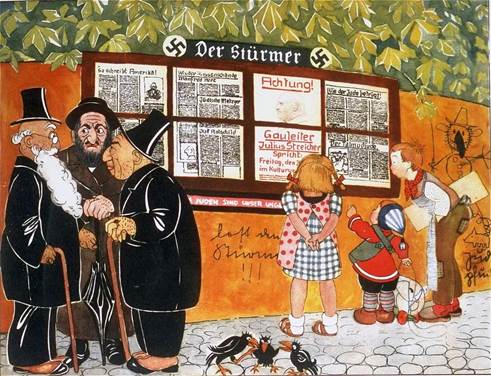
Three children reading the official Nazi newspaper “Der Sturemer”
During the reign of the Nazis in Germany, Jewish caricatures were featured in children’s books.
This illustration was found in the anti-Semetic children’s book, “Trust No Fox on His Green Heath and No Jew on His Oath.”
Jews were often compared to pests, such as rats, to portray them as a threat to society. Illustrations showed Jews as vermin, reinforcing the idea that they were harmful and needed to be exterminated.
Ideas are contagious, especially those that promote distrust, intrigue, conspiracy, and suspicion.
Between 2005 and 2017 a series of films were released called, Loose Change. Dylan Avery, Korey Rowe, and Jason Bermas united with others to argue the government was involved in the attacks that took place on September 11, 2001. The impact on public discourse has been profound.
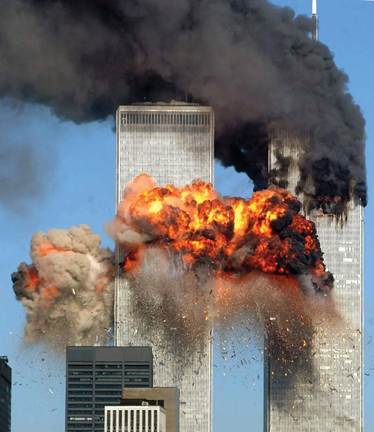
In Loose Change a variety of tactics were used to convince people that what they witnessed was not real. A controlled demolition could explain the collapse of the Twin Towers. A false flag was waved to divert attention from domestic issues. The attack was not carried out by nineteen terrorists, but by the United States Government. Certainly, the CIA has a checkered past when it comes to covert operations. Perhaps they were involved.
More than a few became convinced the events of 9/11 were not as reported. The Tunnel to Towers organization got it all wrong. The planes hitting the towers, people jumping to their deaths, the infernal caused by jet fuel engulfing the building were not the real story The real story was found by asking, “What was the United States Government up to?”
The ability to reframe a “truth” for another “truth” is not by accident. There are people who know exactly what they are doing, and how to go about redirecting people’s attention, sometimes for fun, more often for money, power, and a following. All that is needed is to use the “tricks of the trade.”
The Illusion of Insight. When a major idea is embraced, there is often a feeling of euphoria. There is an eureka moment, a moment of discovery whereby one truth is substituted for another. A person feels they have “see the light.”
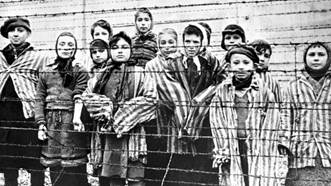
Following World War II, an industry arose dedicated to denying the Holocaust took place. Life for the Jews under the Nazis was not as bad as Zionist “propaganda” made it to be. Of course, the Holocaust deniers have their own agenda, even those who were caught up in the madness.

Died, Age 15
Cognitive dissonance plays a role; accepting the Holocaust contradicts core beliefs about the innate goodness of man.
A closing entry in the Diary of Anne Frank has this statement.
“I keep my ideals, because in spite of everything I still believe that people are really good at heart.”
Soon thereafter, on August 4, 1944, Anne Frank, with her family, was taken into custody.
Once inside the concentration camps, Auschwitz and then Bergen-Belsen, charming, young, idealistic Anne Frank died in March 1945. One wonders if Anne stood by her idealist statement written while hiding in an attic in Amsterdam.
Denial can serve as a coping mechanism for individuals struggling with guilt or shame they survived the Holocaust when so many others did not, including friends and loved one. Imagine being a musician in a Nazis death camp and surviving because you played an instrument. You played music while watching so many enter naked into a bath house where they put to death by exposure to Zyklon B, a cyanide-based pesticide. Who would not want to say that things were not as bad as reported?
There should be concern when people far removed from the events of the Holocaust and were not part of that history sit in judgment on the historical record which is documented by eye witness accounts, official death camp records confiscated, Nazis films, dairies, and photographs.
No other mass murders have been disputed like the Holocaust.
China’s Mao Zedong is said to have killed 45 million people between 1958 and 1962. No one has protested that number.
The Mongol Emperor Genghis Khan slaughtered 40 million people during his rule from 1206 and 1227. No one has disputed this number.
Joseph Stalin died in 1953, but not before causing the death of between six and twenty million people. No one denies the general numbers.
The larger point is that care must be taken when a feeling is experienced concerning an alleged discovery of “the truth.” Feelings can be manufactured and manipulated. Therefore, let no one deceive you into believing something that is contrary to objective reality. You are not immune to this, and neither am I. Christian, beware.

