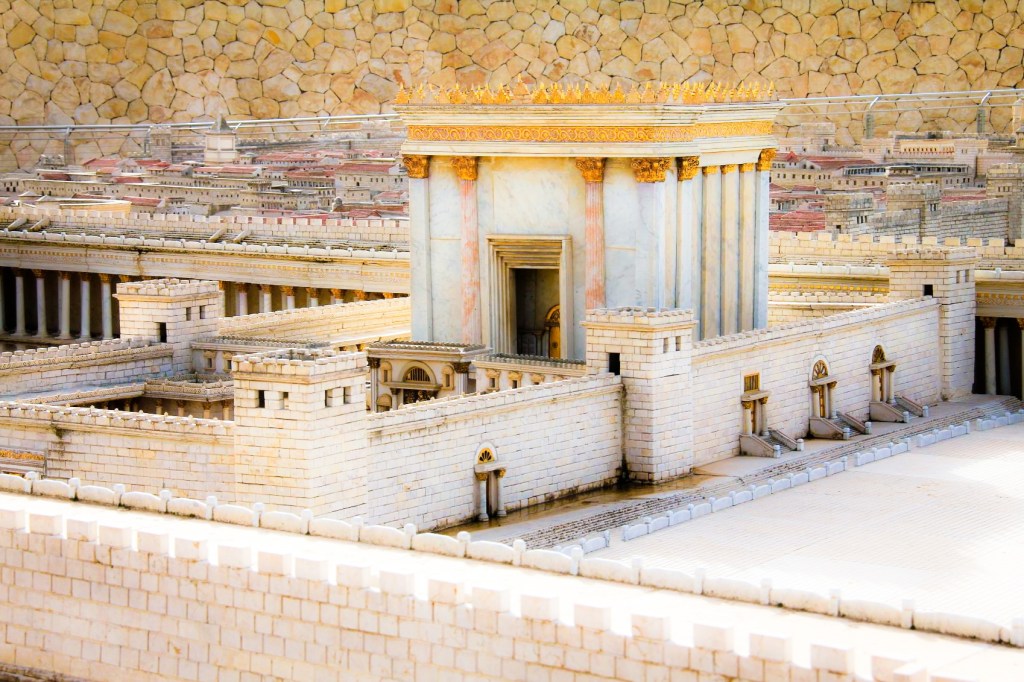
According to Jewish teaching, the Second Temple lacked five things present in Solomon’s Temple.
- Ark of covenant
- Sacred fire falling from heaven on the sacrifices
- The Shekinah, the glory cloud
- The Urim and Thummim (on High Priest’s garments, by which the will of God was discerned)
- The spirit of prophecy
The Holy of Holies in the Second Temple period lacked the elements present in the First Temple. The most important items missing were the Ark of the Covenant and the Shekinah (the glory cloud that represented the presence of the Lord). The whereabouts of the Ark of the Covenant is unknown, with various claims which cannot be substantiated. One is that it was hidden by Jeremiah under the Temple where it will one day be found. Another, that it is located in the Ethiopian Orthodox Church in Axum.
A Greater Glory than the Shekinah (Heb. verb, shachen, to dwell)
With that being noted, attention is given to Haggai who prophesied (520 BC) concerning the rebuilding of the Temple after the Jews’ return from Babylon.
He wrote:
“‘The glory of this Latter Temple shall be greater than the former,’ says the Lord of hosts. ‘And in this place, I will give peace,’ says the Lord of hosts” (Haggai 2:9).
The use of the word glory here does not necessarily mean it would be a more beautiful building than Solomon’s Temple, though with the reconstruction provided by King Herod, it was; rather, the idea is that the glory of God would come into the Second Temple in a greater way than the glory that came into the First Temple.
Did Prophesy Fail?
So, is this a failed prophecy?
Was Haggai a false prophet?
Or was this prophecy fulfilled in a completely different way when Jesus / Yeshua the Messiah came into the Temple?
Consider . . . The apostle Paul wrote of Jesus the Messiah as One who being the brightness of His glory and the express image of His person, and upholding all things by the word of His power, when He had by Himself purged our sins, sat down at the right hand of the Majesty on high (Hebrews 1:3, NKJV).
“For in Him dwells all the fullness of the Godhead bodily; 10 and you are complete in Him, who is the head of all principality and power” (Colossians 2:9, NKJV).
Someone Greater than the Temple
When Joseph and Mary brought the baby Jesus into the temple for the ceremony of pidyon ha ben (the redemption of the first born) in Luke 2.22-24, the elderly priest Simeon, who had been told by the Lord that he would not die before he had seen the Messiah, greeted them with these words:
Now, Adonai, according to your word,
your servant is at peace as you let him go;
for I have seen with my own eyes your yeshu‘ah,
which you prepared in the presence of all peoples —
a light that will bring revelation to the Goyim
and glory to your people Isra’el.”~Luke 2:29-32
Now, Adonai, according to your word,
your servant is at peace as you let him go;
for I have seen with my own eyes your yeshu‘ah,
which you prepared in the presence of all peoples —
a light that will bring revelation to the Goyim
and glory to your people Isra’el.~Luke 2:29-32, Complete Jewish Bible
He saw the glory of God coming into the Temple in this tiny baby, whom he correctly recognized to be the Messiah of Israel, as the Holy Spirit revealed this to him. So the greater glory came into the Temple in the person of the Messiah.
Concerning Yeshua, John wrote:
And the Word became flesh and dwelt among us, and we beheld His glory, the glory as of the only begotten of the Father, full of grace and truth … And of His fullness we have all received, and grace for grace. For the law was given through Moses, but grace and truth came through Jesus Christ. No one has seen God at any time. The only begotten Son, who is in the bosom of the Father, He has declared Him (John 1:14-16).
When John speaks of “the Word,” he means God:
“In the beginning was the Word, and the Word was with God, and the Word was God. He was in the beginning with God. All things were made through Him, and without Him nothing was made that was made. In Him was life, and the life was the light of men. And the light shines in the darkness, and the darkness did not comprehend it” (John 1:1-3).
The New Testament records many times when Jesus went into the Temple.
Study Matthew 21.12-15, Luke 2.41-50, Luke 20, John 5, John 7-10.
And there He manifested the glory of God.
He also said that, “Yet I say to you that in this place there is One greater than the temple” (Matthew 12:6).
Jesus was referring to Himself.
He also prophesied the coming destruction of the Temple under the Romans
Now as He drew near, He saw the city and wept over it, saying, If you had known, even you, especially in this your day, the things that make for your peace! But now they are hidden from your eyes. For days will come upon you when your enemies will build an embankment around you, surround you and close you in on every side, and level you, and your children within you, to the ground; and they will not leave in you one stone upon another, because you did not know the time of your visitation. (Luke 19:41-44)
The time of your visitation which ‘you did not know’ refers to the Messiah coming into Jerusalem and the Temple.
Jesus was rejected by the religious leaders (although He was accepted by many of the common people). This rejection led to His arrest, trial, and crucifixion, in fulfilment of the prophecy of Isaiah 53:
He is despised and rejected by men, a Man of sorrows and acquainted with grief. And we hid, as it were, our faces from Him; He was despised, and we did not esteem Him. Surely, He has borne our griefs and carried our sorrows; Yet we esteemed Him stricken, smitten by God, and afflicted.
But He was wounded for our transgressions, He was bruised for our iniquities; the chastisement for our peace was upon Him, And by His stripes we are healed. All we like sheep have gone astray; We have turned, every one, to his own way; and the Lord has laid on Him the iniquity of us all (Isaiah 53:3-6).
This was in the will of God so that the Lord Jesus would fulfil the prophecy of the Suffering Servant Messiah, and bear the sins of the world so that, those who repent of sin and believe the Gospel, could be born again of the Holy Spirit and have God dwelling in them by the Spirit. As a result, the believer now becomes the ‘Temple of God’ as Paul wrote to the Corinthians:
Do you not know that you are the temple of God and that the Spirit of God dwells in you? (1 Corinthians 3:16; see also 6:19-20).
Coming back to the physical Temple in Jerusalem, something very significant happened there at the time of the crucifixion.
When Jesus died on the cross the veil in the Temple was torn from top to bottom
Then, behold, the veil of the temple was torn in two from top to bottom; and the earth quaked, and the rocks were split” (Matthew 27:51).
This was a very heavy curtain which sealed off the Holy of Holies from the holy place and the other parts of the Temple where the people could go.
The only time when anyone could go past this veil was when the High Priest went in once a year to offer the Yom Kippur / Day of Atonement sacrifice.
Anyone who went in without offering the appropriate sacrifice or anyone other than the High Priest would die, because the presence of the Lord dwelt in the Holy of Holies (although the visible cloud was absent from the Second Temple).
This event symbolized the fact that now that the Messiah had paid the price for the sins of the world, the way was now open for anyone, Jew or Gentile, male or female, to come into the presence of the Lord through the sacrifice of the Messiah who shed His blood when He died for our sins and rose from the dead.
After this, the Temple became desolate as Jesus said
“See! Your house is left to you desolate; for I say to you, you shall see Me no more till you say, ‘Blessed is He who comes in the name of the Lord!’” (Matthew 23:39).
It no longer had any purpose for the offering of sacrifices acceptable to the Lord. The sacrifices given in Leviticus 16-17 for the day of atonement were no longer needed to atone for our sins and had now been replaced by the better sacrifice of Jesus the Messiah (see Hebrews 8-9).
And according to the law almost all things are purified with blood, and without shedding of blood there is no remission. Therefore, it was necessary that the copies of the things in the heavens should be purified with these, but the heavenly things themselves with better sacrifices than these. For Christ has not entered the holy places made with hands, which are copies of the true, but into heaven itself, now to appear in the presence of God for us (Hebrews 9:22-24).
Remarkably, this is shown in a passage in the Talmud, which records that for forty years before its destruction there were visible signs that God no longer accepted the Yom Kippur sacrifice.
At the time of the Second Temple, the practice on Yom Kippur, the Day of Atonement, was to take two goats and sacrifice them to the Lord according to Leviticus 16.
The first goat was “for the Lord” and the second goat was “l azazel” for the scapegoat.
The first goat was sacrificed in the Holy of Holies, and the second goat was sent out into the wilderness, after having the sins of the people placed upon it in accordance with Leviticus 16.21.
A scarlet sash was tied around the neck of the scapegoat and it was then taken to a precipice in the wilderness about 12 miles from Jerusalem.
When the goat finally arrived at the precipice, the attending priest removed the red sash from its head and divided it, returning half to the animal’s horns and tying the other half to a protrusion on the cliff. He then pushed the animal backwards over the cliff to its death.
In connection with this ceremony an interesting tradition arose, which is mentioned in the Mishna.
A portion of the crimson sash was attached to the door of the Temple before the goat was sent into the wilderness. The sash would turn from red to white as the goat met its end signaling to the people that God had accepted their sacrifice and their sins were forgiven.
This was based on the verse in Isaiah where the prophet declared:
“Come now, and let us reason together says the Lord, though your sins are as scarlet, they shall be as white as snow; though they are red like crimson, they will be like wool” (Isaiah 1:18).
The Mishna tells us that forty years before the destruction of the Temple, the sash stopped turning white. That of course was approximately the year that Christ died.
According to tradition, according to history, and according to prophesy, “The glory of this latter house [the Second Temple] shall be greater than of the former, saith the Lord of hosts: and in this place will I give peace, saith the Lord of hosts” (Haggai 2:9).

