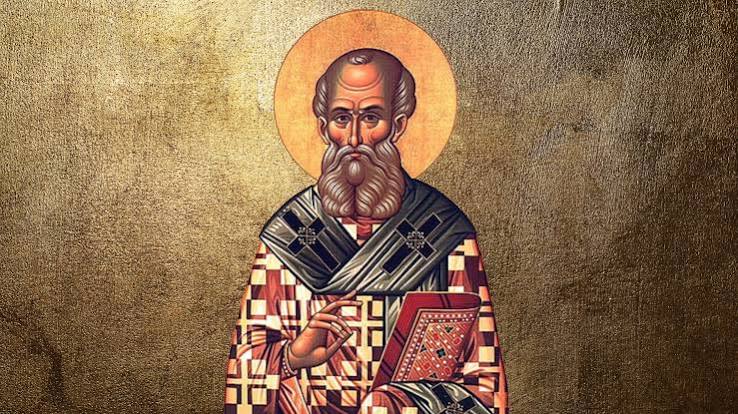
A Remarkable Rise to Church Prominence
Born into a wealthy family c. 296 in Alexandria, Egypt, Athanasius (lit. “immortal”) would become the Bishop of Alexandria in 328 AD when he was 32 years old. Though raised in paganism, with a secular classical education (Grammar, Logic, Rhetoric), Athanasius became a trophy of God’s redeeming grace. His remarkable rise in the Church can be attributed to the following.
First, Athanasius defended the Trinity against Arianism. Though sent into exile five times for political reasons, including a defense of the divinity of Christ and His eternality, Athanasius, returned time and again to guide the Church. During one of his exiles a fellow bishop urged him to compromise, asking Athanasius if he knew that the entire world was against him. Athanasius replied by saying,
“Is the world against Athanasius?
Then Athanasius is against the world.”
Second, the theological writings of Athanasius were impressive. In his work, “On the Incarnation,” he expresses the nature of Christ and the importance of the Incarnation. Because of his intellectual brilliance, and orthodox theology, Athanasius is recognized as a Doctor of the Church.
Third, Athanasius had a central role in the formation of the Nicene Creed when the First Council met in 325 AD.
The Main Theological Arguments
Christ’s Divinity. Christians do not worship three gods. Christians worship one God in three persons: Father, Son, Spirit.
Those who argued against Arianism became very emotional, much like Paul became when, rebuking the Galatians, and expressed his wish they emasculate themselves if they were determined to place the Law of Circumcision of the Flesh above the grace of the gospel. “I wish those agitators would go so far as to castrate themselves!” (Gal. 5:12, New English Translation). In a moment of holy anger St. Nick slapped an Arian. St. Nicholas was the Bishiop of Myra, Turkey. He died on December 6, 343 AD.
The Incarnation.
“He became what we are
That we might become what He is.”~Athanasius
In the fourth century AD, during the time of Constantine (AD 272–337), the emperor of Rome, from AD 306–337, the Church was embroiled in a controversy created by Arius (d. AD 336), a deacon in the Church in Alexandria, Egypt. The city was known to be an intellectual center for Christians, Jews, and pagans. While freedom of thought is proper and to be encouraged, there is truth and falsehood. When the truth of the gospel is denied, twisted, or misrepresented, faithful Christians must respond, as Paul rebuked Peter face to face because he stood condemned (Gal. 2:11). At the Council of Nicene, Athanasius withstood the error of Arianism.
In his zeal to protect the exclusive divinity of the Father, Arius declared that the Son is a creature. The Son is not like God. The Son is like all other men born of women. There was a time when He was not. By extension, the Holy Spirit was also not like God.
Because the Church worships Christ, glorifies Him, and believes Jesus to be equal to the Father, His divinity must be protected. Because the Church does not want to be accused of idolatry, Christian orthodoxy must be defended. At the Council of Nicea, the great controversy was debated. Athanasius argued the Son is equal to the Father. Though this truth remains a mystery, the Scriptures affirm this teaching and the Church receives it by faith with humility.
Authority of Scripture. Because of his faith that the Bible is the authoritative eternal Word of God, Athanasius emphasized the Scriptures in the Christian faith. In a famous letter to Marcellinus, Athanasius encouraged him to study the Psalms in depth, and then pray and sing the Psalms in reflective devotion. “The Letter of Marcellinus” includes a list of the canonical books of the Old and New Testaments.
The Importance of Athanasius
Though the divinity of Christ was officially established at Nicene in AD 325, the controversy continued, but so did the defense of the divinity of Christ by Athanasius. To the day of his death, Athanasius contended for the faith once delivered to the saints (Jude 3). His importance to the cause of Christ and advancing the Kingdom of Heaven is without measure.

