In addition to the study of Bible history I would exhort you to read the biographies of great men and women of faith. It has been pointed out by more than one author that there is no ending to the book of Acts. We are told in Acts 28 that Paul dwelt two whole years in his own hired house, and received all that came in unto him, preaching the kingdom of God, and teaching those things which concern the Lord Jesus Christ, with all confidence, no man forbidding him (Acts 28:30, 31). And there the story ends.
It seems rather strange that the narrative would end so suddenly until this thought arises: the story is not over! There are many more chapters to be recorded. There is so much more to tell. The Acts of the Apostles are really the Acts of the Holy Spirit and the Holy Spirit is vigorously working in individual lives. There are men and women destined to have a date with destiny. Many of them have lived already. Some are alive today. Others are yet to be born.
The Faith of Polycarp
With a view to the past I call your attention to Polycarp (c. 70-156 AD). Born of a Christian family, Polycarp was once a disciple of the Apostle John. As the bishop of Smyrna (a port on the west coast of Asia Minor) Polycarp was zealous to defend the doctrines of the faith against such heretics as Marcion, whom he characterized as the “firstborn of Satan.” That may sound harsh but sin needs to be silenced.
At the center of Marcion’s theology was a dualistic understanding of God. The God of the Old Testament and the God of the New Testament are not the same, said Marcion. The God of the Old Testament is the God who created the world and evil. He is strict, unloving, violent and vindictive. He makes laws and imposes harsh demands.
In contrast there is the God of the New Testament. The God of Jesus Christ is forgiving and loving. He can only be known by the person and work of Jesus. Jesus, said Marcion, came to over throw the God of the Old Testament.
It would have been better if this son of a wealthy ship owner had stayed away from Rome and the Christian community because he drew a large following and led many people astray. And yet good did come out of his apostasy. In reaction to Marcion the orthodox Christians compiled the true canon of Scripture. They also drew up the “rules of faith” which are brief summaries of the fundamentals of the faith. By the end of the second century Marcionism ceased to exist as a movement.
While Polycarp successfully resisted heresy within the Church, he was not strong enough to resist the political opposition that came to the church from the forces of Rome. When official persecution broke out in 156 AD Polycarp was among the spiritual leaders sought. Other Christians had been taken to the local arena; now a mob wanted Polycarp.
Initially, Polycarp did flee from those trying to capture him. He hid on a farm but then surrendered after learning that a slave boy had been tortured on his behalf. Polycarp would resist the authorities no more. If Rome wanted to kill him, then, he said, “God’s will be done.”
The day came when Polycarp entered an arena filled with angry citizens of Rome. They hurled insults at the older man.
“You are an atheist!” they cried.
“You are unpatriotic!” they screamed. Polycarp was silent. The crowd grew more violent. The accusing voice of the people of Smyrna could be heard saying,
“This is the teacher of Asia, the father of the Christians, the destroyer of our gods, who teaches many not to sacrifice or to worship!” Kill him! Kill him!
Even at this late moment, Polycarp could have saved his life by simply offering a sacrifice to the spirit (or genius) of the emperor (Caesar) recognizing his divinity.
“Polycarp,” said the proconsul, “Take the oath, and I shall release you. Curse Christ!”
The bishop stood firm and offered this reply: “Eighty-six years have I served him, and he never did me any wrong. How can I blaspheme my king who has saved me?”
Threatened with fire, Polycarp did not move.
“Your fire burns for an hour,” he said, “and goes out, but the fire of the coming judgment is eternal.”
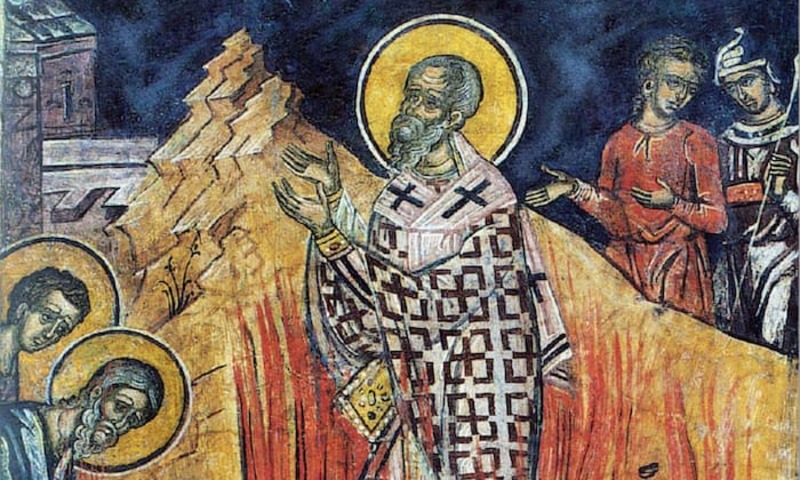
Enraged by this defiance, the proconsul ordered the bishop of Smyrna to be burned alive. Polycarp was tied to the stake and the fire was started. However, something unusual happened according to legend. It cannot be a true narrative of the final moments of this martyr that was circulated to congregations throughout the empire, but it is instructive.
It was said that the body of Polycarp was not immediately consumed.
“He was in the middle, not as burning flesh, but as bread baking or as gold and silver refined in a furnace. And we smelled such a sweet aroma as the breath of incense or some other precious spice.”
When an executioner stabbed Polycarp, the blood poured out and put out the fire. It is a wonderful story. What is certain is that the older gentleman died for Christ and the “blood of the martyrs is the seed of the Church.”
The Courage of John Bunyan
While many people laid down their lives for Christ, others did not die but they suffered for the Saviour and for the Church in order to establish a great Scriptural truth. One example of this may be found in the life of John Bunyan (1628-1688). Bunyan was born at Elstow, near Bedford, England, the eldest son of a tinker. Life was hard for the poor family.
“My father’s house,” acknowledged Bunyan, “being of that rank that is meanest and most despised of all the families in the land.”
When he was sixteen, Bunyan was drafted into the army. After three years, he was discharged and returned to Elstow where he found employment as a tinker.
Though his occupation kept him financially poor, Bunyan was a lover of music and an innovative craftsman. From scraps of iron he hammered out a violin and from one of the legs of a four-legged stool he carved a flute.
He was married twice. His first wife, her name unknown to history, came to the marriage with a simple dowry of two well-known Puritan works: The Plain Mans Pathway to Heaven by Arthur Dent and The Practice of Piety by Lewis Bayly. Four children were born to this marriage including a blind daughter Mary.
Bunyan’s second wife, Elizabeth, was a wonderful women filled with courage and faith. Bravely she stood in the face of political and religious opposition, especially when John was facing years in jail for preaching the gospel. Elizabeth and John Bunyan had two children.
Bunyan has recorded his spiritual journey from sin to the Saviour in a series of special works. His first understanding of what Church fellowship truly meant came by accident. He overhead “three or four poor women sitting in a door in the room, and talking about the things of God.”
Later he said, “I thought they spoke as if joy did make them speak; they spoke with such pleasantness of Scripture language and with such appearance of grace in all they said, that they were to me as if they had found a new world…”
Sometime prior to 1654, Bunyan met John Gifford who was the pastor of the open communion Baptist Church at Bedford where Bunyan had moved to from Elstow. Gifford became a spiritual father to Bunyan and encouraged him in time to preach the gospel. As he began to speak in villages near Bedford the Lord blessed and many people were eager to listen to the poor tinker who knew something about the treasures of heaven.
The ministry of John Bunyan came at a time of the Stuart Restoration of 1660 to the throne which meant that no one could preach unless they were authorized to do so by the State. Unauthorized preaching was a punishable offense.
John Bunyan did not believe that this was right. He believed that God called men to preach, not the state. If God called a man to proclaim the gospel then that person should not keep silent, no matter what.
And so it was, in November, 1660, John Bunyan was arrested for holding a conventicle (an illegal religious meeting). Bunyan was sentenced in January 1661. He was to serve three months imprisonment in Bedford jail.
The three months turned into twelve years because John Bunyan refused to assure the authorities that he would stop preaching if released. There was a great principle at stake, and John Bunyan was not about to compromise his convictions.
During his stay in prison Bunyan made shoe laces to support his family, preached to other prisoners, and wrote many of his great works. His first prison book was Profitable Mediations, followed by Christian Behavior, The Holy City, and Grace Abounding to the Chief of Sinners. From 1667 to 1672 he spent most of his time writing The Pilgrim’s Progress, which was finally published in 1678.
Through the power of the pen and printing press, the ministry of John Bunyan reached an ever widening audience as people became familiar with his plight. On January 21, 1672, the Bedford congregation called John to be the pastor, even though he was still in prison.
Finally, in March of 1672 Bunyan was released and on May 9, he was licensed to preach under Charles’ II Declaration of Indulgence. In addition, he became licensed as a Congregational meeting place. The things he had fought so long for and suffered, for were his: more of a separation between Church, and State, and the freedom of religion.
In the years to come, Bunyan would write many more classic works including The Life and Death of Mr. Badman, and The Holy War.
The end of his earthly pilgrimage came on August 31, 1688. While riding on horseback from Reading to London, Bunyan had been caught in a heavy rain. Contracting a fever, he went to be with the Lord he loved so much, and to the heaven he knew so well. He is buried in Bunhill Fields, London.
Two days before his fatal illness and twelve days before his death, John Bunyan preached for the last time at Mr. Gamman’s meeting house near Whitechapel (Aug. 19th, 1688). His text was John 1:13 which speaks of those who are born “not of blood, nor of the will of the flesh, nor of the will of man, but of God.” The sermon was concluded with these words:
“If you are the children of God, live together lovingly; if the world quarrel with you, it is no matter; but it is sad if you quarrel together; if this be amongst you, it is a sign of ill-breeding; it is not according to the rules you have in the Word of God. Doest thou see a soul that has the image of God in him? Love him, love him; say, This man and I must go to heaven one day; serve one another, do good for one another; and if any wrong you, pray to God to right you, and love the brotherhood.
Lastly, If you be the children of God, learn that lesson—Gird up the loins of your mind, as obedient children, not fashioning yourselves according to your former conversation; but be ye holy in all manner of conversation. Consider that the holy God is your Father, and let this oblige you to live like the children of God, that you may look your Father in the face, with comfort, another day.”
The courage of Esther, the conquests of Alexander, the martyrdom of Polycarp and the sufferings of John and Elizabeth Bunyan are just some of the narratives waiting to be discovered in the story of the glorious institution, the Church in history.
The Glorious Days of the Reformation
As you study Bible history and the biographies of the saints, let me encourage you to pay special attention to the time period in the story of the Church known as the Reformation. There were several great “rallying cries” of the Reformation.
The first rally cry was Sola Scriptura (Scripture alone). The Baptist Confession of Faith of 1689 declares that the Scriptures, “are the Divine and final authority for all Christian faith and life.” The Bible says that ” All scripture is given by inspiration of God, and is profitable for doctrine, for reproof, for correction, for instruction in righteousness: That the man of God may be perfect, thoroughly furnished unto all good works” (2 Timothy 3:14-17).
The second rallying cry of the Reformers was Sola Gratia (grace alone). Luther, like millions of others, had been taught to believe that salvation was not personal but corporate. Salvation came to the individual through the Church structure and sacraments. A person was saved by faith in Christ and good works, with the emphasis being on good works. As we shall see, Luther tried to do good works. But no matter how hard he tried he simply could not be perfectly sinless and holy. This alarmed him for he read that without holiness no man shall see the Lord (Deut. 27:26; Gal. 3:10; 1 John 1:8). Luther wanted to see the Lord. But how?
Eventually, Luther came to understand the grace of God by studying the book of Romans. It was only then that his troubled heart found peace with God and the peace of God (Rom. 4:4-8; 5:1, 2).We want you to have peace with God and others as well. If you know someone who needs salvation, invite them to come tomorrow.
A third rallying cry of the Reformation was Sola Fide (faith alone). This term refers to the doctrine that salvation is by faith alone, apart from any human merit or works (Rom. 3:20-22; Gal. 2:16). We shall discover that God is never impressed with what man can do; but He honors and respects what His Son has done at a place called Calvary.
We Must Come to Calvary!
At Calvary we see united in One both the Judge and the Father, both holiness and utter love, both justice and mercy, both pardon and penalty, both the vindicated Law and the Flood-point of compassion. The Cross honors the Divine Law equally, as it releases the Divine grace. “Believe on the Lord Jesus Christ and thou shalt be saved” (Acts 16:31).
To Sola scriptura (by Scripture alone), Sola gratia (by grace alone), and Sola fide (by faith alone), was Solo Christo (by Christ alone), and Soli Deo Gloria (glory to God alone).

